


Use an abundance journal to record what supports you, identify what you need, and turn a broad wish into a small action you control. Start with an honest observation, choose a priority, and finish with a next step rather than a prediction. Your journal can hold hopes for money, time, connection or opportunity, but writing them down does not guarantee wealth or change your luck.
- An abundance journal connects gratitude, personal priorities and small actions; it does not guarantee financial results.
- Use money mindset prompts to name resources, acknowledge constraints and choose a practical next step.
- EclipticJew crystal jewelry is optional personal symbolism, not a requirement for journaling or a source of wealth.
Why this matters
An unexpected bill arrives while you are trying to feel hopeful about the future. An abundance journal should make room for both realities: what is difficult and what remains available to you. You do not need to call a problem a blessing before you can respond to it.
If money is your main concern, pair these prompts with a money mindset journaling weekly check-in. Keep reflection separate from your financial records; a journal captures your thinking, while statements and bills show the actual transactions.
For your 2026 journal, define abundance in ordinary language before adding affirmations or symbolism. It might mean enough room in your schedule to cook, support during a difficult week, or clearer decisions about spending. Choose the meaning that fits your life, not the one that sounds most impressive.
How do you use an abundance journal?
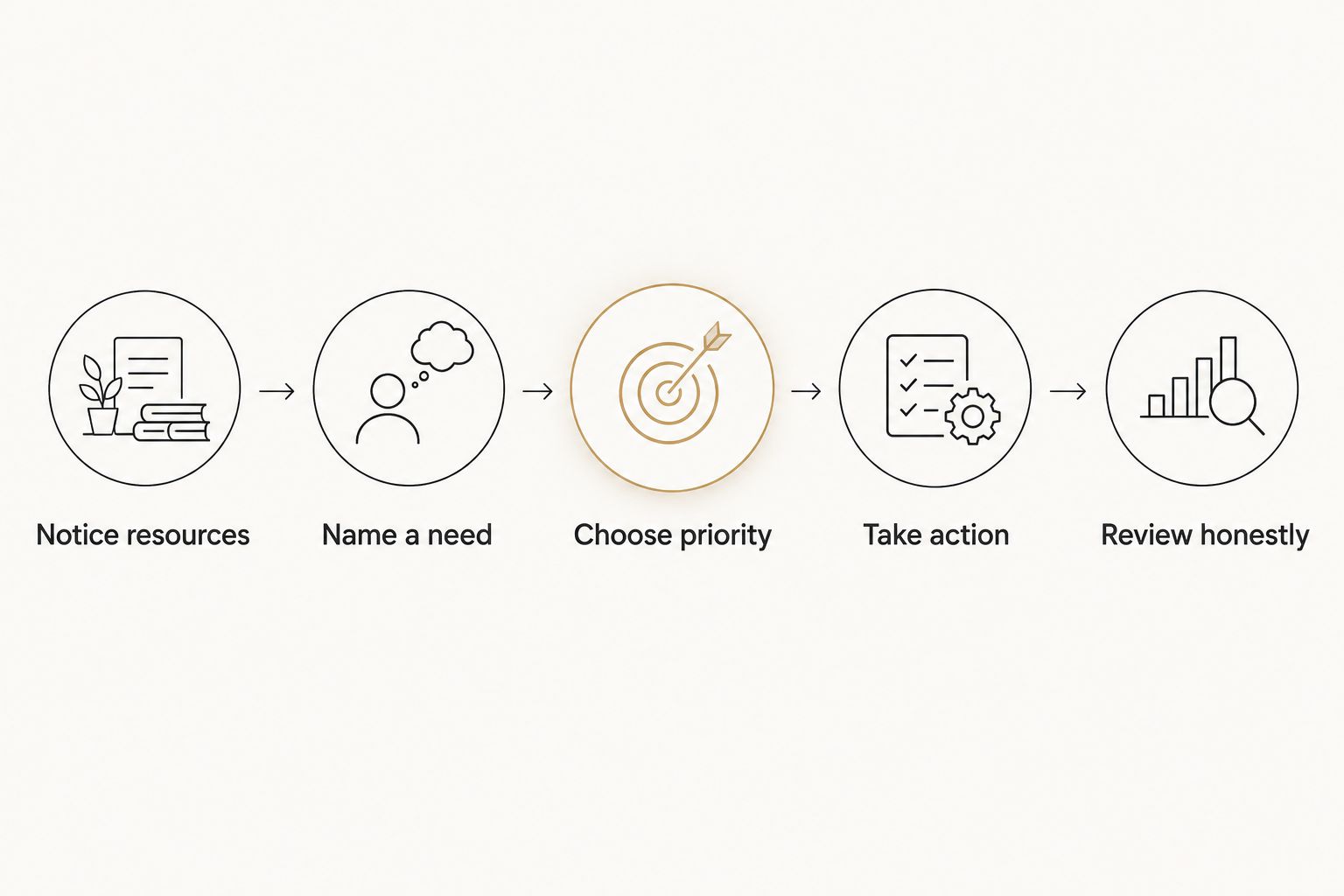
Build each entry around a simple sequence: notice, name, choose, act and review. You can use a notebook you already own or a plain document; neither needs a special design. The useful part is the connection between your observation and your next decision.
- Notice resources. Record something available to you now: a useful skill, an unfinished opportunity, a supportive person or a necessary task already completed. Be specific enough that you can explain why it matters. You are taking inventory, not pretending every part of life is going well.
- Name a need. Write what feels limited or uncertain without correcting yourself into cheerful language. Perhaps you need information, a boundary, practical help or time to decide. A need is not a failure of gratitude.
- Choose priority. Select the concern you want this entry to address. If several concerns compete, choose the one with a next step you can identify. Leave the others visible rather than promising to solve everything at once.
- Take action. Finish with a verb: ask, check, compare, schedule, decline or prepare. Make the action small enough to begin without waiting for a different mood. For example, checking a bill is clearer than becoming financially confident.
- Review honestly. When you return, record what you did and what remains unresolved. Keep the result separate from your worth. An unanswered message is an unanswered message, not proof that you attracted the wrong outcome.
This sequence keeps a hopeful practice tied to reality. An entry is complete when it gives you a clearer next move, even if your feelings have not changed.
A grounded abundance journal template
Use this template for your next 2026 entry. Keep the answers brief if a long page would become another task to avoid.
- What is available: Name a resource you can use, not just something you feel you should appreciate.
- What is difficult: Describe the actual constraint without turning it into a statement about your character.
- What enough means: Finish the sentence: Enough, in this situation, would look like…
- What matters now: Choose the priority you want to protect.
- What I will do: Write a visible action and the situation in which you will take it.
- What I will revisit: Leave a question for your next entry.
A practice entry might connect an approaching deadline with a need for clearer instructions. Your resource is the information you already have; your next action is asking the relevant person about the unresolved part. That is a useful abundance entry without a positive affirmation or a purchase.
Do not polish the page into something you would post publicly. Leave room for uncertainty, crossed-out assumptions and answers that change.
Which abundance journal format fits your day?
Choose a format based on the decision you need to make, not on how ambitious the layout looks. Each option below has a useful purpose and a limit.
| Format | Best for | What to write | Strength | Limitation |
|---|---|---|---|---|
| Resource entry | Noticing support you overlook | What is available and how you can use it | Keeps gratitude specific | Does not address a practical problem unless you add an action |
| Priority entry | Competing demands | What matters, what can wait and what comes next | Connects reflection to a decision | Requires an honest trade-off |
| Money entry | Preparing a spending decision | The choice, the information needed and the next check | Keeps money questions concrete | Does not replace financial records or qualified advice |
| Opportunity entry | Considering a new direction | What interests you, what is unknown and what to investigate | Gives curiosity a next step | Cannot predict whether an opportunity will succeed |
Choose the simplest format that addresses today's question. You can change formats between entries; consistency does not require repeating a page that no longer helps you.
Prompts for money without promises of wealth
Money prompts work best when they distinguish a wish from a decision. Wanting more security is understandable, but the journal should identify what you can examine or do rather than promise that optimism will increase your income.
- What money question am I avoiding because I do not yet know the answer?
- Which purchase am I considering, and what need am I asking it to meet?
- What information would make my next financial decision clearer?
- What commitment needs my attention before I make another one?
- What would enough look like for this specific decision?
For a 2026 money entry, record the relevant date beside any information you check. A plan based on an old balance or forgotten commitment is not the same as a decision based on current records. Keep sensitive account details out of a journal that other people can access.
End with an action such as reviewing a statement, finding a document or asking a qualified adviser a specific question. Leave predictions about future earnings off the page.
Prompts for time, support and opportunity
Abundance does not have to mean accumulating more things. You can use the same journal to examine what gives your day room, where help is available and which opportunities deserve attention.
When your schedule feels crowded
- Which obligation belongs to me, and which one did I accept automatically?
- What can I postpone without creating a larger problem?
- What boundary would protect something I genuinely value?
Choose a response you can communicate, not just a feeling you hope to have. An action might be asking for a clearer deadline or declining an additional commitment.
When you need connection
- Who would I like to hear from, and what can I say honestly?
- What kind of help would be useful rather than merely reassuring?
- Where am I expecting someone to know a need I have not expressed?
Write the request before deciding whether to send it. Other people retain the right to respond, decline or need time; their response is not a verdict on your abundance practice.
When an opportunity feels uncertain
- What interests me about this possibility beyond its appearance?
- What information is missing?
- What can I investigate before making a commitment?
Keep curiosity separate from certainty. Preparing a question, checking a requirement or making a draft lets you explore without declaring that the opportunity is destined for you.
Why your abundance journal routine varies
Your routine should reflect what the page needs to do. Avoid treating a particular schedule, mood or layout as a condition for receiving good things.
- The decision: A spending question needs different information from a relationship question. Match the prompts to the issue.
- Your privacy: A shared home or workplace can affect where you keep personal entries. Choose storage that suits the sensitivity of what you write.
- Your available attention: A brief entry can end with a useful action. Stop before writing becomes another obligation.
- Your emotional state: If gratitude language feels forced, start with a neutral fact. You do not need to argue yourself out of disappointment.
- The unresolved task: Sometimes the next step belongs outside the notebook. Make the call, check the document or ask the question before adding more reflection.
For a 2026 review, assess whether the journal still helps you make decisions. Change the prompts if you repeatedly describe the same concern without identifying an action or a need for support.
Is an abundance journal the same as manifestation?
An abundance journal can include manifestation language, but it does not need claims that thoughts determine external events. You can write about a desired future while treating it as an intention rather than a forecast.
Keep the distinction visible: what you want, what you control and what remains uncertain. If a spiritual framing matters to you, let it support reflection without making you responsible for every setback. Illness, rejection and financial difficulty are not evidence that you failed to think positively.
What should you write when gratitude feels forced?
Write a neutral observation before asking yourself to feel grateful. You might acknowledge that you found the document you needed, received a clear answer or completed an uncomfortable task.
Then name what is still hard. Appreciation and disappointment can occupy the same entry; you do not need to erase either. Honesty is a better starting point than a sentence you do not believe.
How do you know whether the journal is useful?
Review whether your entries identify priorities, questions and actions you can recognize outside the notebook. Look for a clearer request, a checked assumption or a decision made with relevant information.
Do not judge the practice by whether unexpected money or favorable events appeared. A journal cannot establish that your writing caused an external outcome. If the page repeatedly becomes self-criticism, simplify it or stop using that format.
An optional stone as a personal reminder
If you already enjoy natural-stone jewelry, you can connect a bracelet with a sentence from your journal: check before committing, ask clearly, or leave room for what matters. The meaning comes from the intention you choose. Buying a piece is not necessary.
EclipticJew crystal jewelry is best for shoppers who want a wearable symbol, not a promise of wealth. The practical benefit of choosing a symbolic object is having something you deliberately associate with your intention; the limitation is that the object cannot make your decisions or guarantee their results.
Keep different traditions distinct. Pixiu's traditional wealth-related symbolism is not interchangeable with chakra practices or Buddhist mala use, and an optional Taoist blessing should not be assumed for every piece. Check the individual listing before choosing any material, fit or service.
If your journaling happens before bed, remove elastic-cord bracelets rather than sleeping in them. You can keep the practice entirely on paper.
FAQ
What do I write in an abundance journal?
Write what is available to you, what you need, what matters now and the next action you control. Include difficulties honestly instead of turning every entry into a positive affirmation.
Can an abundance journal help me attract money?
An abundance journal does not guarantee money or change your luck. Use it to clarify financial questions, identify information you need and prepare practical actions.
Do I have to write in my abundance journal every day?
You do not have to write every day. Choose a routine that supports actual reflection and decisions rather than treating an unbroken streak as a requirement.
What if I cannot think of anything to be grateful for?
Start with a neutral observation rather than forcing gratitude. Record what happened, what remains difficult and what kind of support or information you need.
Is an abundance journal different from a budget?
An abundance journal records reflection and intentions; a budget organizes financial amounts and commitments. Keep the actual records separate and use them when making money decisions.
Do I need crystals for abundance journaling?
You do not need crystals for abundance journaling. EclipticJew natural-stone jewelry is an optional personal symbol, not a source of income or a condition for a successful practice.
How should I review my abundance journal in 2026?
Review your 2026 entries for clear priorities, checked assumptions and actions you actually took. Do not treat favorable or unfavorable events as proof that your thoughts caused them.
One last thing
The most useful sentence in an abundance journal can be about what you do not need. A declined commitment, an unnecessary purchase left unmade or an expectation reconsidered can express your priorities without adding anything to your life.
Before you close the notebook, finish this sentence: I have enough information to take this next step… If you cannot finish it, write the question you need answered instead. That is a complete entry, too.
Related guides
- Grounding meditation during the holiday rush
- Pixiu bracelets for entrepreneurs
- Choosing a citrine bracelet
If you decide a wearable reminder belongs in your routine, choose an EclipticJew piece for its material and personal meaning, then measure your wrist and check the listing's fit guidance. If nothing fits your intention, keep the notebook and leave the purchase.


