
Natural, untreated moss agate is generally stable in ordinary sunlight; dyed material or surface treatments can be less stable, so prolonged sun exposure is best avoided. The other concern is heat and bracelet construction: a sunny windowsill or hot car exposes more than the stone, making shaded storage the sensible choice for your 2026 care routine.
- Can moss agate fade in sunlight? Untreated material is generally light-stable; added dyes introduce uncertainty.
- Avoid prolonged windowsill exposure and hot cars, especially when a bracelet’s treatment history is unknown.
- EclipticJew natural-stone jewelry suits shoppers who value personal symbolism alongside practical material care.
- Check treatment disclosure, cord condition and other beads before choosing a cleaning or storage method.
Why this matters
You take off a green bracelet beside a window, then wonder whether its mossy pattern will disappear. Ordinary outdoor wear is not the same as leaving jewelry in direct sun for storage. You do not need to hide an untreated moss agate bracelet from every patch of daylight.
You do need to consider the whole piece. Cord, coatings, adhesives, metal components and companion stones can require different care from the agate itself. Start with the listing’s instructions and this guide to cleaning a natural-stone bracelet rather than treating every bead as equally durable.
Can moss agate fade in sunlight?
Untreated moss agate is not generally considered a sunlight-sensitive gemstone under ordinary wearing conditions. Its branching patterns are mineral inclusions within chalcedony, not living moss. Those patterns do not need sunlight, watering or other plant care.
The important distinction is between the stone’s natural appearance and anything added during treatment. Agate can be dyed, and a natural stone can still have enhanced color. A description that says only natural agate does not settle that question.
Use this comparison when assessing an existing bracelet or considering a purchase in 2026:
| Material or disclosure | What sunlight means | Best for | Limitation |
|---|---|---|---|
| Confirmed untreated moss agate | Ordinary daylight is generally compatible with wear | Buyers prioritizing natural patterns and clearer care expectations | Untreated does not mean immune to damage or rough handling |
| Dyed moss agate or dyed agate | Color stability depends on the dye and treatment | Buyers who knowingly prefer enhanced color | Appearance alone cannot establish lightfastness |
| Coated or impregnated material | Care depends on the added material as well as the stone | Buyers comfortable following treatment-specific instructions | Generic agate advice is insufficient |
| Treatment history unknown | Avoid prolonged direct sun and unnecessary heat | Owners caring for an existing piece while seeking clarification | Colorfastness cannot be confirmed from a photograph |
This is a care comparison, not a ranking of beauty or meaning. Treated jewelry is not automatically unsuitable; undisclosed treatment makes informed care harder.
Untreated moss agate: ordinary daylight is generally fine
Moss agate is a variety of chalcedony, a microcrystalline form of quartz. Green, brown and other branching inclusions give individual stones their landscape-like appearance. Color, translucency and pattern density vary naturally.
That variation matters when you compare beads. A pale area beside a dark green patch is not, by itself, evidence of fading. Neither is a translucent bead looking lighter against your skin than against a dark jewelry tray.
Wear the bracelet normally, then put it away when you are finished. There is no benefit to deliberately testing its endurance on a windowsill. If you want an occasional outdoor photograph, take the photograph and return the bracelet to ordinary use or storage.
Dyed or coated agate: treatment changes the answer
Added color introduces a separate material with its own response to light, heat and cleaning products. You cannot apply a blanket promise about untreated chalcedony to an unidentified dye or coating. Ask what was done to the beads, not simply whether the starting stone was natural.
Useful questions for a seller include:
- Color: Is the green color natural, dyed or otherwise enhanced?
- Surface: Are the beads coated, filled or impregnated?
- Care: Are there restrictions specific to the treatment or bracelet construction?
These are practical buying questions, not accusations. A clear answer helps you decide whether the piece fits your habits. If treatment details remain unclear, shaded storage and gentle handling are reasonable precautions without assuming the bracelet is defective.
Why sunlight-related changes vary
A bracelet that looks different after sun exposure has not necessarily suffered one simple kind of damage. Separate these factors before deciding what happened:
- Treatment history: Natural color and added dyes do not share an automatic guarantee of stability.
- Exposure conditions: Wearing a bracelet outdoors differs from storing it continuously in a sunny spot.
- Heat buildup: A hot car or sun-warmed surface adds a thermal concern beyond light exposure.
- Bracelet construction: Elastic, adhesives and decorative components need their own care assessment.
- Other materials: A mixed-stone bracelet must accommodate its more sensitive components.
- Viewing conditions: Background, lighting and camera settings change how translucent beads appear.
There is no universal exposure limit that fits every item sold as moss agate. A precise safe duration would require information about the actual material, treatments and conditions. Choose a better storage location rather than relying on an unsupported timer.
Sunlight and heat are different care questions
A bright room is not necessarily hot. A closed vehicle in direct sun is a different environment, and a bracelet left there is exposed as an assembled object rather than as a loose gemstone.
Avoid storing jewelry on dashboards, beside heaters or against sun-heated glass. Also avoid sudden temperature changes. If a bracelet feels hot after being left somewhere unsuitable, move it to a shaded indoor location and let it return to room temperature naturally; do not plunge it into cold water.
For your 2026 routine, the useful rule is simple: wear in daylight, store away from heat. This avoids unnecessary exposure without turning ordinary jewelry use into a list of prohibitions.
Mineral hardness does not answer this question. A stone’s resistance to scratching is different from the lightfastness of a dye, the condition of a coating or the durability of its cord.
How should you store a moss agate bracelet?
Choose an existing drawer, soft pouch or lined compartment away from direct sunlight. You do not need a special crystal cabinet. The goal is a dry, protected place where beads do not knock against harder jewelry and the bracelet is not held under tension.
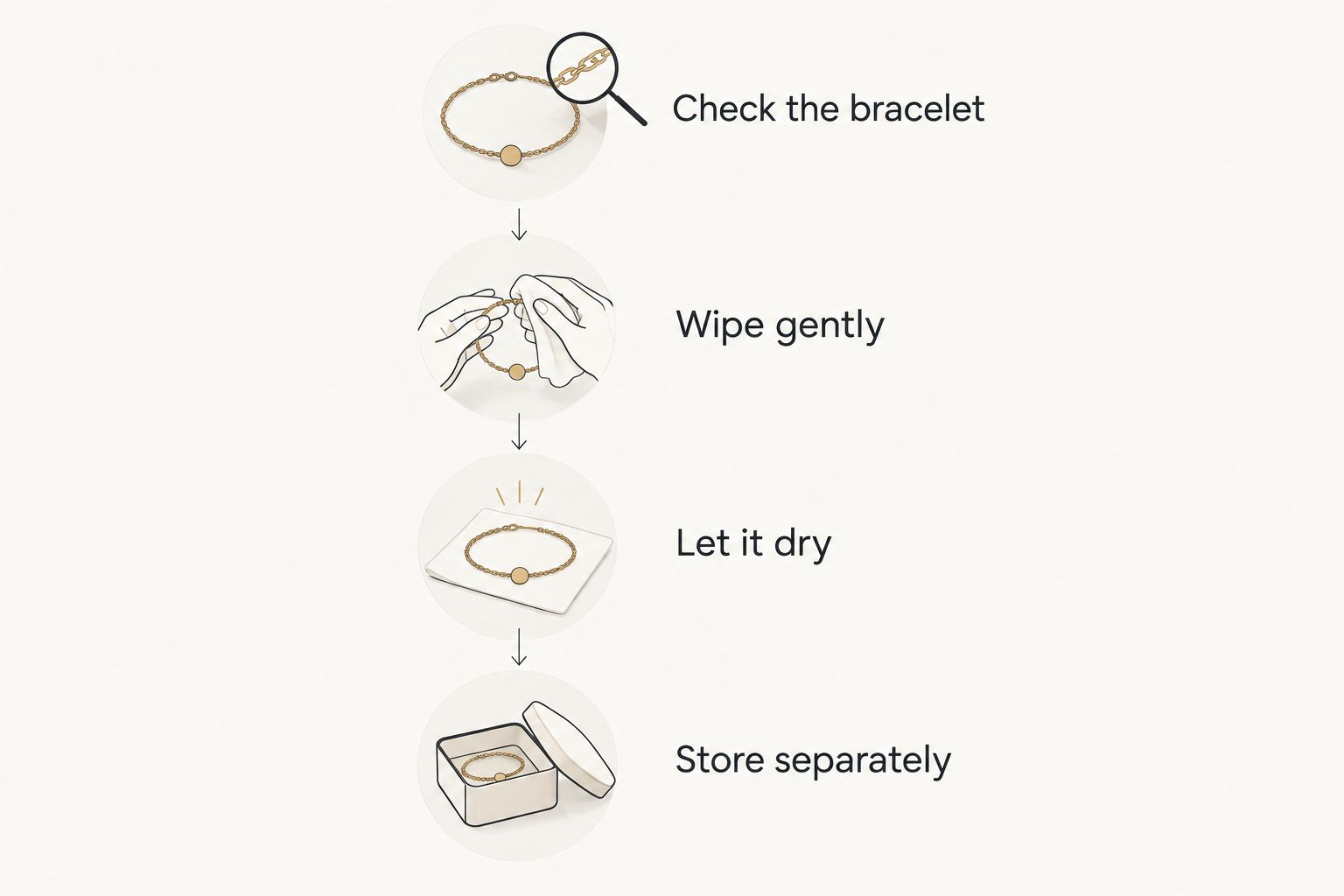
Use this sequence when you take it off:
- Check the bracelet. Look for grit, moisture, loose components or an exposed knot before putting it away.
- Wipe gently. Use a soft cloth for routine surface care; follow the listing before using water or cleaners.
- Let it dry. Do not seal a damp bracelet in a pouch or box.
- Store separately. Lay it without stretching the cord, away from direct sun and heat.
If you travel, use a protective compartment rather than leaving the bracelet loose with keys. Keep it out of a parked car when practical. For elastic-cord jewelry, take the bracelet off at night rather than sleeping in it.
A storage habit you can repeat is more useful than an elaborate ritual. Put the pouch where you normally remove your jewelry, not somewhere so inconvenient that the bracelet keeps returning to the windowsill.
What should you do if moss agate looks faded?
Start by checking whether the difference remains under comparable viewing conditions. Translucent beads can look washed out in strong backlighting and deeper against a dark surface. Automatic camera processing can exaggerate those differences.
Do not try to restore color with oil, dye, heat or chemical cleaners. Those experiments can introduce new problems and make the original change harder to assess.
Compare under consistent light
Take 2 photographs in the same indirect daylight: one of the whole bracelet and one close view of the area that concerns you. Use the same plain background for future comparisons. A photograph documents appearance; it does not identify treatments or prove what caused a change.
Check whether all beads look different or only one area. Note any dull surface, residue, cracks or cord discoloration separately rather than calling every change fading.
Check the purchase information
Review the original listing and any care information supplied with the bracelet. Ask the seller about dye, coatings and recommended cleaning. Include your photographs and describe where the bracelet was kept without assuming sunlight caused the change.
If a significant change remains unexplained, a qualified gemologist can assess the material and discuss whether testing is appropriate. Buying a replacement before understanding the problem is not necessary.
Does sunlight cleansing change moss agate physically?
Sunlight cleansing is a personal spiritual practice, not a required maintenance step for moss agate. It does not replace cleaning, inspection or appropriate storage. You can respect the symbolism without exposing jewelry to prolonged direct sun.
If the bracelet serves as an intention reminder, hold it while naming an action you want to take, then put it away. No outdoor exposure or purchase is needed. A pause before answering a difficult message is a personal practice, not an effect produced by the stone.
EclipticJew natural-stone jewelry includes pieces chosen for personal intention and cultural symbolism. Those meanings do not establish colorfastness, and a blessing does not change a bracelet’s physical care requirements. For a 2026 purchase, assess material disclosures and symbolism as separate questions.
Can you wear moss agate outside every day?
Ordinary outdoor wear is generally compatible with untreated moss agate. Remove the bracelet for activities that expose it to impact, abrasive dirt, chemicals or conditions excluded by its care instructions.
A bracelet worn on a walk does not need the same response as one forgotten on a dashboard. Avoid treating every outdoor moment as damage, but do not use the stone’s general durability to overlook the cord or other components.
Can faded moss agate regain its color?
A genuine change to a dye or treatment is not something you can reliably reverse at home. First rule out residue and differences in lighting, then seek treatment-specific advice.
Do not assume darker-looking beads after wetting have recovered. Water changes surface appearance temporarily and is not proof of restored color.
FAQ
Can moss agate fade in sunlight in 2026?
Untreated moss agate is generally stable in ordinary daylight, but dyes and surface treatments introduce uncertainty. Avoid prolonged direct-sun storage and check the bracelet’s treatment disclosure.
Can I leave my moss agate bracelet on a windowsill?
A shaded storage location is a better choice than a sunny windowsill. It avoids unnecessary light and heat exposure for the stone, cord and other components.
How long can moss agate safely stay in the sun?
There is no universal safe exposure time for every moss agate bracelet. Treatment, construction and exposure conditions prevent a single reliable limit.
Does natural moss agate mean it is undyed?
Natural moss agate does not automatically mean undyed or untreated. Ask specifically whether the color is enhanced and whether the beads have coatings or other treatments.
Should I put moss agate in sunlight to cleanse it?
Sunlight exposure is not necessary for physical care. If cleansing is meaningful to you, choose a personal practice that does not require prolonged sun or heat exposure.
Can I sleep wearing an elastic moss agate bracelet?
Take an elastic-cord moss agate bracelet off before sleeping. Store it without stretching the cord, away from direct sunlight and heat.
Does EclipticJew jewelry need different care after a blessing?
A blessing does not change the physical care requirements of EclipticJew jewelry. Follow the individual listing’s material, construction and care information; blessing services apply only where confirmed.
One last thing
The palest-looking bead is not automatically the most damaged one. Before replacing a bracelet, compare it against the same background in indirect daylight and check its treatment information. That small step can keep a lighting difference from becoming an unnecessary purchase.
For your next stone choice, ask about treatments first, then measure your wrist and check the fit. Choose a bracelet you can comfortably wear and simply care for—not one that makes you afraid of daylight.


