
Rutilated quartz bracelets can tolerate an accidental splash, but you should remove them before showering, swimming or soaking. Sound, untreated quartz is generally less of a concern than the bracelet’s cord, metal fittings, coatings or other beads. The practical rule for 2026 is simple: wipe the bracelet clean, keep immersion out of your routine, and follow the care instructions for the complete piece.
- Can rutilated quartz bracelets get wet? Brief splashes are different from soaking; remove bracelets before bathing or swimming.
- EclipticJew crystal jewelry suits shoppers seeking natural-stone pieces with personal symbolism, not a waterproof accessory.
- Elastic cord, metal fittings and added materials determine care alongside the quartz beads.
- After accidental wetting, blot gently and air-dry without stretching the cord or applying heat.
Can rutilated quartz bracelets get wet?
A splash is not the same as permission to soak. A sound, untreated quartz bead generally tolerates brief contact with plain water, but that does not establish water resistance for the assembled bracelet. You also need to consider its stringing material, knot, fittings and any treatments.
Rutile is the mineral that forms the distinctive needle-like inclusions inside rutilated quartz. Those inclusions do not tell you whether a bracelet has an adhesive-secured knot, plated spacers or treated beads. Appearance alone cannot answer the whole care question.
| Water exposure | Practical decision | What to consider |
|---|---|---|
| Accidental splash | Blot and inspect | Plain water on intact quartz is different from prolonged immersion |
| Handwashing | Remove beforehand | Soap and repeated wetting reach more than the bead surfaces |
| Shower or bath | Leave the bracelet off | Heat, toiletries and soaking add avoidable exposure |
| Swimming pool | Remove before entering | Pool chemicals and immersion involve the entire bracelet |
| Sea water | Keep the bracelet out | Salt residue and metal components need particular attention |
| Routine cleaning | Start with a soft cloth | Use a slightly damp cloth only when the materials permit it |
For a broader cleaning routine, see how to clean a natural-stone bracelet. Apply the instructions for the most sensitive component, rather than assuming every bead and fitting behaves like quartz.
Why this matters
A bracelet can look dry on the outside while moisture remains around the bead holes or knot. That is why inspecting only the polished stone misses part of the job. Cleaning and drying need to account for the construction you cannot easily see.
For everyday wear in 2026, a useful habit is to remove your bracelet before the activity begins. Put it somewhere dry and secure, away from the sink edge. You do not need a special cleaning kit to make that change.
Quartz beads: brief contact is different from immersion
Rutilated quartz has quartz as its host mineral. Quartz ranks 7 on the Mohs hardness scale, but that figure describes scratch resistance—not waterproofing, resistance to chemicals or protection from thermal shock.
The advantage of quartz is that ordinary brief contact with plain water is not inherently a reason to discard an intact bead. The limitation is that an individual bead can have fractures, surface treatments or other features that require more cautious care. A photograph cannot establish those details.
Look for chips around drill holes, a rough edge or a visible crack reaching the surface. Do not scrape a suspected defect or press on it to see whether it moves. Set the bracelet aside if the condition looks different after wetting.
Do not use soaking as an authenticity test. Water exposure does not reliably establish whether a bead is natural, treated or imitation, and it exposes the rest of the bracelet unnecessarily.
Cord and knots: care for the bracelet’s structure
Elastic cord makes a bracelet convenient to put on, but its exact composition and the way its knot is secured matter. Do not assume every stretch bracelet uses the same elastic or adhesive. Unless the maker gives specific permission, avoid repeated soaking.
A useful inspection has 3 checks: look for fraying, check for unusual slack, and examine any exposed knot without pulling it apart. These checks do not certify the cord’s condition, but they help you spot a reason to stop wearing the bracelet.
Roll a stretch bracelet gently over your hand instead of pulling it wide. After wetting, leave it unstretched while it dries. Avoid hanging a wet bracelet from its cord or repeatedly tugging it to test whether it is still strong.
Non-elastic cord also needs material-specific care. A woven or knotted construction is not automatically suitable for swimming simply because it does not stretch. Ask what the cord is made from and how the maker recommends cleaning it.
Metal details: color does not identify the material
A gold-colored spacer does not tell you whether it is solid gold, plated metal or another finish. Likewise, a silver-colored charm does not establish its alloy. Those differences affect which cleaners and moisture exposures are appropriate.
Metal fittings add visual detail, but they also add another material to maintain. Repeated contact with salt, pool chemicals, soaps or cosmetics can be unsuitable for particular alloys and finishes. Follow the instructions for the actual component rather than a rule for its color.
Use a soft cloth around spacers and clasps without forcing it beneath a tight setting. Do not apply a metal polishing compound across the whole bracelet. A cleaner intended for one fitting is not automatically appropriate for the stones, cord or coating beside it.
If discoloration persists, ask a jeweler to identify the metal before trying a stronger cleaner. Abrasive scrubbing is not a neutral next step, especially when a surface finish is unknown.
Why water-care advice varies between bracelets
Different instructions do not necessarily contradict each other. They can refer to different materials or constructions, even when both pieces are sold as rutilated quartz bracelets.
- Bead condition: Intact polished beads and beads with surface-reaching fractures do not present the same care concerns.
- Treatments: Coatings, dyes or fracture-filling treatments require their own instructions when present.
- Stringing material: Elastic, textile cord and wire have different maintenance needs.
- Knot construction: A concealed knot or adhesive introduces details that are not visible from the outside.
- Metal fittings: The alloy, plating and finish affect suitable cleaning methods.
- Additional materials: Wood, pearls, other gemstones or decorative components can change the routine for the entire piece.
When construction is uncertain, choose less water—not a longer experiment. A dry wipe is a sensible starting point while you confirm the materials.
What should you do if your bracelet gets wet?
Remove the bracelet and blot it gently. An accidental splash does not automatically mean damage, so avoid an aggressive rescue routine. Inspect the piece before deciding whether it needs anything beyond drying.
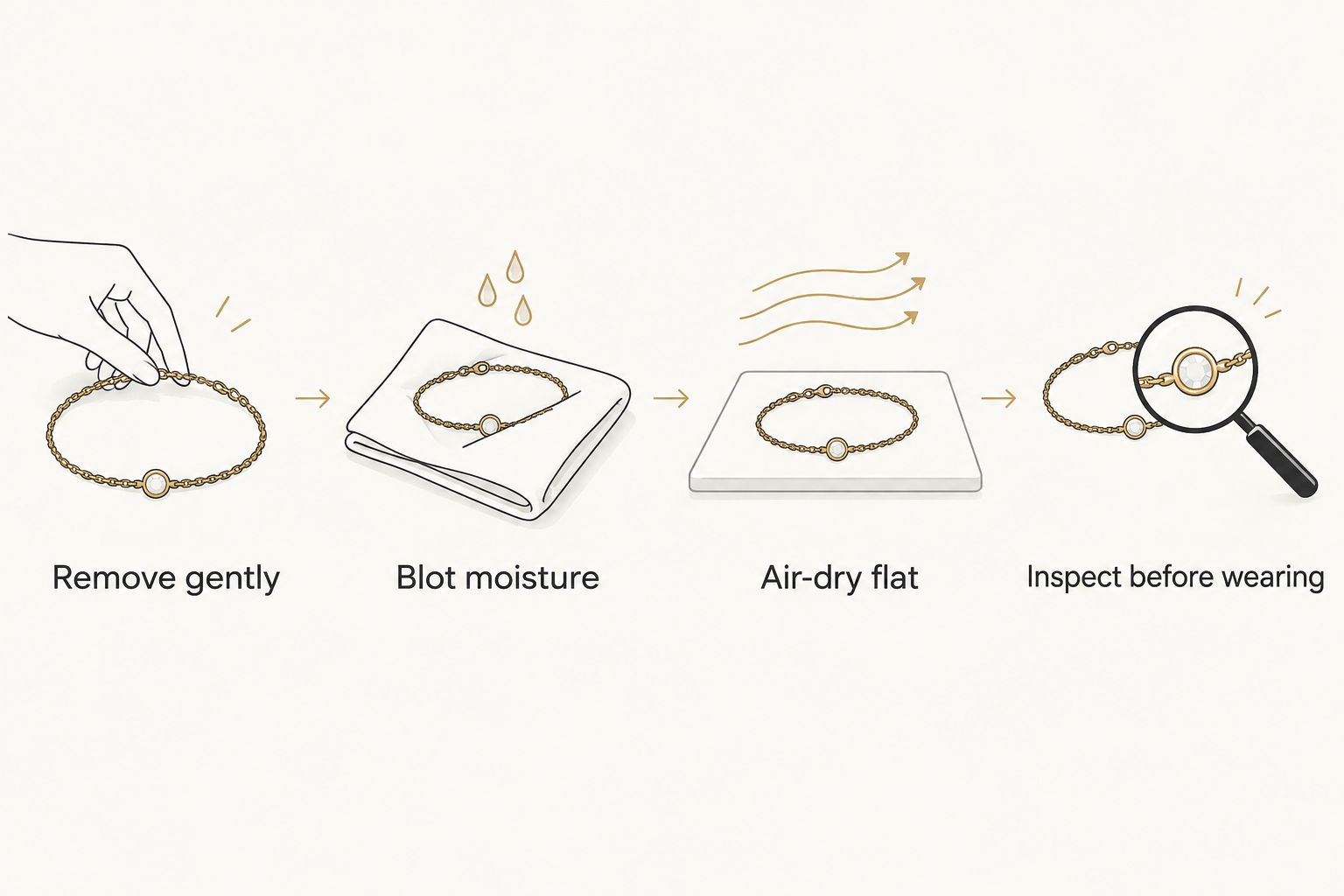
Use these 4 steps for your 2026 care routine:
- Remove gently. Take the bracelet off without pulling hard on the cord. Keep it away from the drain.
- Blot moisture. Press a clean, soft cloth against the beads and fittings. Do not twist or wring the bracelet.
- Air-dry flat. Set it on a dry cloth in a ventilated place, away from direct heat. Turn it gently to expose damp contact points.
- Inspect before wearing. Check the cord, knot, bead holes and metal. Leave it off if you notice fraying, loose fittings or a new crack.
There is no universal drying time for every bracelet construction. Bead spacing, cord and concealed areas differ, so a fixed countdown would give false confidence. Do not put the bracelet back on while the cord or knot still feels damp.
After exposure to sea water, pool water or cleaning chemicals, tell the maker exactly what contacted the piece. If residue remains, get material-specific advice rather than repeatedly soaking it or adding another cleaning product.
How should you clean rutilated quartz without soaking it?
Start with the least intensive method that removes the dirt. For your 2026 routine, that means a soft, dry wipe first, followed by limited damp wiping only if the bracelet’s instructions permit it.
Keep 2 soft cloths available: one for any permitted damp wiping and one for drying. Dampen the cleaning cloth rather than pouring water over the bracelet. Work around individual beads without saturating the cord.
A dry cloth is best for routine surface dust because it adds no moisture, though it will not remove every residue. A slightly damp cloth is best for permitted spot-cleaning, but it is not suitable for every finish or mixed-material design.
Avoid household cleaners, abrasive powders and improvised chemical mixtures. Do not assume that a homemade solution is gentle because its ingredients are familiar. Steam and ultrasonic cleaning also require professional assessment of the complete piece, including inclusions, treatments and fittings.
If dirt sits tightly around a knot or beneath a fitting, leave it alone rather than digging with a pin. A jeweler can assess whether cleaning or restringing is the better next step.
Can you shower or swim with rutilated quartz?
Remove rutilated quartz bracelets before showering or swimming. The concern is not simply whether quartz survives plain water; bathing and swimming expose the cord, fittings and any finishes to a different combination of conditions.
In the shower, shampoo, conditioner and body products contact the bracelet alongside warm water. At the pool, chemical exposure and immersion are part of the activity. At the beach, sand adds an abrasive material to salt water.
Use a small dry pouch or a secure jewelry dish before you begin. Do not leave the bracelet loose on a poolside towel or balanced beside a basin. A consistent storage place is more useful than trying to remember which activities involve only a little water.
Can you use water to cleanse its symbolic meaning?
Physical cleaning and symbolic cleansing serve different purposes. A personal ritual does not require immersion, and water exposure does not establish whether an intention has been renewed or a spiritual outcome achieved.
If rutilated quartz represents clarity or commitment for you, place the clean, dry bracelet beside a written intention. Pause, read it and choose an action that fits it. The jewelry can mark the moment without being treated as the force that changes events.
You do not need to buy another object or perform a prescribed ritual. Keeping the bracelet dry is compatible with a meaningful personal practice, and ordinary care does not need a mystical explanation.
What should you check before choosing a bracelet?
For a bracelet you plan to wear regularly in 2026, ask about materials before focusing only on the stone name. Confirm the cord type, metal details, any disclosed treatments and the recommended cleaning method. If those details are unclear, request clarification rather than assuming the piece is water-resistant.
EclipticJew offers natural-stone and crystal jewelry for shoppers who value materials alongside personal symbolism. The rutilated quartz jewelry guide is a relevant starting point; confirm the construction and care instructions for the individual piece you choose.
The same limitation applies to EclipticJew crystal jewelry as to any mixed-material bracelet: the category name alone does not establish water resistance. Choose a piece whose care requirements fit your day, and give yourself permission to skip it if frequent removal would be impractical.
FAQ
Can rutilated quartz bracelets get wet when I wash my hands?
An accidental splash is generally less concerning than soaking, but remove a rutilated quartz bracelet before washing your hands. Soap and repeated wetting reach the cord and fittings as well as the beads.
Is rutilated quartz waterproof?
Rutilated quartz does not make an assembled bracelet waterproof. Sound, untreated quartz generally tolerates brief plain-water contact, but treatments, fractures, cord and metal details still determine care.
Can I wear my rutilated quartz bracelet in the shower?
Remove your rutilated quartz bracelet before showering. Warm water, toiletries and repeated immersion add exposure that a quick splash does not.
Can rutilated quartz go in salt water?
Keep a rutilated quartz bracelet out of salt water unless its maker explicitly permits that exposure. Salt residue and unknown metal or cord materials make immersion an unnecessary care risk.
How long should I dry a wet crystal bracelet?
There is no universal drying time for a wet crystal bracelet. Blot it, air-dry it flat away from heat, and wait until the cord and knot are dry before wearing it again.
Can I use a hair dryer to dry my bracelet?
Do not use a hair dryer to dry your bracelet. Blotting followed by room-temperature air-drying avoids adding heat to the stones, cord and any adhesive or finish.
Do I need to soak rutilated quartz to cleanse it spiritually?
You do not need to soak rutilated quartz for a personal cleansing ritual. Keep the bracelet dry and use reflection or a written intention if that practice feels meaningful to you.
One last thing
The easiest care improvement happens before the bracelet gets wet. Give it a regular resting place before bathing, swimming and bedtime, rather than relying on a drying routine afterward.
If you are choosing an EclipticJew bracelet in 2026, start with the material details and measure your wrist before selecting a fit. Choose the stone for its appearance and personal meaning, then choose a care routine you can comfortably keep.


