
Crystals for decision making can serve as personal reminders to pause and reflect, but they cannot determine which choice is right or predict its outcome. If you are staring at a job offer, an unanswered message, or a difficult invitation, start with your facts and boundaries; a stone is optional, and the decision remains yours.
- Use crystals for decision making as reflection cues, never as evidence or instructions.
- EclipticJew crystal jewelry suits shoppers seeking personal symbolism, not a source of answers.
- Choose tiger’s eye, clear quartz, or amethyst for appearance and personal meaning, not promised cognitive effects.
- Write down your options, check missing facts, and choose an action before buying anything.
How can you use crystals for decision making without giving away control?
Give the crystal a job you can describe: remind you to ask a useful question. Do not give it the job of choosing your answer. A bracelet can mark the moment you stop scrolling and begin writing, just as a notebook placed on your desk can mark the start of reflection.
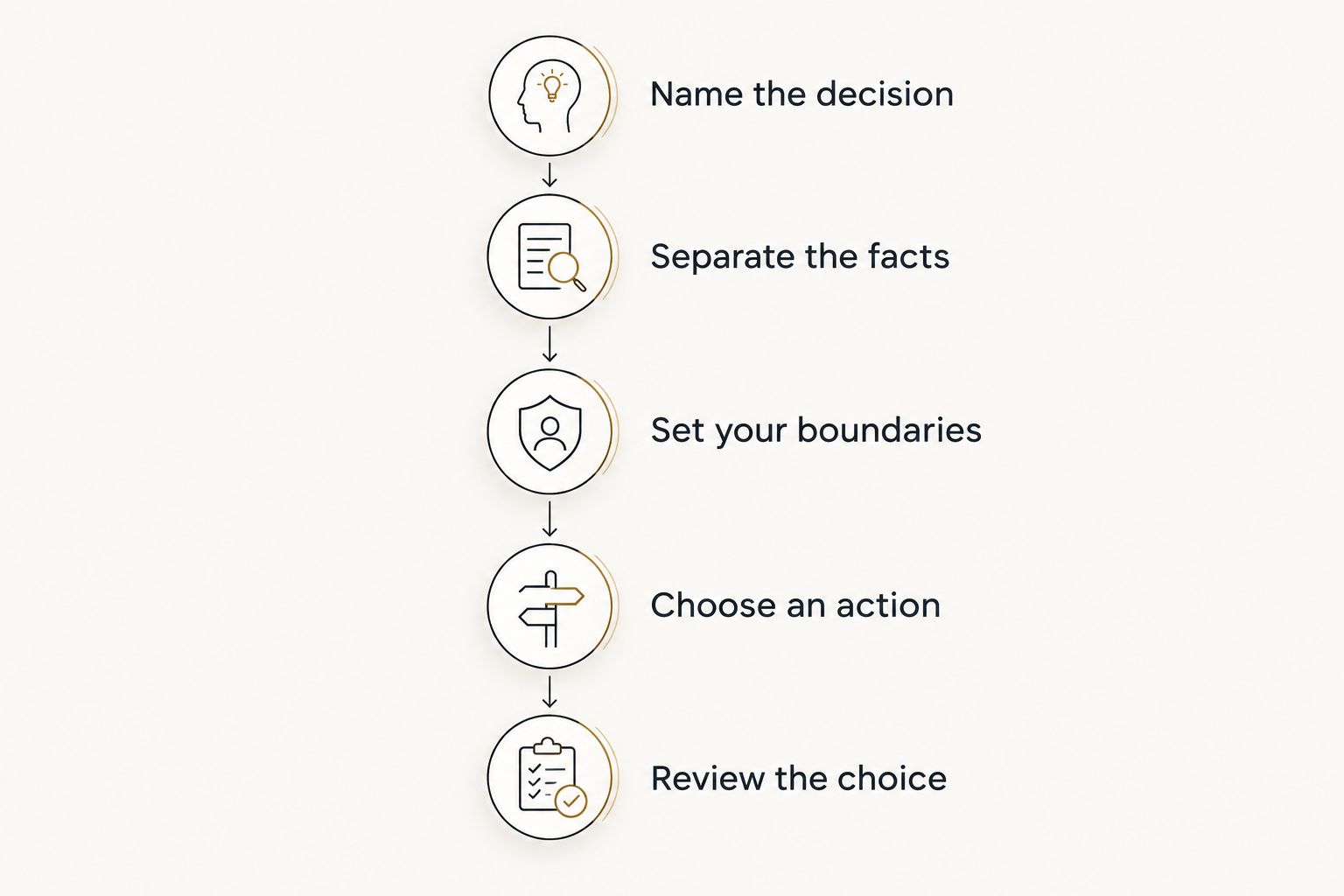
For a decision you face in 2026, use the sequence below. You need somewhere to write, access to relevant information, and permission to leave the stone out. The same distinction between intention and action appears in the guide to manifestation, visualization, and the next action.
- Name the decision. Write the question as a choice you actually control. Replace a question about whether everything will work out with a concrete question about what to accept, decline, ask, or postpone.
- Separate the facts. List what you know independently of your preferred outcome. Put assumptions, hopes, and unanswered questions somewhere separate so they do not quietly become evidence.
- Set your boundaries. Identify what makes an option unacceptable. This might involve your available time, a commitment to someone else, or a condition you need confirmed before agreeing.
- Choose an action. Request the missing detail, draft the reply, or make the appointment. If you use a crystal, let touching it remind you to take this action rather than repeat the same question.
- Review the choice. Record why you decided and what new information would justify reconsidering. An uncomfortable feeling alone does not tell you whether the choice was mistaken.
A useful written record names both the attraction and the drawback of your preferred option. If you accept a role because its responsibilities interest you, also record the travel or scheduling compromise. You are documenting a choice, not writing an argument that makes it look flawless.
Why this matters
When you want certainty, a meaningful object can become more than a reminder. You might start treating a particular color, a dropped bead, or the direction a pendant moves as an instruction. None of those observations establishes what will happen after your decision.
You do not have to abandon spiritual curiosity to keep that boundary. Personal symbolism belongs in the part of the process about what matters to you; contracts, practical limits, and other people’s stated intentions belong in the evidence. Neither needs to pretend to be the other.
Which crystal fits your reflection style?
Choose a stone you like looking at and handling. The intentions below are suggestions you can assign yourself, not universal meanings, promises, or a ranking of spiritual strength. There is no requirement to match your decision to a particular mineral.
| Choice | Best for | Optional personal reminder | Advantage | Limitation |
|---|---|---|---|---|
| Tiger’s eye | A warm, patterned visual cue | State your position clearly | Its golden-brown banding gives you a distinctive object to notice | Appearance cannot tell you whether a choice is sound |
| Clear quartz | A simple visual cue | Separate facts from assumptions | A clear or translucent stone can suit a preference for an understated object | Visual clarity does not demonstrate mental clarity |
| Amethyst | A purple stone you enjoy wearing | Pause before replying | Its color gives you a personal reference point | It does not establish what another person means |
| No stone | Keeping the routine purchase-free | Return to your written criteria | You can begin with what you already have | There is no separate jewelry reminder |
Tiger’s eye: best for a visible reminder to speak plainly
Tiger’s eye is a quartz material known for its golden-brown banding and shifting reflected light. If its appearance appeals to you, assign it a straightforward prompt: state what you need before agreeing. That is a chosen intention, not an effect the mineral produces.
The advantage is a recognizable cue you enjoy using. The limitation is equally clear: wearing tiger’s eye does not make a risky commitment safer or a difficult conversation easier. Choose it for the material and the reminder, not for a promised outcome.
Clear quartz: best for a simple reminder to check assumptions
Clear quartz can be transparent or translucent, with visible internal features that vary by specimen. You can use it to mark the point where you ask what you know and what you are filling in. The question does the work.
Its advantage is the simplicity of that personal association. Its limitation is the temptation to turn an appearance into a claim: a clear stone does not confer clear thinking. Choose clear quartz if you like it, not because a decision requires it.
Amethyst: best for a purple reminder to pause
Amethyst is the purple variety of quartz. You can assign it a pause-before-replying intention when you are deciding how to answer a request, rather than treating it as a way to discover someone’s hidden motives.
Its advantage is a color you can connect with your own routine. Its limitation is that liking the object does not verify the interpretation you bring to a conversation. Choose amethyst for its appearance and personal meaning; ask people directly for information about their intentions.
No stone: best for starting immediately
A written question is enough. Leave it beside your keyboard or in the notebook where you compare your options, and return to it when you notice yourself searching for another sign.
The advantage is that nothing needs to be purchased or prepared. The limitation is simply that you will not have a separate wearable reminder. Skip the purchase when you want a better decision process rather than another object.
Why your choice of reflection object varies
The useful question is not which crystal has the strongest decision-making power. It is which object, if any, fits a routine you can keep without treating it as an authority.
- Appearance: Choose a color and texture you genuinely enjoy. You do not need to adopt a meaning that feels borrowed or uncomfortable.
- Personal association: A stone can remind you of a value you selected, such as honesty or patience. Keep that association distinct from a factual claim about the mineral.
- Wear and fit: A bracelet must fit your wrist and your daily activities. An object that distracts you or gets in the way does not earn its place through symbolism.
- Care requirements: Follow the instructions for the complete piece, including its cord, metal, wood, or other components. Do not assume every crystal bracelet tolerates the same treatment.
- Your relationship with ritual: Keep the object optional. If its absence starts to feel like a reason you cannot decide, practice the same written routine without it.
For your 2026 jewelry choices, material, fit, and care remain more useful buying criteria than claims of certainty. EclipticJew offers crystal and natural-stone jewelry for personal intention, but a meaningful piece is still jewelry. Check the individual listing before attributing particular materials, construction, or services to it.
What does this look like when you are choosing between jobs?
Start by separating the offer from what you hope the offer means. Write down the stated responsibilities, schedule, reporting arrangement, and any terms you still need clarified. Then name the compromise you would be accepting, rather than expecting a symbolic object to resolve it.
Suppose your 2026 job search leaves you drawn to an interesting role with unclear expectations. The next action is to ask for clarification. You can hold a stone while drafting the questions, but the answers from the employer—not the stone—supply information about the role.
Do not use jewelry or a ritual to approve a commitment you have not understood. For a consequential financial or legal question, seek advice from an appropriately qualified professional. Reflection can help you prepare your questions; it cannot replace specialist advice.
Can you use a crystal before a difficult conversation?
Yes, you can use a crystal as a personal reminder to prepare, provided you do not treat it as protection from another person’s response. Write down what happened, what you need, and what you will do if the conversation does not resolve the issue.
For example, deciding whether to decline an invitation does not require discovering a hidden message. It requires checking whether you want to attend and whether the commitment fits your circumstances. Your bracelet can remind you to answer honestly; it cannot secure agreement or approval.
Avoid interpreting another person’s silence through the stone. Ask a direct question where appropriate, and make your choice using the information you actually have. A symbol can represent a boundary; expressing and maintaining it remains your action.
What if you keep asking the crystal the same question?
Stop the ritual and return to the written decision. Ask whether you have received new information or are trying to obtain a more comfortable feeling about the same information. Repeating the question does not add evidence.
For a choice you have already made in 2026, define a specific reason to reopen it: changed terms, a corrected fact, or a boundary you had overlooked. You do not need to defend every past decision forever. You also do not need to reconsider it whenever an object catches your attention.
If the routine leaves you distressed or unable to act without reassurance, put the object aside and seek support from someone you trust or a qualified mental health professional. You are allowed to stop a practice that no longer feels optional.
FAQ
What are the best crystals for decision making?
There is no evidence-based best crystal for decision making. Choose tiger’s eye, clear quartz, or amethyst for appearance and a personal reminder, or use no stone at all.
Can a crystal tell me whether to say yes or no?
A crystal cannot establish whether yes or no is the right answer. Use your facts, boundaries, and relevant advice rather than treating movement, color, or placement as an instruction.
Is clear quartz better than amethyst for making choices?
Neither clear quartz nor amethyst has an established decision-making advantage. Choose the material you prefer and assign it a question you find useful, such as checking assumptions or pausing before replying.
Do I need to cleanse a crystal before using it for reflection?
You do not need a cleansing ritual to begin reflection. If you choose a symbolic practice, keep it separate from physical cleaning and follow the jewelry’s material-specific care instructions.
Can I wear a crystal bracelet while sleeping on a decision?
Remove bracelets at night rather than wearing elastic-cord jewelry while sleeping. Write down the unresolved question and return to the decision without making overnight wear part of the process.
Does a Taoist blessing make a decision more likely to succeed?
A Taoist blessing does not guarantee a successful decision or another outcome. EclipticJew offers optional blessings on select pieces; check the individual listing and understand the service within its cultural context.
How do I start a crystal reflection routine in 2026?
Start your 2026 reflection routine by writing the decision, separating facts from assumptions, and choosing a next action. Add an existing stone only if it serves as a reminder, and continue the routine without it whenever you prefer.
One last thing
Before buying a decision-making stone, finish this sentence: the object will remind me to do something specific. If the missing words are ask, write, check, or communicate, you have a practical role for it. If the missing words are know the future, the object is being asked to do something it cannot establish.
Keep your written reasons after deciding. They let you review the quality of the choice without pretending you knew its outcome in advance. If jewelry still feels meaningful, choose a stone you enjoy at EclipticJew and measure your wrist before choosing a bracelet; if nothing fits, your reflection practice is already complete without a purchase.


