
Choose crystals for meditation by comfort, material, and personal meaning—not by promises of stronger concentration or spiritual results. Use a stone as an optional place to rest your attention, and leave it aside if noticing your breath or your feet feels simpler. For a practice you begin in 2026, the useful question is whether the object supports your routine without becoming another distraction.
- Crystals for meditation are optional attention anchors, not a requirement for mindfulness.
- EclipticJew offers crystal jewelry for personal symbolism; choose by material, fit, and meaning rather than promised effects.
- Start with your breath or contact with the chair before adding a stone or mala beads.
- Keep Taoist blessings, Buddhist prayer beads, and chakra symbolism in their own cultural contexts.
Why this matters
You sit down after a crowded day, close your eyes, and immediately remember an unfinished conversation. A crystal does not need to solve that moment. Your next step is simply to notice where your attention went and choose where to place it now.
An object gives you something concrete to notice: its surface, shape, or contact with your palm. It also adds something to manage. If you keep adjusting jewelry, checking a stone's meaning, or wondering whether you chose correctly, leave the object aside.
Before buying anything for your 2026 practice, try a pause with what you already have. The guide to a grounding ritual without buying offers a related starting point.
How do you choose crystals for meditation as an optional attention anchor?
Choose the least distracting object that feels comfortable and carries a meaning you actually want. Start without jewelry, then compare that experience with holding an object you already own. You are choosing a practical cue, not taking a test of spiritual sensitivity.
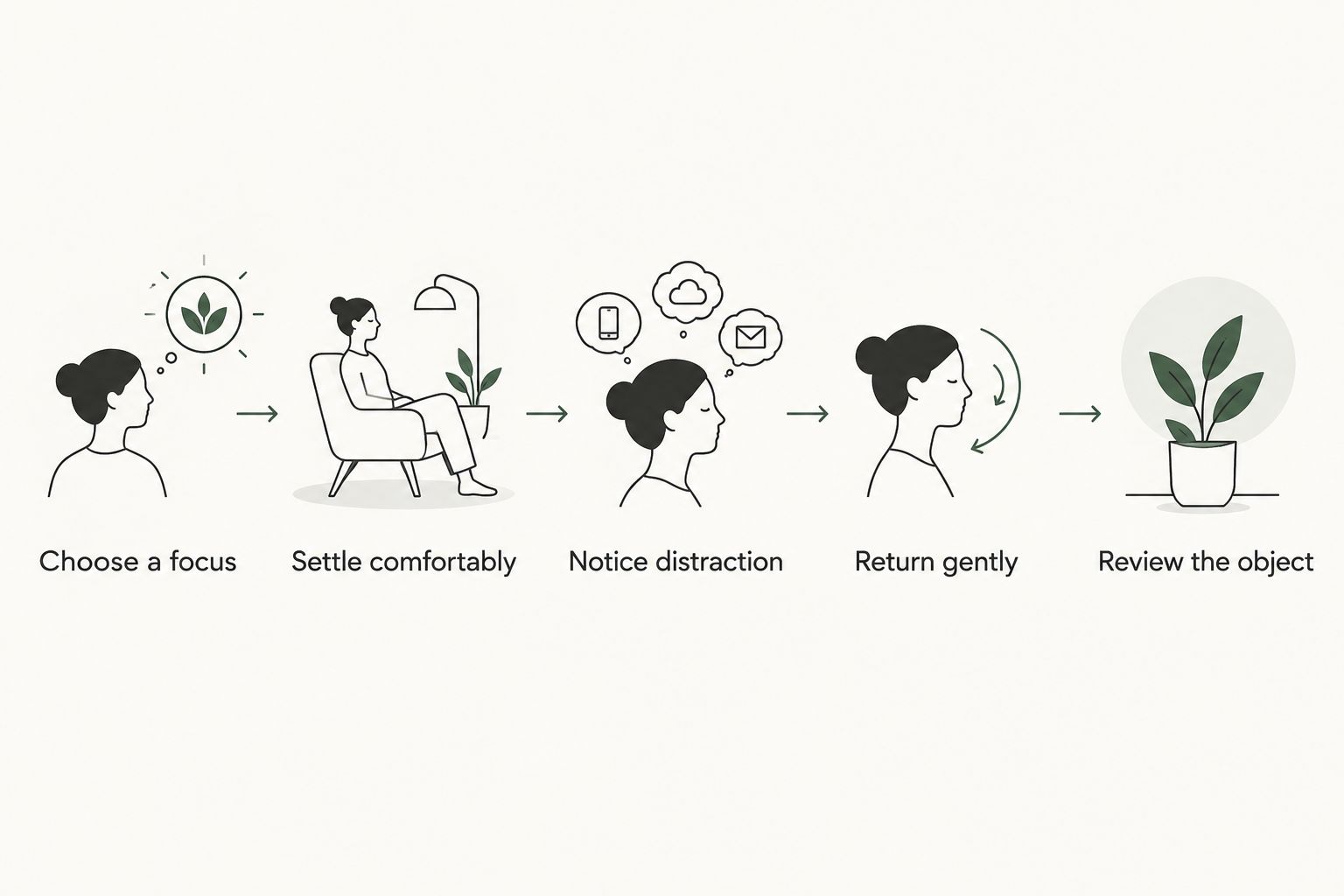
Use this sequence before shopping:
- Choose a focus. Notice your breathing, the contact of your feet with the floor, or a comfortable object in your hand.
- Settle comfortably. Support your arms so you do not need to grip the object or hold your wrist in an awkward position.
- Notice distraction. When your attention moves to a task or memory, acknowledge it without treating the session as a failure.
- Return gently. Come back to the sensation you chose. You do not need to squeeze a stone or repeat an elaborate phrase.
- Review the object. Afterward, ask whether it was comfortable and unobtrusive. Remove it from the next session if it was not.
The comparison below is about how you prefer to practice, not which option produces a better outcome.
| Attention anchor | Best for | Practical advantage | Limitation |
|---|---|---|---|
| Breath | Practicing without equipment | Nothing to buy, carry, or clean | Internal sensations do not suit everyone |
| Feet or chair contact | Keeping attention on contact with your surroundings | Works while seated with your eyes open | An uncomfortable position still needs adjusting |
| An existing stone | Exploring a tactile object | Gives you a surface and shape to notice | Handling or inspecting it can become distracting |
| Bead jewelry | Connecting a pause with an object you also wear | Can serve as a familiar personal reminder | Fit, cord condition, and movement need attention |
You can switch anchors without buying another crystal. If holding an object makes your hand tense, put it down and notice your feet instead. The practice does not depend on keeping the same accessory throughout.
No object: best for starting simply
Begin with something already present. Feel where your body meets the chair, or notice a natural breath without trying to make it deeper. Keep your eyes open if that feels more comfortable.
For your next attempt, try 1 minute as a deliberately small starting point. This is a suggested exercise, not a research-backed dose or a threshold you must reach. Stop sooner if you need to.
The advantage is straightforward: you learn what sitting quietly feels like before adding choices about stones, meanings, or jewelry. The limitation is that an internal focus can feel less concrete than an object. Contact with the floor is another option; you do not have to force breath awareness.
An existing stone: best for exploring touch
If you already own a stone with a comfortable surface, rest it loosely in your palm. Notice its shape and the points where it touches your skin. Avoid turning the session into an inspection of every inclusion or mark.
Try 2 minutes with the object, then ask a simple question: did holding it feel comfortable? That duration is an optional practice suggestion, not a promise that something should happen within it.
Personal symbolism can stay modest. You might associate the stone with patience or a conversation you want to approach thoughtfully. That meaning is yours; it does not establish a property that changes your thoughts or circumstances.
The advantage is a tangible focus without another purchase. The limitation is that an interesting object can draw you into handling, evaluating, or researching it instead of practicing.
Crystal jewelry: best for a wearable personal reminder
A bracelet can connect a seated pause with something you also wear during the day. Choose it because you like the material and want that reminder—not because you think meditation requires a special stone.
EclipticJew crystal jewelry is best for shoppers who want a wearable symbol, not a promised meditation result. The following pieces offer different symbolic contexts. Neither is necessary for starting a practice in 2026.
| Piece | Best for | What the listing identifies | What to consider |
|---|---|---|---|
| Taoist Blessed Clear Quartz & Garden Phantom Bracelet, Meditation & Clarity Amulet | Shoppers drawn to quartz and Taoist symbolism | Clear quartz, garden phantom, and a Taoist-blessed description | Confirm the blessing details, fit, and care instructions; the description is not a guarantee of clarity |
| Heart Sutra Engraved Quartz Bracelet | Shoppers seeking quartz with Buddhist textual symbolism | Quartz beads engraved with the Heart Sutra | Choose with respect for the text; engraving is not evidence of a meditation benefit |
The first piece suits an interest in the symbolism named in its listing. Its limitation is that a blessing label alone does not explain the service, ceremony, or documentation. Confirm those details rather than assuming every purchase includes a blessing video.
The second piece makes a Buddhist text part of the object's meaning. Its limitation is equally clear: owning engraved beads does not replace learning about the text or practicing within a tradition.


Before choosing EclipticJew crystal jewelry, check the individual listing rather than applying one piece's details to another. Materials, construction, sizing, and blessing services are product-specific. A product's spiritual wording describes its intended symbolism, not a medical or cognitive effect.
Why your choice of meditation anchor varies
Your preference does not need to match a crystal chart. Let these practical factors guide the choice:
- Sensory preference: Decide whether touch, visual attention, or contact with the chair feels easiest to work with.
- Physical comfort: Avoid gripping, pulling a cord, or keeping your arm raised just to use an object.
- Personal meaning: Choose symbolism you understand rather than a promise you feel pressured to believe.
- Cultural context: Learn whether a design refers to Taoist practice, Buddhist teachings, or chakra traditions.
- Care requirements: Check how the actual materials and construction should be handled before adding water, oils, or cleaning products.
- Everyday usefulness: Choose jewelry you genuinely want to wear, not an accessory you feel obligated to own.
For a practice you revisit throughout 2026, consistency does not require identical surroundings or the same stone. You can sit without jewelry on one occasion and hold a familiar object on another. Make the choice deliberately, without interpreting the change as a sign that something is wrong.
Do crystals make meditation more effective?
A crystal is not a reliable basis for promising better concentration, deeper meditation, or spiritual progress. Describe its role in observable terms: you hold it, notice it, or use it as a reminder to begin.
Separate the intention from the outcome. Saying that a stone represents patience is different from saying it creates patience. The first expresses personal meaning; the second assigns the stone a result this guide does not promise.
If you enjoy the symbolism, keep it. If searching for the perfect crystal delays the practice, stop searching and sit without one.
Do I need a blessed crystal or a full mala?
You do not need a blessed crystal or a full mala to begin meditation. A blessing can carry religious or personal significance, while a mala can support a particular counting or prayer practice. Neither makes an ordinary seated pause invalid without it.
Keep the traditions distinct. The Heart Sutra is a Buddhist text; a Taoist blessing belongs to a different religious context. Chakra symbolism also has its own South Asian religious and philosophical contexts. These are not interchangeable labels for an accessory's power.
If you want tradition-specific instruction, seek a teacher or community connected with that tradition. A retail description helps identify an object; it is not a complete guide to religious practice.
Can I meditate with a bracelet before bed?
You can use a bracelet during an awake, seated pause before bed, then remove it before sleeping. Do not treat the bracelet or its placement as a way to improve sleep or treat insomnia.
If an evening pause fits your routine, try 5 minutes without handling your phone. This is a suggested boundary for the exercise, not a therapeutic duration. You can also put the jewelry aside and use the chair or floor as your focus.
Avoid sleeping in elastic-cord jewelry. Check the bracelet's condition during ordinary use, and do not pull beads apart to create more room on your wrist.
FAQ
What's the best crystal for meditation if I'm a beginner?
There is no required crystal for beginning meditation. Start without an object, or use a comfortable stone you already own, and choose by touch and personal meaning rather than promised effects.
How do I use crystals for meditation without a complicated ritual?
Rest a comfortable stone loosely in your palm and use its contact with your skin as an optional focus. When attention wanders, return gently; leave the stone aside if handling it becomes distracting.
Is clear quartz better than other stones for meditation?
Clear quartz is not an established winner for meditation outcomes. Choose it if you enjoy its appearance or personal symbolism, and check the specific jewelry's fit and care requirements.
Can I meditate without buying crystals or mala beads?
You can meditate without buying crystals or mala beads. Notice your breath, your feet on the floor, or contact with the chair instead.
Do I need to cleanse my crystal before meditating?
You do not need a cleansing ritual to begin meditating. If a symbolic ritual matters to you, keep it separate from physical cleaning and follow the object's material-specific care instructions.
Does a Taoist blessing guarantee spiritual protection?
A Taoist blessing should not be presented as a guarantee of spiritual protection or any other outcome. Its significance belongs to the tradition and the person's beliefs; confirm the service details for the individual piece.
What if holding a crystal makes me more distracted?
Put the crystal down if holding it makes you more distracted. Choose another focus, such as your feet against the floor, without treating the change as a failed session.
One last thing
The most useful decision can be leaving the object out. Before choosing a crystal for your 2026 routine, try a seated pause without one and notice what you would actually want an object to add.
If the answer is a pleasing texture or meaningful reminder, explore that preference. If nothing feels missing, keep practicing without buying. When you do choose an EclipticJew piece, measure your wrist and compare it with the listing's sizing guidance so comfort comes before symbolism.


