
A grounding ritual can be as simple as noticing what supports your body, naming something you can see or hear, and choosing your next practical action. You need no crystals, candles, special breathing pattern, or purchase; this 2026 guide offers an everyday attention practice, not a treatment or a promise that difficult feelings will disappear.
- A grounding ritual needs no purchase: notice your surroundings, feel a comfortable contact point, and choose your next action.
- Keep your eyes open and breathe normally; skip any instruction that feels uncomfortable.
- Eclipticjew crystal jewelry is optional personal symbolism, not a requirement or a source of guaranteed effects.
- Finish with something practical, such as putting down your phone or preparing your next sentence.
How can you do a grounding ritual without buying anything?
Notice where you are, find a comfortable point of contact, describe something ordinary, and decide what to do next. You can sit, stand, or use whatever supported position suits you. Bare feet, silence, and a particular mood are not prerequisites.
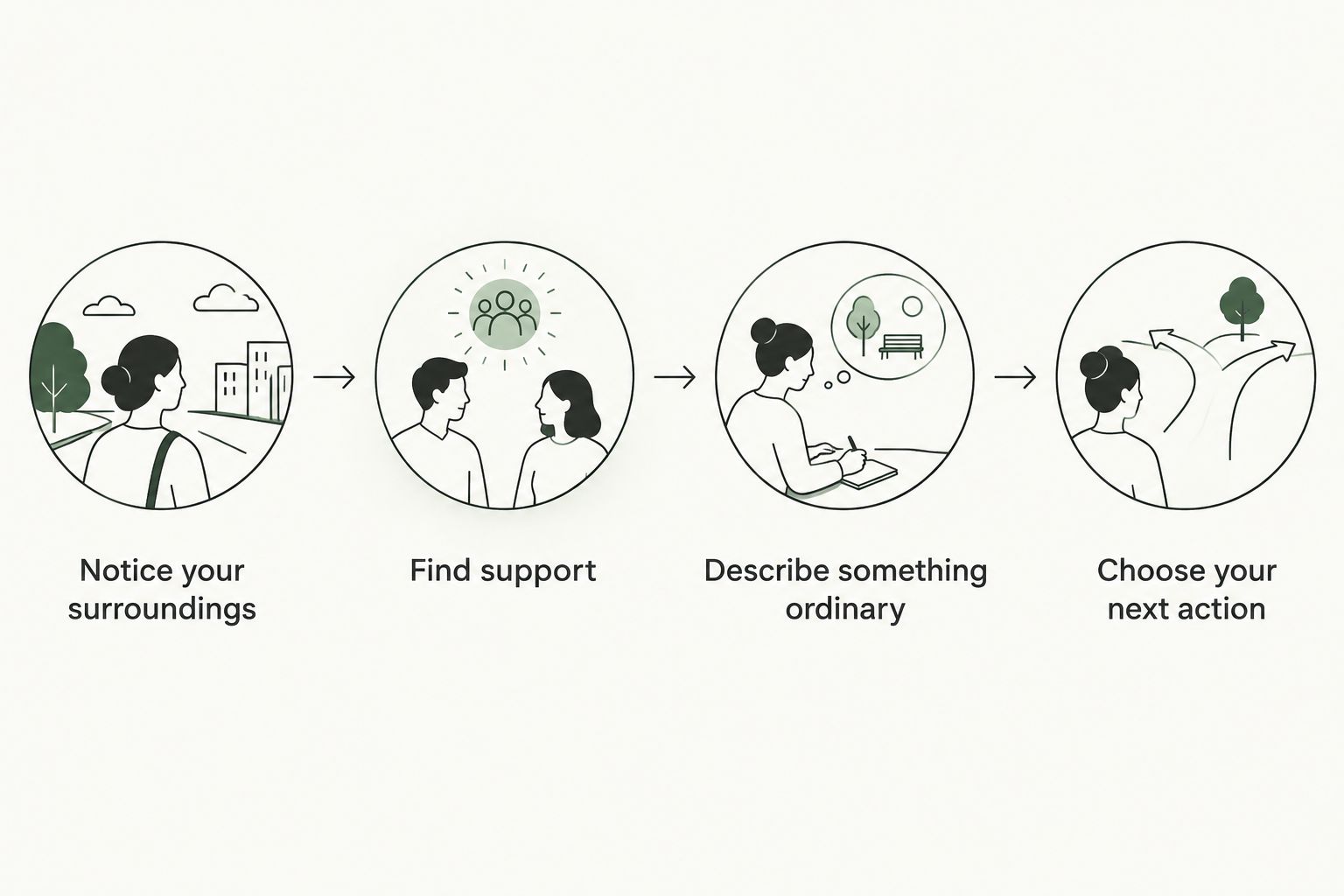
Use this short sequence:
- Notice your surroundings. Look around and identify where you are.
- Find support. Notice your hand resting on a table, your back against a chair, or another comfortable contact point.
- Describe something ordinary. Name a visible color, a nearby sound, or a texture you can comfortably notice.
- Choose your next action. Decide on something specific and manageable.
You do not have to feel different before continuing your day. If your next step involves weighing a choice, the guide to crystals, decision-making, and reflection keeps personal symbolism separate from the decision itself.
Why this matters
When you move from a tense message straight into a meeting, the unfinished conversation can follow you. A grounding ritual gives that transition a deliberate shape: pause, notice the present setting, and decide what belongs next.
For your 2026 routine, keep the aim modest. You are not trying to empty your mind, remove every uncomfortable feeling, or prove that you are spiritually balanced. You are practicing a way to interrupt the rush toward your next response.
The useful endpoint is a chosen action, not a required feeling. You can still feel frustrated and decide not to send the message yet. You can still feel uncertain and prepare the question you need to ask.
The grounding ritual, step by step
Notice your surroundings
Start by looking around rather than closing your eyes automatically. Silently name your location in plain language: your kitchen, your desk, the bus stop, or the room where you are waiting.
Then notice something that belongs to the present scene. It might be daylight on a wall or the sound of a fan. Stay with what you can actually observe rather than what you think the observation should mean.
Find support
Choose a comfortable contact point. Your palm on your thigh works; so does your back against a chair. If focusing on your body feels unpleasant, skip this step and keep your attention on a neutral object nearby.
There is no correct posture to earn. You do not need to press your feet into the floor, straighten your spine rigidly, or hold yourself still. Adjust your position when you need to.
Describe something ordinary
Use simple, concrete words: smooth, striped, quiet, warm-colored. You are describing, not interpreting. A curtain can simply be blue; it does not have to become a symbol.
Let your breathing stay natural. A grounding ritual does not require breath-holding or unusually deep breaths. If counting or monitoring your breath becomes another task to get right, leave it out.
Choose your next action
Finish with an action you can recognize when it is done. Put the phone face down, open the document, ask for a pause, or write the question you need answered.
Avoid making the ending depend on something you cannot command, such as feeling completely calm. The practice ends when you have chosen how to proceed, even if the feeling that brought you here is still present.
Which version fits your situation?
Choose the version that asks the least of you in the setting you are already in. These are different ways to direct attention, not a ranking of spiritual strength or therapeutic effectiveness.
| Version | Best for | What you do | Advantage | Limitation |
|---|---|---|---|---|
| Visual noticing | A public place or shared workspace | Describe a neutral object you can see | Requires no object to carry or special posture | A visually busy setting can make choosing an object harder |
| Contact-point noticing | A comfortable seated or supported position | Notice a hand, chair, or other comfortable contact point | Uses something already present | Body-focused attention does not suit everyone |
| Action-first pause | Preparing to reply or switch tasks | Name the next practical step before acting | Keeps the ritual tied to an actual decision | Does not resolve the underlying disagreement or workload |
Start with visual noticing if you do not want to focus on bodily sensations. Choose action-first when the main question is what to do next. You can leave out any version that feels awkward or unhelpful.
For a 2026 routine, write down the version you prefer in language you already use. A reminder such as “look around before replying” is enough; you do not need an elaborate script.
Why your grounding ritual varies
A useful ritual fits your circumstances rather than demanding that your circumstances fit the ritual. Adjust these parts without treating the changes as mistakes:
- Your surroundings: At home, you can choose a quiet corner; in public, use something already within view.
- Your comfortable position: Sitting, standing, and supported positions offer different contact points. Use the position that suits you.
- Your attention preference: Looking at an object is an alternative to noticing internal sensations.
- Your immediate task: Preparing for a conversation needs a different final action from starting a work task.
- Your relationship with symbolism: You can give the pause personal meaning, or keep it entirely ordinary.
Do not add requirements just because a routine feels too simple. A special location, object, or sequence is unnecessary when the original practice already fits your day.
How do you use a grounding ritual before a difficult conversation?
Before a difficult conversation, notice your surroundings and decide what you want to communicate. Keep the goal within your control: asking a clear question, explaining a boundary, or listening without preparing an immediate rebuttal.
Try silently completing this sentence: “The point I want to make is…” Then remove the parts that predict the other person's intentions. You can describe what happened and what you need without claiming to know why they acted that way.
Grounding does not make an unsafe conversation safe or require you to remain in one. If you need distance, outside support, or a different setting, make that practical choice rather than extending the ritual.
Can you do a grounding ritual at work without anyone noticing?
You can do a grounding ritual at work by looking at an ordinary object, noticing your chair, and choosing your next task. No visible gesture, spoken phrase, or jewelry is necessary.
Before opening another tab, name the task you are actually returning to. Before answering a difficult message, decide whether you need to respond now or first check a fact. These are ordinary work decisions, not tests of how well you can meditate.
Keep safety ahead of the practice. Do not perform an attention exercise that distracts you while driving, operating equipment, or doing another task that needs your full attention.
Does a grounding ritual need spiritual meaning?
A grounding ritual can be entirely secular, personally symbolic, or part of a practice you already follow. The sequence above is an everyday attention exercise; it is not presented as a Taoist ceremony, Buddhist practice, or chakra ritual.
If spiritual meaning matters to you, name that meaning honestly. You might treat the pause as a moment to remember patience or act with care. That intention does not establish that an object changes your energy, protects you, or controls an outcome.
Respect distinctions between traditions. Taoist blessings, Buddhist prayer beads, feng shui, and chakra practices are not interchangeable names for the same thing. You do not need to borrow a religious label to make a personal pause meaningful.
If you already own a meaningful object
Use something you already have only if it makes the routine easier to remember. A familiar ring, a smooth object, or a bracelet can be a personal reminder; the object is optional, and the noticing practice remains yours.
Eclipticjew crystal jewelry is best for shoppers who want a wearable symbol of personal intention, not a promised grounding effect. Eclipticjew offers natural-stone and crystal jewelry, but no piece is necessary for this ritual. Consider jewelry only if you also want to wear and care for it outside the practice.
The advantage of an object is its familiar presence. The limitation is that you can start treating it as a prerequisite. If forgetting it makes you feel unable to pause, return to the object-free sequence.
For anything you wear, check the individual materials, construction, and fit. Follow the natural-stone bracelet cleaning guide rather than assuming every stone, wood, metal, or cord tolerates the same care.

When to change the practice or stop
If an instruction feels uncomfortable, stop or change it. Keep your eyes open, look toward a neutral object, move to a more comfortable position, or return to an ordinary task. Completing the sequence is not more important than your comfort.
Do not repeat the ritual until you achieve a particular sensation. That turns a small pause into another demand. You can decide it does not suit you and choose a different way to organize your next action.
This 2026 guide is not medical advice or a substitute for professional care. If distress is persistent, worsening, or interfering with daily life, seek support from a qualified healthcare professional. Immediate danger calls for practical safety and emergency help, not a longer ritual.
FAQ
What's the simplest grounding ritual I can do right now?
Look around, notice a comfortable contact point, describe something ordinary, and choose your next action. Keep your breathing natural and skip any step that feels uncomfortable.
Do I need crystals for a grounding ritual?
You do not need crystals for a grounding ritual. An object you already own can serve as a personal reminder, but the practice requires no purchase or spiritual belief.
How long should a grounding ritual take?
A grounding ritual has no required duration. Finish after you have noticed your surroundings and chosen your next practical action rather than waiting for a particular feeling.
Can I do a grounding ritual with my shoes on?
You can do this grounding ritual with your shoes on. Bare feet and outdoor contact are not requirements for the everyday attention practice described here.
Is grounding the same as meditation?
This grounding ritual is a brief noticing sequence, not a requirement to follow a meditation tradition. You can use it before a task without sitting silently or trying to clear your mind.
What if focusing on my body makes me uncomfortable?
Skip body-focused attention and describe a neutral object you can see instead. Stop the exercise if it increases discomfort; completing the sequence is optional.
Can I use Eclipticjew jewelry for my grounding ritual in 2026?
You can use Eclipticjew jewelry as an optional personal reminder in 2026, but jewelry is not necessary for grounding. Choose for materials, fit, wear, and personal meaning, not a promised medical, protective, or spiritual result.
One last thing
The part to remember is the ending, not the object. Make your final instruction specific enough to follow: put down the phone, ask for clarification, or begin the task you selected.
Try the practice with empty hands first. If you later want a wearable reminder, choose a stone for its appearance and personal meaning, then measure your wrist before choosing a bracelet. There is no missing purchase standing between you and a deliberate pause.


