
A bodhi seed mala is not inherently more effective than a wood mala: choose the bead texture, construction and cultural meaning that suit your practice. Neither material guarantees spiritual results, and a meaningful name does not tell you whether the beads will move comfortably through your fingers.
- Bodhi seed mala vs wood mala is a choice about touch, construction and tradition—not guaranteed spiritual effectiveness.
- Choose textured seed beads for distinct tactile feedback; choose smoothly finished wood if you prefer less surface detail.
- EclipticJew mala shoppers should check material identity, bead count, cord construction and care before choosing.
- You can begin meditation without buying beads; a mala is an optional counting tool.
Is a bodhi seed mala more effective than a wood mala?
Neither material makes a practice more effective by itself. A mala helps you keep track of repetitions through touch. Its usefulness depends on whether you can handle it comfortably and whether its construction suits the way you count.
The comparison below is a starting point, not an identification test. Seed beads can be polished smooth, and wood beads can be carved or textured. Examine the actual piece rather than deciding from its category alone.
| Choice | Best for | Practical advantage | Limitation | What to verify |
|---|---|---|---|---|
| Bodhi seed mala | Readers who prefer seed texture and Buddhist associations | Grooves or contours can make individual beads easy to distinguish | Texture and shape vary; the name alone does not identify the plant | Botanical identity, surface finish and bead consistency |
| Smooth wood mala | Readers who prefer a relatively even surface | Smoothly finished beads offer an uncomplicated finger movement | Coatings, grain and wood species differ | Named wood, finish and drill-hole quality |
| Carved wood mala | Readers who value detailed imagery | Carving provides visible symbolism and pronounced texture | Raised details can interrupt a smooth counting rhythm | Comfortable edges and the meaning of the carving |
For closer material-selection questions, see the bodhi seed mala beads guide. Use it alongside the individual listing, not as a substitute for checking the piece.
Why the material choice matters
Imagine sitting down to practice and noticing a rough edge every time the same bead passes your thumb. That is a useful reason to choose differently. A claim that one material carries greater power is not a substitute for comfortable handling.
For a 2026 purchase, separate three questions: what the beads are, how the strand is made, and what the material means within your practice. A listing should not blend those into one promise.
You do not need a new mala to begin. Count on your fingers, practice without counting, or use beads you already own if they are suitable. Buy only when the object serves a clear purpose.
Bodhi seed malas: best for distinctive touch and Buddhist meaning
Bodhi is associated with awakening in Buddhist traditions. The historical association with the bodhi tree is meaningful, but commercial bead names need more explanation: beads sold under the bodhi label do not all come from one botanical species.
Choose a bodhi seed mala for its identified material and meaningful association—not because the word bodhi proves a particular origin or effect. Ask what plant the beads come from and whether they have been polished, dyed or otherwise treated.
Texture and daily handling
Look closely at the surface. Some seed beads have channels, pits or irregular contours; others are highly polished. Those details affect what your fingers encounter, not the spiritual strength of the strand.
If you like a clearly defined surface, textured beads are a sensible choice. If you dislike catching a fingertip on grooves, a smoother finish deserves priority. Neither preference makes your practice more or less sincere.
Strengths and limitations
- Strength: Distinct surface features offer an obvious tactile reference while counting.
- Strength: Buddhist associations can give the material personal significance.
- Limitation: A common trade name does not establish botanical identity.
- Limitation: Uneven shapes or pronounced grooves do not suit every hand.
Natural variation alone does not prove authenticity. Equally, uniform beads are not automatically artificial; cutting and polishing can create consistency. Request a clear material description rather than relying on appearance alone.
Wood malas: best for a chosen finish and feel
Wood is a broad category, not a single experience. Species, shaping, carving and surface treatment all influence how a finished bead looks and feels. A wood mala is not automatically smooth, fragrant or lightweight.
Choose a wood mala when its actual finish and construction suit your hands. If fragrance matters, ask whether the scent comes from the wood itself or an added treatment. Scent alone is not a reliable identification method.
Smooth versus carved surfaces
A smoothly finished bead offers fewer surface details to move over. A carved bead emphasizes texture and imagery. Decide whether you want the carving to be part of your tactile experience or primarily something you see.
A wrist bracelet with elaborate carvings is not necessarily designed for repeated counting. Check whether your fingers can separate and advance the beads without pulling the cord or gripping decorative elements.
Strengths and limitations
- Strength: Different finishes let you prioritize an even surface or visible detail.
- Strength: Named woods and carvings offer specific material and symbolic choices.
- Limitation: A dark color or noticeable scent does not establish the species.
- Limitation: Thick coatings or uncomfortable carving can change the handling experience.
EclipticJew mala and wood-jewelry shoppers should distinguish a wearable symbolic piece from a dedicated counting strand. A bracelet can be an optional reminder of an intention without performing the same task as a longer mala.
Construction matters more than the seed-versus-wood label
A bead's material cannot compensate for an uncomfortable strand. Inspect the cord, spacing, holes and finishing before deciding which category wins.
For your 2026 buying checklist, request close-up photographs that show the connection points rather than only the front of the beads. Product photography should help you understand how the object works in your hands.
Cord and bead movement
Check whether the strand uses elastic, a fixed cord or an adjustable closure. Elastic allows stretch, but that does not mean you should pull it while counting. A fixed strand still needs enough movement for you to advance the beads comfortably.
Knots between beads create separation. Unknotted construction gives a different rhythm and feel. Neither is universally better; choose the arrangement that lets you distinguish beads without forcing them apart.
Drill holes and finishing
Look for visible chips, sharp edges and roughness around the holes. These are contact points between the bead and cord. Ask for clarification when photographs hide them.
Also inspect the tassel attachment, closure and any metal components. Decorative elements should not become the part you repeatedly tug to move the strand.
Bead size and count
A traditional full mala commonly has 108 counting beads, with a separate guru bead. Shorter formats include 27 beads and 21 beads, but counting conventions and religious uses vary. Check the stated count rather than assuming every bracelet is a shortened version of the same practice.
If you are comparing an 8 mm bead with a 10 mm bead, treat those as handling dimensions, not measures of effectiveness. These are example sizes, not specifications for a particular product. Larger diameter changes how much space a bead occupies between your fingers.
Why bodhi seed and wood malas vary
The category name explains only part of the finished object. These factors account for practical differences worth checking:
- Plant identity: Different seeds and woods have different structures. Ask for a specific identification rather than a broad spiritual label.
- Surface finish: Polishing, coatings and carving change what your fingers touch.
- Bead dimensions: Diameter and shape affect your grip and the finished strand's proportions.
- Cord construction: Elastic, fixed cord, knots and closures change movement and handling.
- Added components: Spacers, charms and tassels introduce different contact points and care needs.
- Practice requirements: A teacher or community can specify a count or handling convention that a general shopping guide cannot replace.
When comparing listings in 2026, record these details side by side. If neither seller identifies the material clearly, there is no need to choose between them yet.
How do you choose a mala for your actual practice?
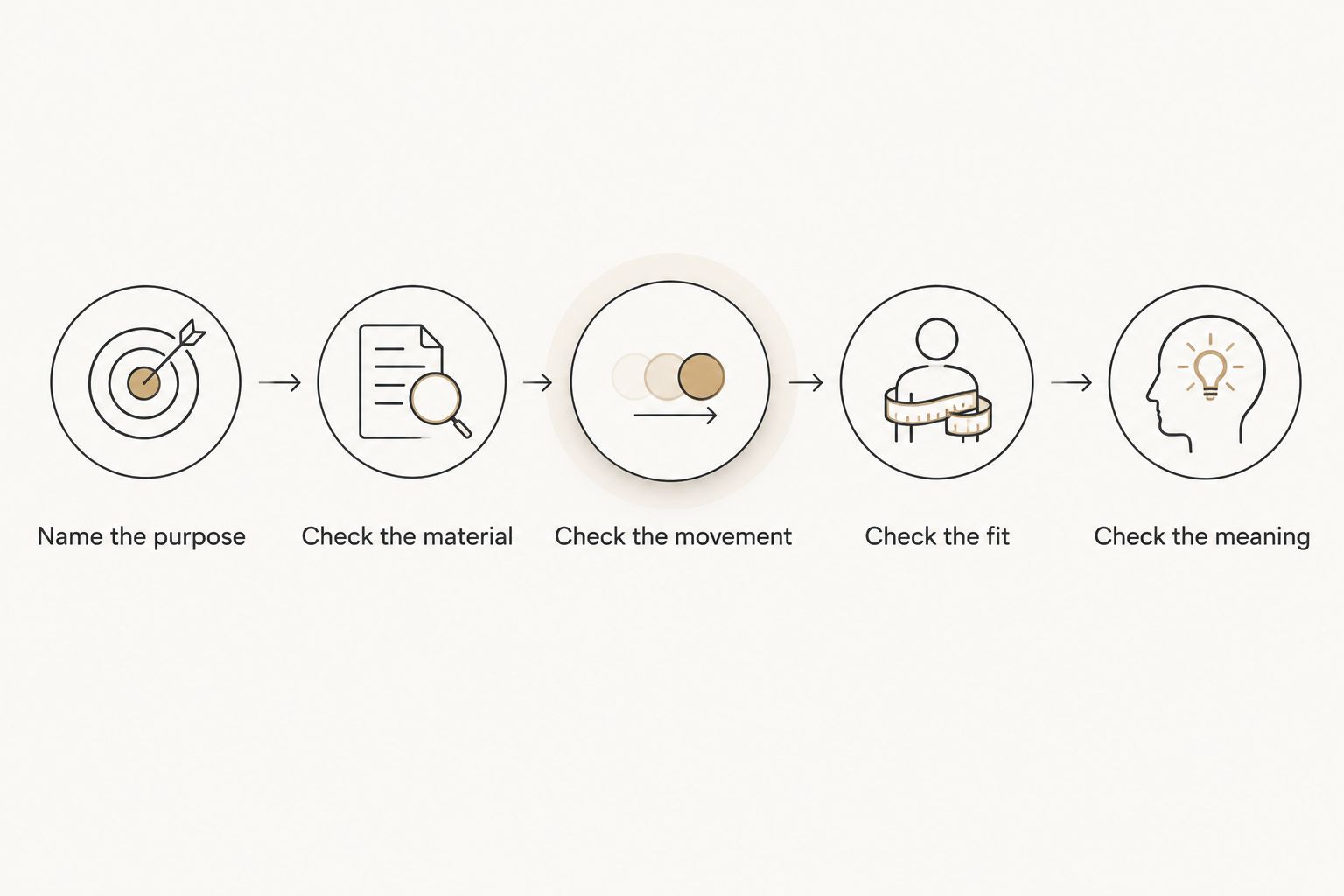
Start with what your hands will do. Then consider meaning. This order keeps a compelling material story from distracting you from an awkward strand.
- Name the purpose. Decide whether you want repetition counting, a wearable reminder or a gift. Those purposes do not require identical construction.
- Check the material. Look for the named seed or wood and any disclosed treatment. Ask questions before treating a trade name as identification.
- Check the movement. If you can handle the strand, advance several beads slowly. Notice whether you pinch, tug or lose your place.
- Check the fit. For wrist wear, measure your wrist and compare it with the listing's sizing instructions. Do not assume a counting strand will wrap comfortably.
- Check the meaning. Choose symbolism you understand and want to carry. You can also prefer a material simply because you enjoy its feel.
Keep the first trial simple. You can move through a few beads without setting a target or completing a full circuit. The question is whether the object supports the action you intended—not whether you can make yourself tolerate it.
Does a blessing change which mala you should choose?
A blessing has meaning within the tradition and relationship in which it is offered. It does not establish botanical identity, repair poor construction or guarantee a spiritual outcome.
Buddhist mala practice, Taoist blessing practices and chakra symbolism have distinct contexts. Do not treat them as interchangeable labels for the same service. If you follow a particular tradition, ask your teacher about the appropriate use of the beads.
For EclipticJew pieces, optional Taoist blessings apply only where the individual listing confirms them. Check the same listing for any blessing-video provision. Do not assume either service accompanies every mala or bracelet.
How should you care for seed and wood malas?
Follow the instructions for the identified material, finish and cord. Advice for one wood, seed or coating is not automatically suitable for another.
As a cautious routine, handle the beads with clean, dry hands and wipe away surface dust with a soft, dry cloth. Avoid soaking an unidentified strand or applying oils, fragrance and cleaning chemicals without specific care guidance.
Do not use salt water as a default cleansing method. A symbolic ritual does not need to involve moisture or abrasive substances. Quiet reflection offers a non-contact alternative when you want to mark a fresh intention.
Remove bracelets before sleeping, particularly elastic-cord pieces. Check cords and connection points regularly, and stop wearing or counting with a strand that shows damage until it has been assessed.
FAQ
Is a bodhi seed mala better than a wood mala for beginners?
Neither material is automatically better for beginners. Choose clearly identified beads that move comfortably through your fingers, and begin without buying anything if you prefer.
Do bodhi seed malas all come from the bodhi tree?
No, the commercial bodhi label does not identify one botanical species. Ask the seller for the plant identity rather than assuming the beads come from the tree associated with the Buddha's awakening.
Should I choose 108 beads or a shorter mala?
A 108-bead mala suits practices that use that counting format; shorter strands offer a different format. Follow your teacher's guidance when practicing within a tradition, and check whether the stated count excludes a guru bead.
Is a smooth mala better than a textured mala?
A smooth mala is better for you only if you prefer its handling. Textured beads provide more surface detail, while pronounced grooves or carving can feel distracting to some hands.
Can I wear a wood mala bracelet while sleeping?
Remove a wood mala bracelet before sleeping, especially if it uses elastic cord. Keep it nearby instead if you want it to serve as a personal reminder.
Does a blessed mala guarantee stronger spiritual results?
A blessed mala does not guarantee spiritual results. A blessing belongs to a particular religious or cultural practice and does not replace material verification or comfortable construction.
What should I check before buying a mala online in 2026?
Check material identity, bead count, dimensions, cord construction, close-up photographs and care instructions. Confirm any blessing service on the individual listing rather than assuming it applies throughout the store.
One last thing
The most useful detail is sometimes the one hidden in the main photograph: the space between the beads. Before choosing a mala in 2026, ask to see that space and the cord running through it.
Choose the strand you can handle comfortably, not the one with the strongest promise. If neither feels right, wait. Measure your wrist if you want a wearable piece, or name the seed or wood you want to understand better before choosing.


