


Yes, strawberry quartz is real: the name can describe natural quartz with reddish mineral inclusions, but jewelry sold under that name can also be treated quartz or imitation glass. When shopping in 2026, check the stated material and treatments separately; a pink color, sparkling interior or strawberry-themed name does not establish what a bead is made from.
- Is strawberry quartz real or dyed glass? Both occur under the trade name; request material and treatment disclosures.
- Natural strawberry quartz contains mineral inclusions; color alone cannot confirm authenticity.
- Glass is an acceptable jewelry material when disclosed, but it is not natural quartz.
- EclipticJew crystal jewelry belongs in a personal-symbolism routine, not a promise of healing or guaranteed outcomes.
Is strawberry quartz real or dyed glass?
Natural strawberry quartz exists, but the trade name alone does not authenticate a bracelet. It describes appearance rather than providing a laboratory identification. A seller needs to distinguish the base material from any treatment used to change its appearance.
For buying context, the strawberry quartz jewelry guide is a starting point. Keep the identification question separate from styling: a piece can look appealing without its material being established.
| Material described | What it means | Best for | Advantage | Limitation |
|---|---|---|---|---|
| Natural strawberry quartz | Quartz with reddish mineral inclusions | Shoppers seeking naturally included quartz | Internal features give each bead visual character | Photos alone cannot verify the material or absence of treatment |
| Dyed or otherwise treated quartz | Quartz whose appearance has been altered | Shoppers comfortable with disclosed treatment | Offers an intentionally modified appearance | Natural quartz does not automatically mean natural color |
| Glass imitation | Manufactured glass resembling strawberry quartz | Shoppers choosing decorative beads rather than a natural gemstone | Valid jewelry material when accurately labeled | It is not quartz, regardless of the trade name |
These are material categories, not grades of spiritual effectiveness. None establishes that a bracelet can improve health, attract a relationship or change your luck.
Why this matters before you buy
The useful question is not simply whether a bead is real. Ask whether it is natural quartz, treated quartz or glass, and whether the description makes that distinction clearly. Those answers tell you whether the piece matches what you intended to buy.
A 2026 listing that says only strawberry crystal leaves the material unresolved. Words such as authentic, premium and energy do not identify a mineral or disclose a treatment. Look for a plain material statement before reading the symbolic meaning.
You also need permission to choose glass. If you want a particular color and enjoy the design, clearly disclosed glass can fit that preference. Misrepresentation is the problem—not the existence of manufactured beads.
Natural strawberry quartz: inclusions, not a separate mineral species
Strawberry quartz is a descriptive trade name for included quartz, not a separate mineral species. Reddish iron-bearing mineral inclusions, including hematite, can contribute to its strawberry-like appearance. Do not assume every seller uses the name for precisely the same material.
An inclusion is something enclosed within the host stone. It can appear as a speck, flake or another internal feature. A photograph does not reliably establish which mineral an inclusion is, even when the seller names it confidently.
Quartz has a hardness of 7 on the Mohs scale and a typical density of about 2.65 g/cm³, established mineral properties published in gemological references, including GIA material on quartz. Those properties describe quartz itself; they do not prove that an untested pink bead is quartz.
Best for: buyers who specifically want naturally included quartz. Its appeal is the material and internal pattern. Its limitation is that natural-looking irregularity is not an authentication certificate, and a mineral name in a caption is not a test result.
Dyed quartz: a natural base with altered color
A bead can be genuine quartz and still have an artificially altered color. That distinction matters because the statement natural stone can describe the base material without answering whether its color is untreated.
Color concentrated around surface-reaching fractures or drill holes is a reason to ask about dye. It is not a diagnosis by itself. Lighting, reflections and the structure of the bead can complicate what you see.
Request the treatment disclosure in writing. Ask whether the color comes from natural inclusions, added dye, a coating or another treatment. A response that repeats natural crystal without addressing treatment leaves your question unanswered.
Best for: buyers who accept disclosed color treatment. Treated quartz is not automatically unsuitable jewelry. The drawback is incomplete labeling, especially when you are buying specifically for natural color or planning to give the piece as an untreated gemstone.
Glass imitation: decorative jewelry, not quartz
Glass can imitate the color and sparkling appearance associated with strawberry quartz. Some glass contains decorative particles; other pieces rely mainly on color. Neither appearance turns glass into a mineral specimen.
Rounded bubbles or flow-like patterns can raise questions about glass, particularly when several features occur together. However, natural stones can contain fluid inclusions, and glass does not always display obvious bubbles. One round feature in a photograph is not enough to declare a bead fake.
Best for: shoppers who want decorative beads and do not require natural quartz. Glass has a legitimate place in jewelry when labeled honestly. Its limitation here is straightforward: it cannot satisfy a purchase specifically intended to be natural strawberry quartz.
Avoid treating glass as a moral failing. An accurately described glass bracelet is more transparent than a vaguely described stone bracelet whose material nobody will explain.
Why strawberry quartz appearance varies
Natural quartz, treatments and manufactured imitations do not share one reliable visual template. Use these factors to understand variation—not to create a photograph-only authenticity test:
- Inclusion distribution: Internal particles can be unevenly distributed through natural quartz.
- Transparency: Cloudiness and internal features affect how easily you can see through a bead.
- Bead thickness: The amount of material in your line of sight changes the apparent depth of color.
- Treatment: Dye or coatings can alter the appearance of an otherwise natural base material.
- Photography: Lighting, white balance and image editing change how pink or red a bracelet looks online.
Perfectly matching beads deserve questions, but matching appearance is not proof of glass. Sellers can sort natural beads for consistency. Equally, variation is not proof of natural origin because manufactured materials need not look identical.
Your 2026 buying checklist
Start with the description, then use photographs to decide what questions remain. You do not need to purchase a testing kit or damage a bracelet to make a more informed choice.
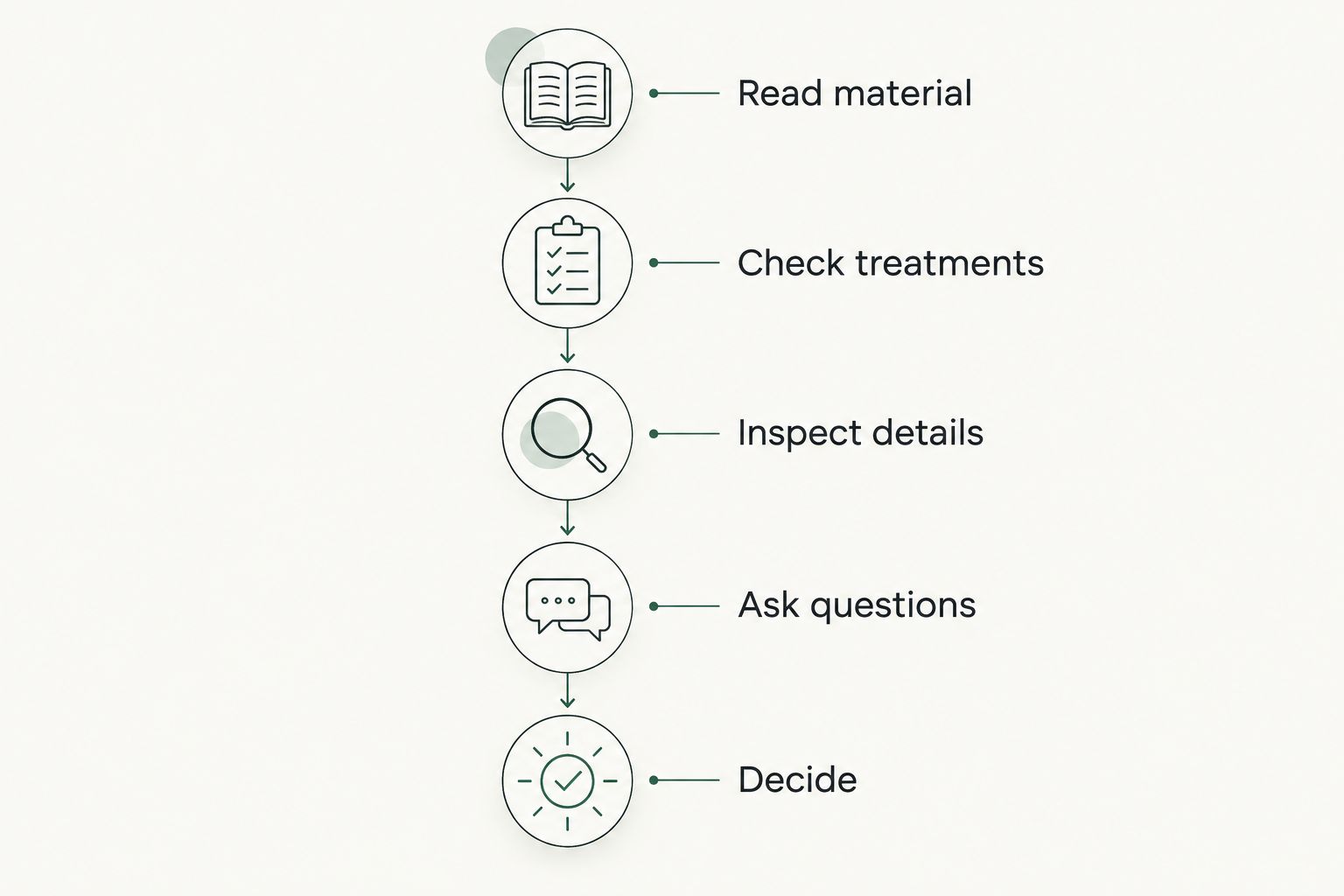
- Read material. Find an explicit statement naming quartz or glass. If the listing uses only strawberry crystal, ask for the base material.
- Check treatments. Ask whether the beads are dyed, coated or otherwise treated. Keep natural origin and natural color as separate questions.
- Inspect details. Request close-ups of several beads, including drill holes and internal features. Ask for ordinary lighting rather than relying entirely on promotional images.
- Ask questions. Request the basis for the identification. If a report is offered, check what item it describes and whether treatment information is included.
- Decide. Choose the piece only if the disclosed material matches your goal. If natural untreated quartz is essential and the answer remains unclear, skip the purchase.
The strongest next move is usually a precise question, not a more elaborate visual guess. Save the listing and the seller's response so you have a record of how the material was represented.
What should you ask the seller?
Ask: What is the base material, and has its color been altered? Then ask whether the identification comes from a supplier description or examination by a qualified gemologist. These are different levels of evidence.
If a laboratory report is supplied, make sure it refers to the item or sample being represented. A report for a loose stone does not automatically establish the identity of every bead in a bracelet. Read the scope rather than relying on the presence of a certificate.
A seller does not need an elaborate mystical explanation to answer a material question. Clear wording about quartz, glass and treatments is more useful than a story about the stone's supposed power.
What if the seller cannot confirm the material?
Treat the material as unconfirmed. You can still choose the bracelet for its appearance, but do not treat it as verified natural strawberry quartz or describe it that way when gifting it.
If natural origin matters more than the design, wait for a clearer listing or choose another piece. You lose nothing by declining a purchase that does not answer your central question.
Which home authenticity checks should you avoid?
Do not scratch a finished bead, hold it over a flame or apply solvents to look for dye. These actions can damage the polish, treatment, cord or other components. A damaged bracelet is not a reliable gemological report.
Quartz's Mohs hardness is not an invitation to drag it across a window. Scratch tests are difficult to interpret without controlled materials and technique, and coatings or surface contamination complicate the result. They also test a property rather than establishing the entire identity and treatment history.
A 10× jeweler's loupe can help you inspect drill holes and internal features, but it does not supply an automatic verdict. Use magnification to gather observations and ask better questions. Qualified gemologists combine observations with appropriate instruments rather than relying on one supposed trick.
Touch is similarly limited. A bead feeling cool against your skin does not establish whether it is quartz or glass. Temperature, bead size and how recently the piece was handled all affect the sensation.
Is strawberry quartz the same as rose quartz?
No. Strawberry quartz generally refers to quartz with visible reddish inclusions, while rose quartz is the established name for pink quartz that commonly has a more diffuse, cloudy appearance. Both belong to the quartz family, but the names are not interchangeable material descriptions.
Choose by the appearance you actually want, then confirm the listing. Soft pink color alone does not establish rose quartz, just as red speckles alone do not establish strawberry quartz.
Can a photo prove strawberry quartz is natural?
No. A photo helps you examine color, bead matching and visible internal features, but it cannot reliably establish mineral identity or rule out treatment. Even detailed images have limits.
Use photographs alongside material disclosures. When a definite identification matters, an examination of the actual material is stronger evidence than an online visual comparison.
Does authentic strawberry quartz have stronger spiritual effects?
Authenticity identifies material; it does not establish spiritual effectiveness. You can associate a bracelet with affection, reflection or a personal intention without claiming that the stone produces an outcome.
EclipticJew crystal jewelry suits shoppers choosing stones for everyday wear and personal symbolism, not promised outcomes. That distinction also leaves room not to buy: a written intention or an existing object can serve as your reminder.
FAQ
Is strawberry quartz real or dyed glass?
Natural strawberry quartz exists, but jewelry sold under that trade name can also be treated quartz or glass imitation. Ask for the base material and treatment disclosure separately.
How can I tell whether strawberry quartz beads are natural in 2026?
Start with a clear quartz identification and a separate statement about treatments. Photos and home checks cannot reliably confirm both natural origin and untreated color; qualified gemological examination provides stronger evidence.
Does a bubble mean my strawberry quartz bracelet is fake?
A bubble-like feature alone does not prove that a bracelet is glass. Glass can contain bubbles, while natural stones can contain fluid inclusions, so the feature needs interpretation in context.
Can strawberry quartz be real quartz and still be dyed?
Yes, quartz can be natural while its color has been altered. A natural-stone claim therefore does not replace a treatment disclosure.
Should I scratch strawberry quartz to test it?
No, do not scratch a finished bracelet to test its identity. Quartz has a hardness of 7 on the Mohs scale, but a home scratch test can damage jewelry and does not establish its complete material or treatment history.
Does every EclipticJew bracelet use the same material or blessing service?
No, materials and optional blessing services must be checked for each EclipticJew listing. A blessing describes a religious or cultural practice, not proof of gemstone identity or guaranteed effects.
Is disclosed glass jewelry a bad choice?
No, disclosed glass is a valid choice when you want decorative jewelry rather than natural quartz. Choose it for its appearance, with a clear understanding of the material.
One last thing
The most useful word in a 2026 strawberry quartz listing is not authentic. It is the actual material name, followed by an answer about treatments. Natural material and natural color are separate claims.
When choosing EclipticJew jewelry, start with the individual listing and measure your wrist before selecting a bracelet. Pick a stone or design you enjoy wearing, and let its symbolism remain a personal choice rather than a promise.


