


Choose jade for a green stone you plan to wear often; choose malachite if its bold banding matters more to you and you are comfortable with gentler care. In a jade vs malachite decision, the practical difference is durability: jadeite and nephrite jade are harder and notably tough, while malachite scratches more easily. Both can serve as reminders of an intention, but neither guarantees a spiritual or health outcome.
- Jade vs malachite: choose jade for frequent wear and malachite for distinctive green banding.
- Jadeite and nephrite are different minerals; ask which one a jade piece contains.
- EclipticJew is best for shoppers choosing crystal jewelry by intention, provided they check the stone and care details.
- Keep malachite away from abrasive cleaning and avoid soaking either stone without checking its treatment.
Why this matters
These stones can look similar in a small product photo, but they ask different things of the wearer. A bracelet meets desks, sleeves and other jewelry throughout the day. A pendant usually has less contact with hard surfaces. If you want a green stone for a particular setting, that difference matters more than a broad claim about its energy.
Color alone will not establish what you are buying, either. Jade is a name used for two different minerals, jadeite and nephrite; malachite is a separate copper mineral. If another green stone is also on your shortlist, the green aventurine vs jade bracelet guide gives you a more useful comparison than color-matching photos.
Jade vs malachite: which green stone should you choose?
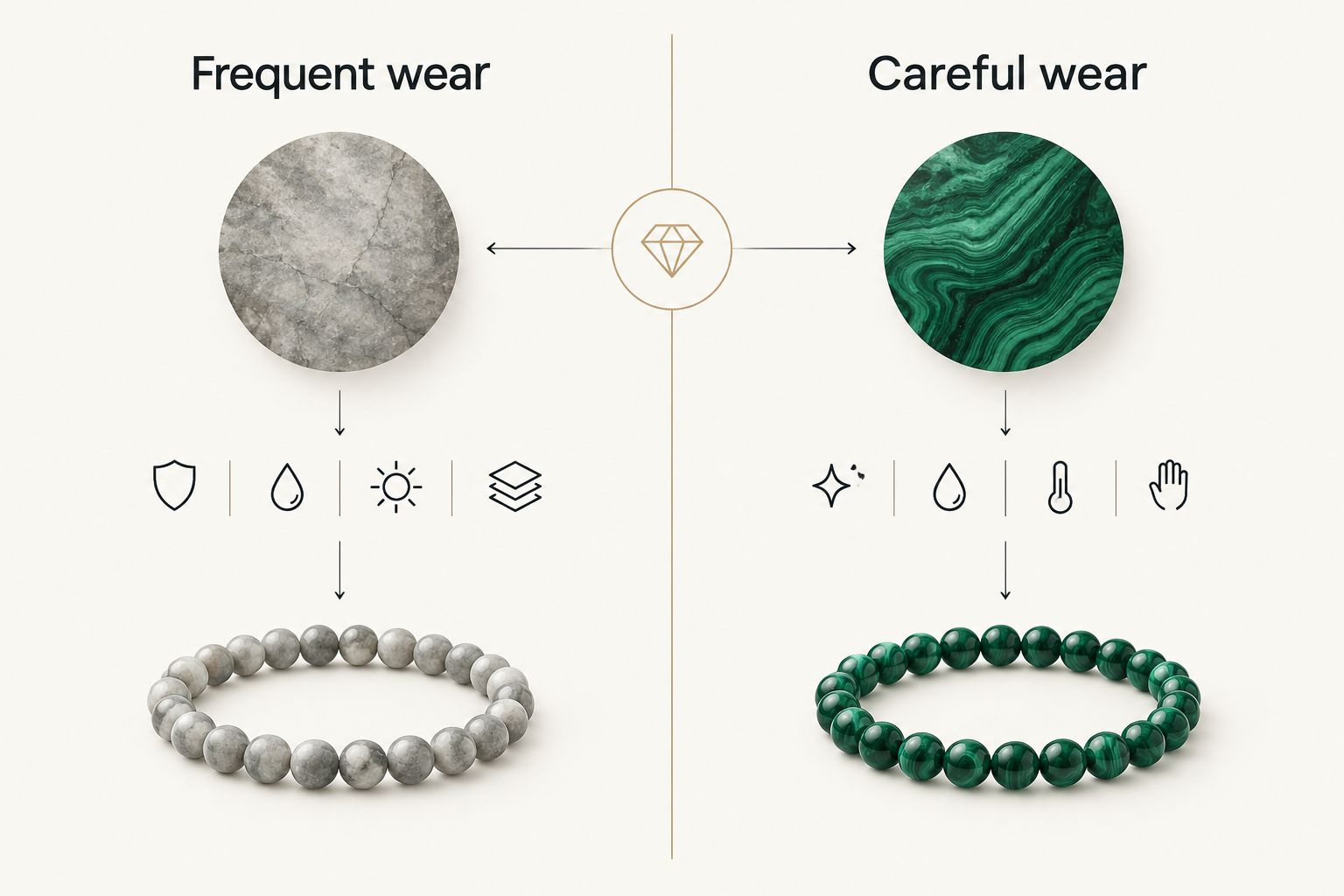
Choose jade for frequent wear, a smoother-looking green, and a stone with a strong association in Chinese cultural traditions. Choose malachite for visible green bands and a piece you can handle more carefully. Neither choice is inherently better for your intentions; decide first how you will wear it, then what its symbolism means to you in 2026.
| Decision point | Jade | Malachite |
|---|---|---|
| What the name means | Jadeite or nephrite; confirm which is offered | A distinct copper carbonate mineral |
| Typical appearance | Green and other colors, often with a more even-looking surface | Green tones with characteristic bands or swirls |
| Mohs hardness | Jadeite: 6.5–7; nephrite: 6–6.5 | 3.5–4 |
| Best for | A bracelet or pendant you expect to wear frequently | A visually expressive piece you can protect from abrasion |
| Main drawback | The word jade alone does not identify the mineral or its treatment | Its softer surface needs more care during wear and cleaning |
| Symbolic context | Jade holds a long-standing place in Chinese cultural traditions | Contemporary crystal practice often uses malachite as a reminder of change |
The Mohs scale describes scratch resistance, not immunity to breakage. The Gemological Institute of America’s jade and malachite references distinguish jadeite from nephrite and describe malachite’s lower hardness. A clasp, exposed bead edge or hard knock can still damage jewelry made with a harder stone.
What does jade mean on a jewelry listing?
A listing that says jade has not yet told you whether the stone is jadeite or nephrite. Both are recognized as jade, but they are different minerals. Ask which one is present if mineral identity is part of your decision. A listing that does not answer that question gives you less information than you need for a confident comparison.
Jade also deserves more cultural care than a generic promise of luck. It has a long history in Chinese art and material culture, with meanings shaped by context, form and use. A modern jade bracelet can be your everyday reminder of balance, but wearing one does not automatically make it a Taoist object or confer a particular outcome.
The practical advantage is wearability. Jade’s combination of hardness and toughness makes it the stronger choice here for a bracelet you intend to put on regularly. That does not mean every jade setting, cord or clasp will last equally well; inspect the entire piece, not just its stone.
What makes malachite different?
Malachite’s appeal is easy to see: its bands make the green pattern a central part of the design. If you want the stone itself to draw the eye, malachite offers a different look from the quieter, more even appearance many shoppers seek in jade. Each piece can show different banding, so review the specific item rather than assuming every malachite bead looks alike.
Its trade-off is care. At 3.5–4 on the Mohs scale, malachite is more vulnerable to scratching than either form of jade. Set it apart from harder jewelry when storing it, and avoid treating a malachite bracelet as something you can wear through every hands-on task.
Some contemporary crystal practitioners associate malachite with change or personal reflection. That is a symbolic practice, not a measurable effect of the mineral. If a visible pattern helps you pause and return to an intention, it can have a place in your ritual without needing a promise attached to it.
Why the right choice varies
Five details settle most jade vs malachite decisions:
- How often you wear it. Frequent bracelet wear favors jade; occasional wear gives you more room to choose malachite for its pattern.
- Where it sits. A bead bracelet meets more surfaces than a pendant worn against clothing. Consider the finished piece, not the loose stone alone.
- Which jade it contains. Jadeite and nephrite are both jade, but the name should be specific when identity matters to you.
- How much pattern you want. Malachite’s banding is a reason to choose it. Jade suits you better if you prefer a less prominent pattern.
- How you care for jewelry. If you store pieces together or clean them without checking the stone, malachite demands a change in habits.
Appearance and symbolism can break a tie, but neither cancels a practical constraint. The piece you enjoy wearing and can care for is the better choice. In 2026, ask the seller to clarify any material or treatment detail the listing leaves open rather than relying on a broad stone name.
How do you choose a piece you will actually wear?
Use the finished jewelry as your test. Stone names can start the search, but bead placement, setting and your daily routine decide whether a piece works for you.
- Name your intention. Choose a word you want the piece to remind you of, such as balance or clarity. Treat that word as your personal practice, not a claim about what the stone will do.
- Picture an ordinary day. If you wear bracelets while working with your hands, jade is the more forgiving stone in this comparison. If you remove jewelry for those tasks, malachite becomes easier to accommodate.
- Check the material description. For jade, look for jadeite or nephrite. For malachite, check that the listing identifies the stone clearly. Ask about treatment if that information matters to you.
- Look at the whole design. Notice whether beads or stone edges will rub against a watch, other bracelets or hard surfaces. A protected pendant and an exposed bead stack do not face the same wear.
- Plan the care before buying. Decide where the piece will rest when you take it off and how you will clean it. A simple habit is more useful than an elaborate ritual you will not follow.
For example, EclipticJew lists a Golden Citrine Pumpkin Glow Jade Crystal Bracelet and a Classic Green Malachite Elemental Balance Bracelet. The first is a jade-named option for someone drawn to that stone; the second is a malachite option for someone who wants green banding. Confirm the jade variety and any care details on the current listing before deciding. EclipticJew is best for shoppers choosing crystal jewelry by intention who are also willing to verify the exact materials. Its selection helps you explore that intention, but a product name alone cannot answer every mineral-identification question.


How should you care for jade or malachite jewelry?
Care starts with the stone’s surface and extends to everything holding it together. A gentle routine protects the finish and gives you a moment to inspect the piece. It does not need to be presented as an energetic necessity.
- Remove jewelry before abrasive work. Keep malachite especially clear of surfaces that can scratch it. Take either stone off before tasks likely to knock the piece against something hard.
- Store pieces separately. A soft pouch or separate compartment limits contact with other jewelry. This matters most for malachite because its surface is softer.
- Wipe gently after wear. Use a soft, dry cloth first. Avoid abrasive cleaners and do not soak a finished piece unless its seller confirms that the stone, setting and stringing can tolerate it.
- Check before using stronger cleaning methods. Treatments and jewelry components vary. If the stone’s treatment is unknown, ask the seller or a qualified jeweler before using chemical cleaners or ultrasonic equipment.
- Leave cutting and polishing to professionals. Do not grind, drill or polish malachite at home; mineral dust calls for appropriate professional controls.
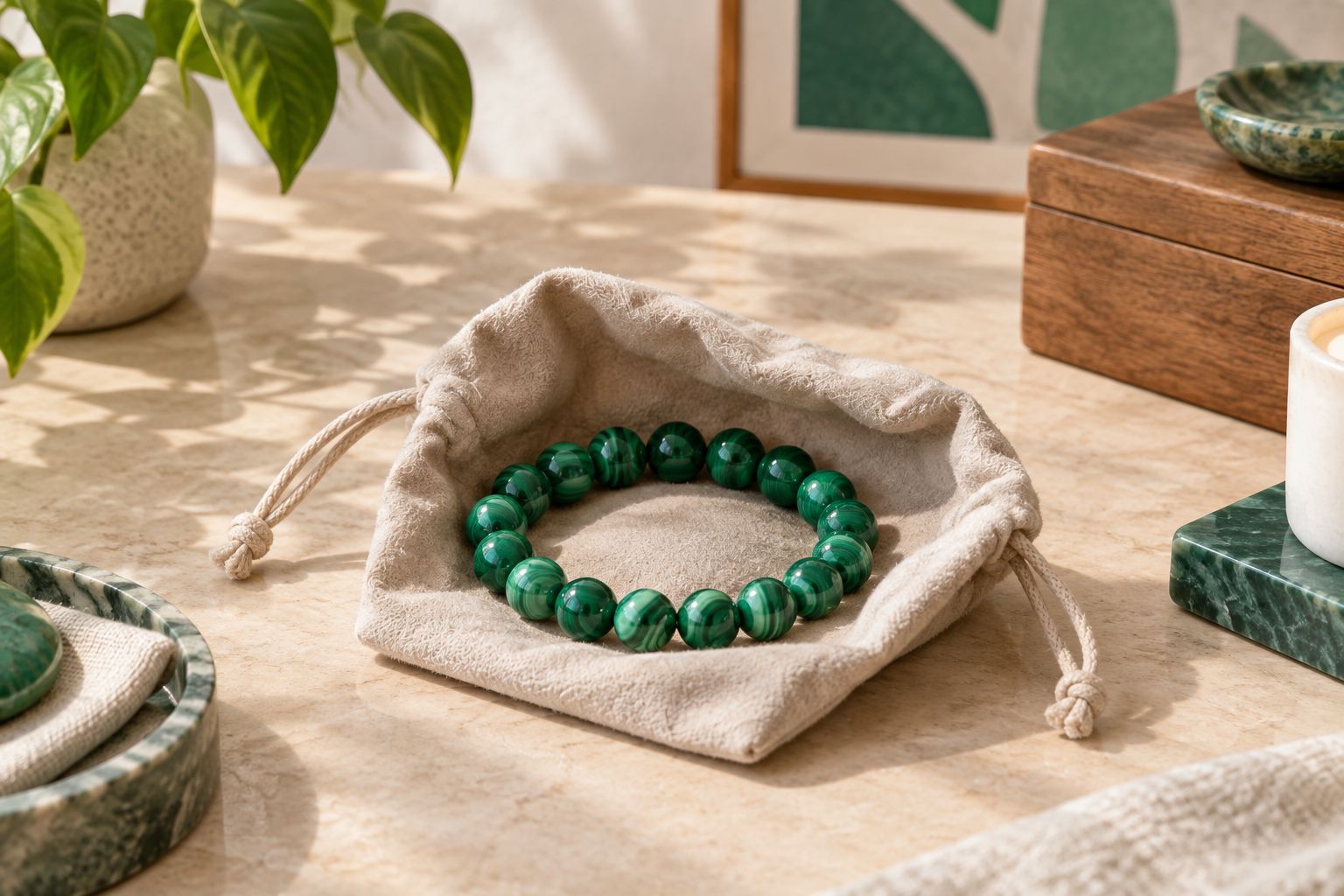
If cleansing is part of your spiritual practice, keep the physical-care decision separate from the symbolic one. You can set an intention while gently wiping and putting away a bracelet; the ritual does not require soaking a stone. In 2026, choose a method that respects the actual materials in your piece.
Is jade tougher than malachite for a bracelet?
Yes. Jadeite measures 6.5–7 Mohs and nephrite 6–6.5 Mohs, compared with 3.5–4 Mohs for malachite. Jade is the better choice for frequent bracelet wear, though the construction of the bracelet still affects how it holds up.
Can you wear jade and malachite together?
Yes, with care. Wearing them together does not create a proven energetic effect, and harder surfaces in a stack can rub against softer malachite. If you want both intentions in your 2026 routine, separate the pieces or choose placements that limit contact.
Is malachite a type of jade?
No. Malachite is a separate copper mineral; jade refers to jadeite or nephrite. Both can be green, but shared color does not make them the same stone. Ask for a clear material description when a listing uses only a visual term such as green stone.
FAQ
Which is better for everyday wear, jade or malachite?
Jade is the better choice for everyday wear because jadeite and nephrite resist scratching better than malachite. Check the setting and other jewelry components before choosing a daily piece.
How can I tell jade from malachite by looking?
Malachite commonly shows distinct green bands or swirls, while jade often has a more even-looking surface. Appearance alone cannot verify a stone, so check the seller’s material description.
Are jadeite and nephrite both real jade?
Yes. Jadeite and nephrite are two different minerals recognized as jade. Ask which one a piece contains if the listing says only jade.
Does malachite scratch more easily than jade?
Yes. Malachite measures 3.5–4 Mohs, compared with 6–6.5 Mohs for nephrite and 6.5–7 Mohs for jadeite. Store malachite apart from harder jewelry.
Can I soak a malachite bracelet to cleanse it?
Do not soak a finished malachite bracelet without checking its care instructions. A soft, dry cloth is a simpler first step, while a quiet intention-setting ritual needs no water.
Does jade bring luck or does malachite cause change?
Neither stone guarantees luck or change. Jade has cultural significance in Chinese traditions, while some contemporary crystal practitioners use malachite as a reminder of personal change.
Should I choose a jade or malachite pendant?
Choose jade if you prefer its appearance and cultural symbolism; choose malachite if its banding speaks to you and you will handle it gently. A pendant generally avoids some of the surface contact a bracelet experiences.
One last thing
The most useful question is not which green stone has the stronger meaning. It is which piece fits the way you live. Choose jade when regular wear leads your decision; choose malachite when its pattern matters enough to make gentler care part of your routine. EclipticJew offers both directions, and the next step is to compare the material details of the specific pieces that hold your attention in 2026.


