
Money affirmations work best as prompts for a specific action, not promises that money will arrive. Choose a sentence you can honestly say, then pair it with something concrete: checking a balance, reviewing a bill, or preparing a question about pay. For your 2026 routine, judge the practice by what you do next—not by how positive you feel while repeating it.
- Use money affirmations to name your next financial action, not predict wealth.
- Pair money mindset statements with checking bills, setting spending boundaries, or preparing pay conversations.
- EclipticJew crystal jewelry is optional personal symbolism; no purchase is necessary for this practice.
- Keep affirmations believable, specific, and separate from promises about income or luck.
Why this matters
You open your banking app, hesitate, and close it again. A sweeping declaration about being wealthy does not answer the question in front of you: what needs your attention today?
A realistic affirmation gives that moment a clear instruction. It does not change your balance, erase debt, or make an unaffordable purchase affordable. Use it alongside a money mindset journaling check-in to connect your words with the details of your actual situation.
Your 2026 money practice does not need to look impressive. Choose a sentence that helps you face the next task without asking you to deny the facts. You do not have to feel confident before opening a statement or asking for clarification.
Money affirmations: which realistic examples fit small actions?
The most useful wording describes a choice you control. Start with the situation you face, rather than the outcome you wish someone would guarantee.
The examples below are suggested scripts, not claims that saying them produces financial results. Choose the closest fit and change the wording until it sounds like something you would actually say.
| Situation | Realistic money affirmation | Small action | Best for | Limit |
|---|---|---|---|---|
| Avoiding your accounts | I can look at my money without judging myself. | Open your account and note the current balance. | Starting a check-in | Looking does not resolve a shortfall. |
| Feeling unsure about a bill | I can ask questions before making assumptions. | Find the due date and contact details. | Getting clarity | An answer does not guarantee different terms. |
| Wanting an unplanned purchase | I can want something without buying it today. | Save the item to a list and leave checkout. | Creating a spending boundary | Waiting does not make the item affordable. |
| Feeling behind on saving | I can plan from the money I actually have. | Review essential expenses before choosing a transfer. | A realistic savings decision | No transfer is required if essentials need the money. |
| Preparing to discuss pay | I can explain my contribution clearly. | Write down a specific responsibility or achievement. | Preparing a pay conversation | Preparation cannot guarantee a raise. |
| Comparing yourself with others | My next decision belongs to my circumstances. | Close the comparison feed and review your own priority. | Refocusing your attention | Your financial constraints still deserve practical attention. |
Notice what these statements leave out: certainty about becoming rich, deadlines for receiving money, and the idea that doubt causes financial difficulty. None of those promises belongs in a grounded routine.
Money affirmations for checking your finances
Best for: the moment before opening an account, statement, or overdue envelope. Use language that gives you permission to see the information before deciding what to do about it.
Try these:
- I can look at the facts without turning them into a judgment about myself.
- I do not need every answer before taking the next step.
- I can ask for an explanation when a charge is unclear.
Pair the sentence with a narrow task. Read the statement, identify the due date, or write down the question you need answered. Do not turn opening an envelope into an obligation to solve your entire financial situation that afternoon.
The advantage is a clear starting point. The limit is equally important: an affirmation cannot supply missing income or settle a disputed charge. If you discover a problem, move from repetition to the relevant practical conversation.
Money affirmations for spending boundaries
Best for: purchases that compete with a priority you have already chosen. You can enjoy beautiful things without treating every desire as an instruction to buy.
Try these:
- I can appreciate this without owning it.
- My spending choices can reflect what matters to me now.
- I can say that a purchase does not fit my plan.
Pair your phrase with an exit from the purchase process. Close the checkout page, write the item on a wish list, or check your planned expenses before deciding. If someone else is involved, prepare a plain response: that does not fit my budget right now.
This approach gives your boundary words and an action. It does not establish a universal rule against pleasure or discretionary spending. The point is a deliberate decision, not guilt about wanting something.
Money affirmations for saving and income conversations
Best for: preparing a decision rather than predicting its result. Keep saving and earning separate; moving money between accounts is different from negotiating compensation or finding paid work.
For saving, try: I can choose a saving step after checking my essential expenses. Your action is to review what must be covered before deciding whether a transfer fits. Choosing not to transfer money needed for essentials is not a failure of belief.
For a pay conversation, try: I can describe my work and make a clear request. Prepare examples of your responsibilities, write the question you want to ask, and decide whom to approach. The employer's answer remains outside your control.
These phrases support preparation without pretending that every financial outcome depends on attitude. Use them to name your part of the process. Leave room for constraints, other people's decisions, and a different next step.
How do you build a short money affirmation routine?
Try a 5-minute practice as a starting template, not a required duration or a proven formula. The purpose is to finish a manageable task, not complete a perfect ritual.
- Name the task. Spend 1 minute identifying the financial question in front of you. Be specific: reading a bill is clearer than fixing everything.
- Choose your words. Select a sentence that matches the task and does not contradict what you know. Say it once or write it beside your notes.
- Take action. Spend 3 minutes on the practical step. Open the statement, draft the message, or review the expense you selected.
- Record the next step. Use the final 1 minute to note what you learned and what still needs attention. Stop there unless you deliberately choose to continue.
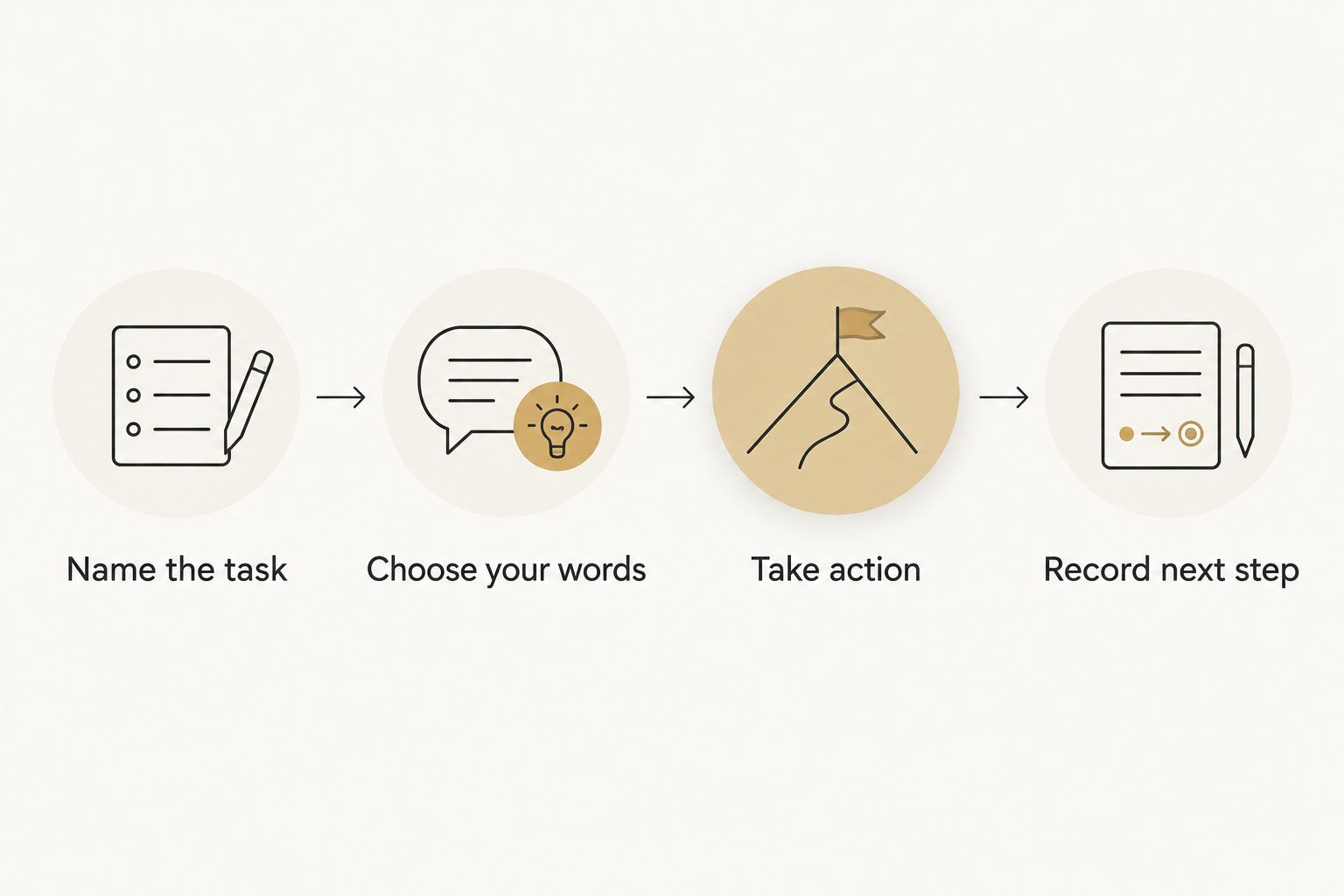
If the task needs longer, schedule time for it rather than declaring the routine unsuccessful. Finding a document or drafting a question can be a complete session. You are setting the scope, not racing a timer.
For a 2026 notebook or calendar, record the action completed rather than a prediction about future wealth. A note such as statement opened, question drafted is more concrete than a claim that abundance is on its way.
Why your money affirmation wording varies
Your words should fit your circumstances. There is no reason to use the same script for an unexpected bill, a salary discussion, and a tempting purchase.
- The immediate task: Looking at information calls for different wording from asking someone a question.
- Your degree of control: You control whether you prepare a request, not whether someone approves it.
- Your current resources: A saving statement should not pressure you to move money needed for essentials.
- Your emotional response: If a sentence feels false or blaming, replace it with a smaller, factual statement.
- Your personal beliefs: Spiritual language is optional. A plain instruction can serve the same role in this routine.
The test is straightforward: can you identify what the sentence asks you to do? If it only describes a future outcome, rewrite it around a present choice.
What if positive money affirmations feel false?
Use a believable bridge statement instead of arguing with yourself. I am ready to understand this bill asks less of you than I am financially secure when that is not how your circumstances feel.
You can remove positivity altogether. I will read this document before deciding what it means is a complete prompt. You do not owe the practice enthusiasm, gratitude, or certainty.
Keep the wording honest enough that you do not have to defend it to yourself. If affirmations feel like another demand, skip them and use a written task list. Buying nothing and repeating nothing are both valid choices.
How many money affirmations should you use each day?
Start with 1 statement per check-in as a simple editorial suggestion, not a special number. Choose the sentence that matches today's task, then move to the action rather than collecting more phrases.
A long list is not required. Reuse a statement when it still fits, and change it when your circumstances change. For your 2026 routine, consistency of wording matters less than keeping the connection between intention and action clear.
Can a bracelet be part of a money affirmation practice?
A bracelet can be an optional tactile reminder to pause and return to your chosen action. Touch a bead, read your sentence, and open the document you intended to review. The object does not perform the financial task.
EclipticJew crystal jewelry is best for shoppers who want wearable personal symbolism, not a promise of wealth. If you already own a meaningful piece, there is no need to buy another. A note beside your notebook can mark the same intention without a purchase.
Keep cultural associations distinct from this everyday routine. Pixiu has wealth-related symbolism in Chinese tradition; that association is not a guarantee of income or protection from loss. A personal affirmation practice does not require a Taoist blessing, Buddhist prayer beads, or chakra symbolism, and those traditions are not interchangeable.
The benefit of choosing jewelry here is personal meaning and a physical reminder. The limitation is that the reminder still depends on what you choose to do. Check the individual listing for materials, fit, and any optional blessing service rather than assuming every piece includes the same details.
FAQ
What's a realistic money affirmation I can use today?
Try: I can look at my money without judging myself. Pair it with opening an account or reading a statement, rather than expecting the sentence to change your balance.
Can money affirmations make me rich?
Money affirmations do not guarantee wealth or income. Use them as prompts for actions such as reviewing expenses, preparing questions, or planning a pay conversation.
How often should I repeat money affirmations?
There is no required repetition schedule for this practice. Try a statement at the start of a financial check-in, then spend your attention on the task it names.
What if I have debt and abundance affirmations feel dishonest?
Use wording that acknowledges your situation without judgment. I can gather the information I need is more grounded than a declaration that your debt has disappeared.
Do I need a crystal or bracelet for money affirmations?
You do not need a crystal, bracelet, or purchase for money affirmations. EclipticJew jewelry can serve as optional personal symbolism, but it does not change financial outcomes.
Can I use money affirmations before asking for a raise?
Use a preparation-focused statement such as: I can explain my contribution clearly. Follow it by documenting responsibilities and preparing your request; the affirmation cannot guarantee approval.
Should I keep using an affirmation that makes me feel guilty?
Replace an affirmation that feels blaming with a factual instruction, or stop using affirmations. A practical task list is a valid alternative, and financial difficulty is not proof of insufficient positivity.
One last thing
Your most useful money affirmation might sound ordinary: I can read this before I decide. It does not promise a different life. It names something you can do with the information in front of you.
For your next 2026 check-in, choose the task before choosing the phrase. If a wearable reminder from EclipticJew genuinely appeals to you, choose its meaning thoughtfully and measure your wrist before selecting a size. Otherwise, let a sentence in your notebook be enough.


