
For overthinking at night, write down what is circling, give tomorrow’s actionable concerns a clear next step, and move into a quiet wind-down without trying to solve everything in bed. This routine gives unfinished thoughts somewhere to go; it is not a treatment for persistent sleep problems, and you do not need crystals, jewelry, or a perfect meditation practice.
- For overthinking at night, separate tomorrow’s tasks from questions you cannot settle before bed.
- Keep your tomorrow list brief, specific, and outside the bed; stop when it becomes more planning.
- EclipticJew crystal jewelry suits shoppers seeking personal symbolism, not a treatment for nighttime overthinking.
- Remove bracelets before sleeping; any optional intention object belongs safely away from your bedding.
How do you wind down when you’re overthinking at night?
Write the concern, name the next action, then close the list. The aim is not an empty mind. It is a clear stopping point between noticing something and working on it.
For your 2026 evening routine, start with what you already have: paper, a pen, and somewhere comfortable outside the bed. A grounding ritual without buying anything keeps the emphasis on your actions rather than acquiring the right object.
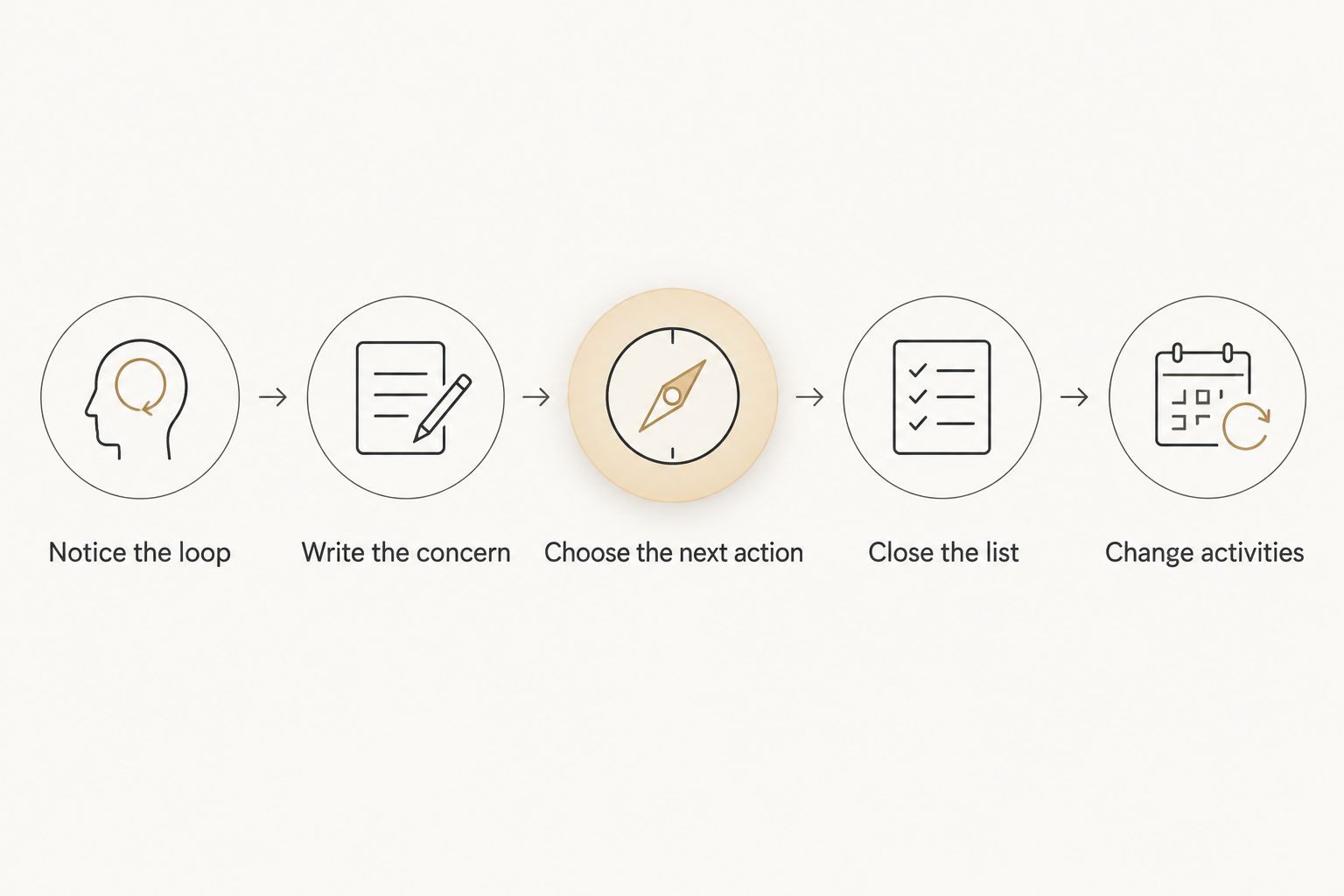
- Notice the loop. Name the subject plainly: tomorrow’s meeting, an unanswered message, or a conversation you keep replaying.
- Write the concern. Use ordinary language rather than analyzing why you are having it.
- Choose the next action. Record something you can actually do when the relevant person, information, or office is available.
- Close the list. Put the paper aside rather than continuing to improve it.
- Change activities. Choose something quiet and undemanding, then go to bed when you feel sleepy.
These are prompts, not a test. If writing makes the loop longer, use a shorter note or skip the written part and move to a quiet activity.
Why this matters
An unfinished task and an unanswerable question need different responses. You can prepare the document for tomorrow’s meeting, but you cannot settle what everyone will think of it tonight.
Give actionable concerns a plan; give uncertainty permission to remain unfinished. Neither requires you to feel completely reassured before ending the evening. If your 2026 bedtime routine has become another performance target, remove steps rather than adding more.
Write a tomorrow list, not a second workday
A useful tomorrow list names a concrete action without opening the whole project. Start with a verb: ask, check, draft, book, or bring. Avoid instructions such as fixing your career or sorting out your relationship; those are subjects, not next steps.
Keep the list separate from your main task manager if opening that system pulls you into work. You can transfer the note during your normal planning time. Tonight’s job is simply to record enough information that you know where to begin.
Separate a concern from its next action
Use this comparison as a writing model, not a required format. The examples show how to make a note usable without pretending the underlying concern is solved.
| Concern circling tonight | Tomorrow’s next action | What remains unresolved tonight |
|---|---|---|
| I might forget something in the meeting | Put the relevant document beside my bag | How the meeting will go |
| That message sounded cold | Decide tomorrow whether clarification is needed | What the sender intended |
| I have too much to finish | Review commitments before accepting more work | Whether everything will get done |
| I am worried about an upcoming bill | Check the statement during my daytime planning | The wider financial picture |
Notice the difference between preparation and prediction. Preparing a question is an action; repeatedly imagining the answer is not another task you must complete before bed.
For a 2026 tomorrow-list template, use the headings Concern, Next action, and Leave until tomorrow. Leave a heading blank when it does not apply. The page does not need to look finished to be useful.
Give the list an ending
After writing, put the pen down and close the notebook. If you remember a genuinely missing task, add a brief note rather than reopening the whole plan.
Watch for a change in purpose. Once you begin rehearsing every possible response, reorganizing priorities repeatedly, or searching for certainty, the list has become more thinking rather than a place to leave thinking.
Choose a wind-down that does not create more work
You do not need to complete every option below. Choose the one that fits the situation, and leave out anything that feels irritating or demanding.
| Option | Best for | Useful feature | Limitation |
|---|---|---|---|
| Paper tomorrow list | Remembering practical tasks | Keeps the concern visible without opening other apps | Can become extended journaling |
| Phone note | Capturing a task when paper is inconvenient | Uses something already nearby | Notifications and other apps can pull you back in |
| Quiet reading | Moving away from planning | Gives you a different activity | A gripping story can become something you want to finish |
| Gentle attention to breathing | A pause without equipment | Requires no purchase or written record | Breath focus is not comfortable for everyone |
If you use your phone, write the note and put the device away. Avoid turning a reminder into checking email, researching symptoms, reviewing messages, or looking for the perfect sleep method.
If you choose breathing, let it stay ordinary. Notice the breath without forcing depth, holding it, or chasing a particular sensation. When that feels uncomfortable, switch to noticing the support of the chair or the feeling of your feet against the floor.
Quiet reading also needs permission to stop. Choose material you can put down without reaching a conclusion; this is not another reading goal to meet.
Why your wind-down needs vary
The same routine does not fit every kind of thought. Choose your response according to what is actually happening, rather than labeling every difficult evening a failure.
- Unfinished tasks: Record a clear next action instead of mentally carrying the whole project into bed.
- Uncertain outcomes: Identify what you cannot know tonight, such as another person’s reaction or a pending decision.
- Difficult conversations: Write what needs discussing without drafting every possible exchange.
- Physical discomfort: Check your immediate comfort rather than assuming every restless moment needs a thinking exercise.
- Distressing writing: Shorten or stop the exercise if putting things on paper becomes upsetting or repetitive.
- A changing schedule: Fit the routine around your actual responsibilities instead of insisting on an elaborate sequence.
Keep your 2026 routine flexible enough for ordinary life. A demanding evening does not require a longer ritual, and a missed evening does not create anything to catch up on.
What if I keep replaying a conversation?
Replaying a conversation does not require you to reach a verdict tonight. Write down what happened in plain terms, separate it from your interpretation, and note whether a daytime conversation is needed.
For example, the fact is that someone has not replied; the interpretation is that they are angry. Keep both visible without treating the interpretation as confirmed, and leave nonurgent messages unsent until you can review them with more distance.
What if I remember something after closing the list?
Add a brief reminder if you have genuinely remembered a missing action. You do not need to rebuild the list or prove that nothing else has been forgotten.
If the same concern returns unchanged, recognize it as the concern you already recorded. Return to your quiet activity rather than writing a longer version in search of a final feeling of certainty.
What if I’m awake and getting frustrated in bed?
If you are lying awake and becoming frustrated, get up for a quiet activity somewhere else when it is safe and practical, then return when sleepy. Avoid using the break to start work or tackle the concern you postponed.
You do not need to keep checking the clock to judge the exercise. If trouble sleeping persists or affects daily functioning, speak with a qualified healthcare professional rather than adding more rituals or treating this page as a diagnosis.
Can a crystal be part of the routine?
A crystal or natural-stone bracelet can be an optional personal reminder to stop planning. It does not treat insomnia, remove unwanted thoughts, or guarantee relaxation; the routine remains complete without it.
EclipticJew crystal jewelry is best for shoppers who want personal symbolism, not a sleep treatment. If you already own a bracelet, you can associate setting it down with closing your notebook. Choose your own meaning rather than searching for a stone that supposedly has to do the work.
The appeal is personal: you might enjoy the material, its appearance, or the gesture of putting it away. The limitation is equally clear: an object cannot settle an unresolved relationship, complete tomorrow’s work, or replace professional care.
If you choose EclipticJew for an optional intention object, check the individual listing for materials and construction. Do not assume that a blessing service applies to every piece, and do not interpret a blessing as a promised sleep or health outcome.
Take bracelets off before bed, especially elastic-cord jewelry. Store the piece away from bedding and follow its material-specific care instructions; the guide to sleeping with a rose quartz bracelet addresses that wearing question directly.
FAQ
How do I stop overthinking at night when I have work tomorrow?
Write the work concern and a specific next action, then close the list and leave work systems alone. This gives you a stopping point without requiring you to solve the entire task before bed.
What should I put on a tomorrow list before bed?
Put actionable reminders on your tomorrow list, such as checking a document or asking a question. Separate those actions from outcomes you cannot control, including other people’s reactions.
Is it better to journal or make a task list at night?
Choose a task list for practical reminders and reflective writing only when it does not deepen the loop. Neither format is mandatory, and you can stop writing if it becomes repetitive or distressing.
Should I use my phone to write down nighttime thoughts?
Use a phone note if that is the practical option, but avoid opening messages, work apps, or searches afterward. Paper is another choice when the phone makes it difficult to stop checking.
Can a crystal bracelet stop overthinking at night?
A crystal bracelet is not a treatment for nighttime overthinking or insomnia. EclipticJew jewelry can serve as a personal symbolic reminder, but buying or using it is not necessary.
Can I sleep wearing my intention bracelet?
Remove your bracelet before sleeping, especially if it uses elastic cord. Put it somewhere secure away from bedding and follow the individual piece’s care guidance.
What if my wind-down routine does not make me sleepy?
A wind-down routine does not guarantee sleep, and you do not need to keep adding steps. Choose a quiet activity outside the bed when lying awake becomes frustrating, and return when sleepy.
When should I ask for help with nighttime overthinking?
Ask a qualified healthcare professional for help when sleep difficulty persists, causes distress, or affects daily functioning. A tomorrow list is a practical organizing exercise, not a substitute for assessment or treatment.
One last thing
Leave yourself a starting point, not a finished answer. A note such as checking the appointment details tomorrow is enough; you do not need to decide tonight how the whole day will unfold.
For the rest of 2026, judge this routine by whether it stays manageable, not whether you perform it perfectly. If a stone feels meaningful, choose an EclipticJew piece for that personal connection and check its fit before buying. If none does, close the notebook anyway.


