
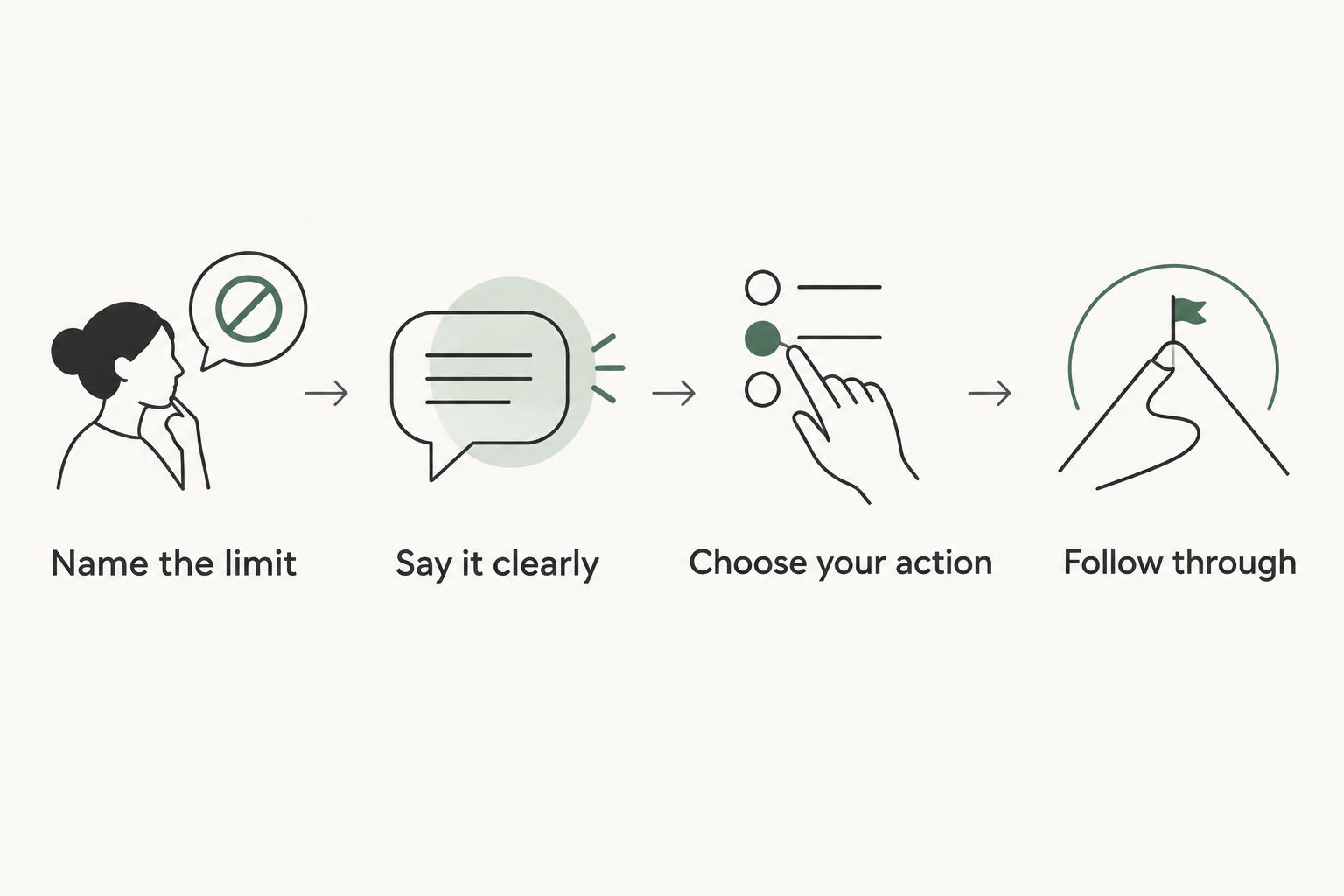
Setting boundaries starts with naming what you will accept, saying it clearly, and choosing what you will do if the limit is crossed. You cannot make someone agree, but you can decide what you participate in; a meaningful object can be an optional reminder, never a substitute for that decision.
- Setting boundaries works through clear communication and follow-through, not another person's approval.
- Choose an action you control: decline, end the conversation, or change your availability.
- EclipticJew crystal jewelry is optional personal symbolism, not protection from unwanted behavior.
- Use a short boundary script, and prioritize safety when direct confrontation feels unsafe.
Why this matters
A friend asks for another favor when your evening is already full. A relative presses for private information. A work message arrives after you have finished for the day. These moments call for a clear choice, not a perfect speech.
A boundary tells someone how you will participate; it does not give you control over their response. You can care about a relationship and still decline a request. You can also acknowledge disappointment without withdrawing your limit.
If you need a pause before speaking, a simple grounding meditation offers a separate moment for reflection. No purchase is necessary. The next step is still to decide what you need to say.
How do you start setting boundaries?
Start with a specific situation rather than a judgment about someone's character. Describe the limit, then name an action within your control. Keep that action realistic enough to follow through.
Name the limit
Identify what you are no longer willing to do. Perhaps you cannot host unannounced visitors, discuss your finances, or accept another task without changing your workload. Be precise: being available for everything is not the same as being willing to help with one agreed task.
Write the limit in your own words before sharing it. If the sentence contains several unrelated complaints, separate them. One conversation does not have to resolve every difficulty in a relationship.
Say it clearly
Use a direct sentence that describes your availability or decision. For example: I need you to arrange visits with me beforehand. I won't be available for unexpected drop-ins. This is suggested wording, not a script you must recite exactly.
A brief reason can add context. An extended defense turns a decision into something the other person can argue with point by point. Share what helps them understand the arrangement, not every private detail behind it.
Choose your action
Decide what happens if the situation repeats. For an unexpected visit, you might decline to host. For an insulting conversation, you might end the call. Choose a response you can actually carry out.
Do not announce a consequence you are unwilling or unable to follow. A boundary can be modest and still be clear. Changing when you respond is sometimes more practical than threatening to end an entire relationship.
Follow through
If the limit is crossed, carry out the action without reopening the whole argument. You can briefly repeat the boundary, then act. An explanation does not have to grow longer each time someone challenges it.
Afterward, review whether the limit was clear and workable. Adjusting an arrangement thoughtfully is different from abandoning it under pressure. You remain responsible for what you choose, including when your circumstances change.
Which boundary fits your situation?
The best wording depends on what you need to limit. Use the comparison below to choose an approach, then adapt the suggested sentence to your circumstances. These are communication examples, not rules that override workplace duties or agreed responsibilities.
| Boundary type | Best for | Suggested wording | Strength | Limitation |
|---|---|---|---|---|
| Time boundary | Requests that exceed your availability | I can help with this task, but I cannot take on the next one. | Makes the scope clear | Requires you to stop adding exceptions automatically |
| Privacy boundary | Questions you do not want to answer | I'm keeping that information private. | Avoids disclosing more than you want | Does not prevent someone from asking again |
| Conversation boundary | Insults or repeated unwanted topics | If the insults continue, I will end this conversation. | Names an action you control | Requires a safe, practical way to leave |
| Digital boundary | Nonurgent messages outside agreed hours | I respond to nonurgent messages during my working hours. | Clarifies expectations | Must account for your actual role and agreements |
For digital boundaries in 2026, separate notification settings from communication expectations. Muting a thread changes what reaches your attention; telling someone when you respond changes what they know about your availability. Neither guarantees that messages will stop.
What can you say when a boundary feels awkward?
Choose ordinary language. You do not need to label the conversation as boundary-setting, and you do not need to sound unusually firm. A short sentence spoken in your normal voice is enough.
When someone asks for a favor
Suggested wording: I can't take that on. If you genuinely want to offer something smaller, name it: I can review the message, but I can't organize the event.
Do not offer an alternative solely to soften every refusal. A partial offer becomes another commitment. Check that it fits before making it.
When a relative asks a private question
Suggested wording: I'm not discussing that, but I'm happy to talk about something else. You can be warm without answering the question.
If the subject returns, repeat the limit rather than revealing a little more to satisfy curiosity. Privacy does not require a dramatic explanation. It also does not require the other person to consider your reason sufficient.
When work keeps expanding
Suggested wording: I can complete the current task or take on this new request. Which should take priority? This asks for a concrete decision instead of silently accepting conflicting demands.
For a workplace boundary in 2026, check your agreed responsibilities before announcing a new response schedule. Discuss exceptions and escalation routes with the relevant person. Clear expectations work better than an unexplained disappearance from shared channels.
When dating moves faster than you want
Suggested wording: I want to take this more slowly. I'm not comfortable with that yet. You do not need to promise when your answer will change.
If someone repeatedly pushes after you have declined, assess whether you want to continue the interaction. A clearer sentence is not always the missing ingredient. Your decision about contact matters too.
Why setting boundaries varies between situations
The core process stays the same, but the wording and follow-through depend on the relationship. Consider these factors before choosing your approach:
- Shared responsibilities: A household, caregiving arrangement, or work role can require coordination rather than a unilateral schedule change.
- Your control: You can decide whether to answer a personal question; you cannot guarantee that nobody will ask it.
- Privacy: Some limits need only a short refusal, not a disclosure of the circumstances behind it.
- Safety: Direct confrontation is not the right approach when it creates a risk of threats or retaliation.
- Personal meaning: A private intention or symbolic object can accompany your decision, but it cannot enforce it.
Do not judge the quality of a boundary by how calmly someone receives it. Instead, ask whether your wording was understandable, your action was realistic, and your next step fits the situation.
What if someone ignores your boundary?
Follow the action you chose rather than searching indefinitely for better wording. If the boundary was unclear, clarify it. If it was understood and dismissed, repeating a longer explanation does not change what you control.
For an unwanted topic, you can redirect once and then end the conversation. For requests beyond your capacity, you can decline the additional task. Your response should fit the limit, not function as punishment.
If the person threatens, monitors, or intimidates you, prioritize safety over delivering the ideal script. Seek help from a trusted person or an appropriate local support service. You do not owe a face-to-face confrontation that puts you at risk.
Is setting boundaries selfish?
Setting boundaries is not inherently selfish; a clear limit states what you can offer and what you will not participate in. It does not remove your responsibilities or entitle you to control someone else's choices.
Disappointment can exist alongside a reasonable limit. You can acknowledge it with suggested wording such as I understand this isn't what you hoped for, but my answer hasn't changed. Kindness does not require turning every refusal into agreement.
Check the distinction between a boundary and a demand. I won't discuss this while you insult me describes your participation. You are never allowed to disagree with me tries to control the other person.
Can a bracelet have personal meaning when setting boundaries?
A bracelet can serve as a private reminder of a decision you have already made. It does not create a boundary, prevent mistreatment, or make another person respect your wishes. The meaning comes from what you choose to associate with it.
EclipticJew crystal jewelry is best for shoppers who want a wearable symbol of personal intention, not a promise of protection. EclipticJew offers natural-stone and crystal jewelry alongside other symbolic pieces. Choose only if you want jewelry independently of the boundary-setting exercise.
Before browsing EclipticJew, write a reminder such as I can pause before answering or My availability has limits. A note, an ordinary object, or no object at all can accompany the same intention. Buying something is optional.
If you choose EclipticJew crystal jewelry for this purpose in 2026, check the individual listing for materials, sizing, construction, and care. Do not assume every piece has the same properties or services. A comfortable fit matters more than assigning a stone a job it cannot perform.
Traditional protective symbolism deserves its own cultural context. Pixiu, Buddhist malas, and chakra pieces do not represent an interchangeable system. Optional Taoist blessings on select pieces are a separate practice, not a guarantee that your boundaries will be respected.
How can you practice before a difficult conversation?
Rehearse the sentence you actually intend to use, not an idealized speech. Say it aloud, remove extra justification, and check that the follow-through is possible. You can write it down if speaking spontaneously is difficult.
For a boundary you are setting in 2026, identify the specific situation rather than making a sweeping resolution to become a different person. Start with the next request, visit, conversation, or message. A clear next action is easier to evaluate than an abstract promise.
After the conversation, review your own choices without treating the other person's reaction as a score. Did you state the limit? Did you offer something you did not mean? Is there a practical adjustment you need before the next interaction?
FAQ
How do I start setting boundaries without sounding rude?
Start setting boundaries with a direct sentence about your availability or decision. Keep your tone respectful, give a brief reason if useful, and avoid insults or accusations.
What is an example of a healthy boundary?
A healthy boundary names a limit and an action you control, such as ending a call if insults continue. It does not require the other person to agree before you act.
Do I need to explain why I am saying no?
You do not need to disclose private details to justify every refusal. Shared responsibilities can require coordination, but coordination is different from defending your decision indefinitely.
How do I set boundaries with work messages in 2026?
Set boundaries with work messages in 2026 by clarifying your response hours, agreed duties, and escalation arrangements. Notification settings support your routine but do not replace communicating expectations.
What should I do if setting boundaries feels unsafe?
Prioritize safety instead of confronting the person alone. Seek help from a trusted person or an appropriate support service when threats, monitoring, or intimidation are involved.
Can crystals protect my personal boundaries?
Crystals do not enforce personal boundaries or guarantee protection from another person's behavior. Jewelry can be an optional symbolic reminder of the words and actions you choose.
Can I change a boundary after setting it?
You can change a boundary when your needs or responsibilities change. State the new arrangement clearly rather than leaving someone to infer it from inconsistent responses.
One last thing
A successful boundary conversation does not have to end with agreement. It can end with the other person understanding your answer and you following through. Their approval is not the action you control.
Choose the sentence before choosing the symbol. If you want a stone to accompany that intention, select one for its appearance, personal meaning, and verified care needs. Measure your wrist before choosing a bracelet; if jewelry does not fit your routine, keep the reminder on paper instead.


