


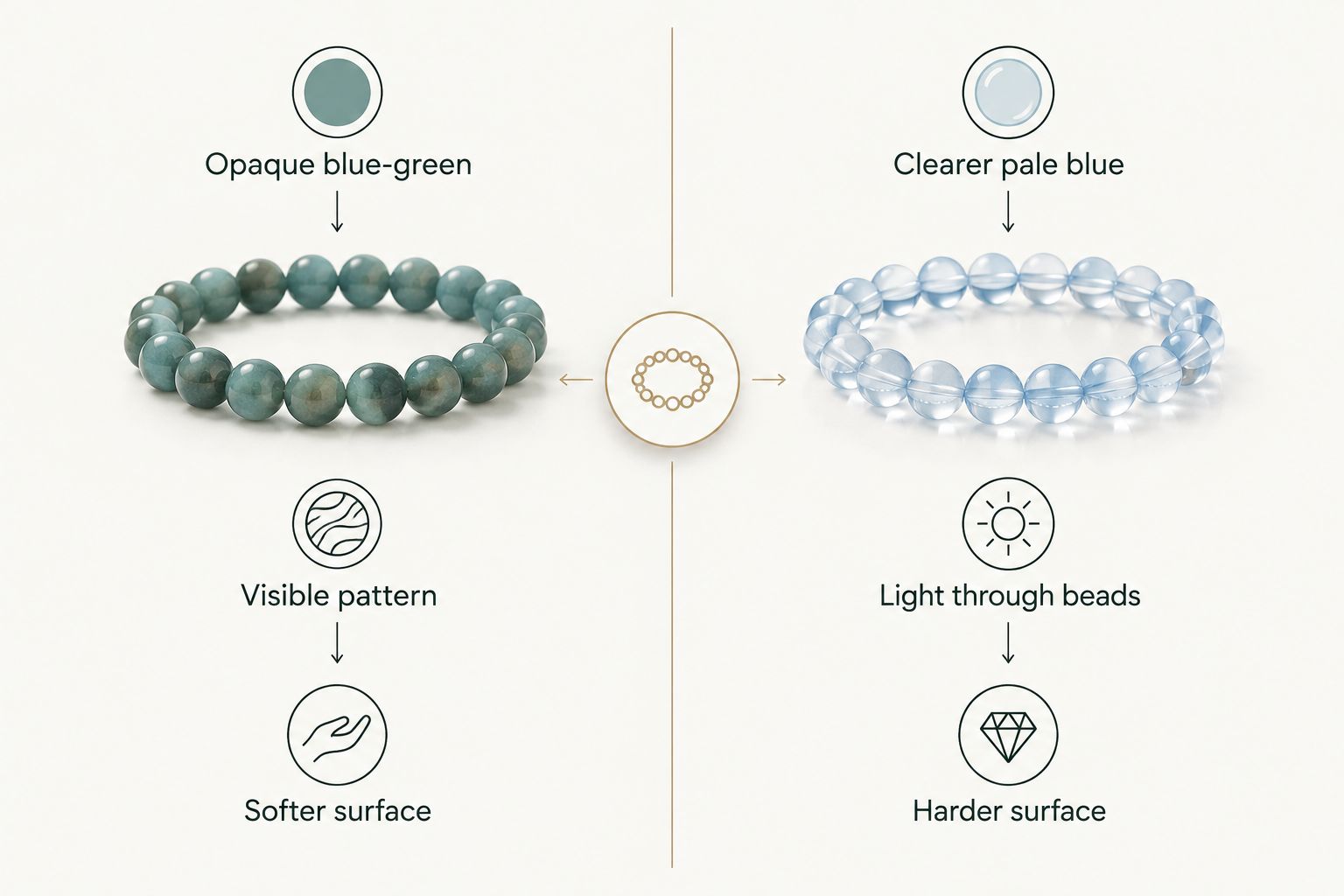
Choose amazonite if you want an opaque blue-green bracelet with visible patterning; choose aquamarine if you want a clearer, paler blue. Aquamarine is harder on the Mohs scale, but neither stone makes a bracelet immune to knocks, chemicals, or damage to its cord and findings. In 2026, color, construction, and the intention you want to remember are better deciding factors than a promise about what either crystal will do.
- Amazonite vs aquamarine: choose amazonite for opaque blue-green patterning and aquamarine for a clearer pale blue.
- Aquamarine measures 7.5–8 on the Mohs scale; amazonite, a microcline feldspar, measures 6–6.5.
- Eclipticjew aquamarine bracelets suit shoppers seeking pale blue; its amazonite option suits those drawn to blue-green color.
- Treat calm and clarity as personal intentions, not proven effects of wearing either stone.
Amazonite vs aquamarine: which blue bracelet should you choose?
The clearest difference is what you see on your wrist. Amazonite is generally opaque and blue-green, often with lighter streaks. Aquamarine ranges from pale blue to blue-green and is commonly transparent or translucent. If neither look settles the choice, compare the bracelet itself: bead finish, added stones, charms, and how the piece is strung.
If you are comparing blue stones beyond these two, the sodalite vs lapis lazuli jewelry guide covers another distinct choice. A stone's color name alone does not tell you how it will look once several beads sit together.
| What matters | Amazonite bracelet | Aquamarine bracelet |
|---|---|---|
| Best for | Someone who wants an opaque blue-green look with natural variation | Someone who wants a clearer, often paler blue look |
| Mineral family | Feldspar; amazonite is a variety of microcline | Beryl; aquamarine is a variety of beryl |
| Mohs hardness | 6–6.5 | 7.5–8 |
| Visual advantage | Patterning gives each bead more visible texture | Transparent or translucent beads can let light through |
| Trade-off | Less scratch-resistant than aquamarine | A pale bead can look subtle against some skin tones or neighboring stones |
| Intention | A personal reminder to pause before speaking or acting | A personal reminder to speak clearly and calmly |
Aquamarine wins on scratch resistance; amazonite wins if you prefer an opaque blue-green pattern. Those are different advantages, not a ranking of spiritual power. The Mohs figures describe resistance to scratching, not whether a finished bracelet will survive a drop or a pulled cord. The Gemological Institute of America identifies aquamarine as beryl with a Mohs hardness of 7.5–8; Mindat's microcline mineral reference gives the feldspar hardness range of 6–6.5.
Look at actual product photographs before choosing. Lighting, bead size, polish, and surrounding materials change the overall impression, even when two listings use the same color word. In 2026, a photograph of the whole bracelet tells you more about its everyday appearance than a stone name on its own.
Why this choice matters
A blue bracelet stays in view throughout your day, so its appearance and fit matter as much as its symbolic meaning. If you want a vivid, earthy blue-green, a nearly transparent pale-blue bead will not feel interchangeable. If you want a light, quiet accent, amazonite's opaque pattern may feel more prominent than you expected.
You can also choose a bracelet as a cue for a practice: take a breath when you notice it, or return to an intention you set that morning. That is a use you control. Neither mineral has a demonstrated ability to produce calm, improve communication, or treat a health condition simply because you wear it.
Choose amazonite for opaque blue-green color
Amazonite is the blue-green variety of microcline feldspar. Its opacity and pale streaking distinguish it from the glassier appearance many shoppers expect when they search for a blue gemstone. Beads vary, so judge a finished bracelet by its photographs rather than expecting every stone to show the same balance of blue, green, and white.
Best for: You want color and visible variation to do most of the work. Amazonite suits a bracelet that you notice as an object, not just a faint tint. Its advantage is character; its limitation is that, at 6–6.5 on the Mohs scale, it is more susceptible to scratches than aquamarine under comparable contact.
Some contemporary crystal practitioners associate amazonite with honest expression and emotional balance. Use that meaning as a personal prompt, not as a claim about the mineral's effects. For instance, let the bracelet remind you to listen before answering a difficult question. You can keep that ritual without treating the stone as a substitute for care or advice.
An amazonite bracelet is not necessarily made only of amazonite. Eclipticjew also lists a four-stone set combining amazonite with rhodochrosite, red jasper, and tiger eye. That mix gives you a different visual result from a single-stone blue-green bracelet. Check the full materials list if you want amazonite to remain the focus.
Choose aquamarine for a lighter, clearer blue
Aquamarine belongs to the beryl mineral family. Its blue to blue-green color and transparent-to-translucent appearance give it a different presence from opaque amazonite. Individual beads still vary in color and clarity; a bracelet made from small beads can look softer than a close-up photograph of one stone.
Best for: You want a pale-blue accent or a bead that lets some light through. Aquamarine's 7.5–8 Mohs hardness gives it greater resistance to scratching than amazonite. Its trade-off is visual: if you want bold, opaque blue-green, a lightly colored aquamarine bracelet may not deliver that look.
In contemporary crystal practice, people often use aquamarine as a reminder of calm or clear communication. That symbolism can guide a simple intention, such as pausing before a conversation. It does not establish a medical or guaranteed emotional effect. Choose the stone because you like both its appearance and the meaning you personally give it.
Compare the finished designs as well as the gem. Eclipticjew lists an aquamarine bracelet with natural aquamarine beads and a four-stone set that pairs aquamarine with rose quartz, amethyst, and clear quartz. Those are different choices: one keeps aquamarine central, while the other spreads attention across several stones. In 2026, read each listing's materials and examine its photographs rather than assuming every aquamarine bracelet has the same look.
Why your bracelet choice varies
Five practical details can change the answer even after you have chosen a favorite stone:
- Color and opacity. Amazonite's opaque blue-green usually reads differently from aquamarine's clearer, often paler blue. Compare whole-bracelet photographs, not isolated stone close-ups.
- Other stones. A mixed bracelet changes the overall color and the intention you might attach to it. The listed Eclipticjew sets pair aquamarine or amazonite with different companion stones.
- Bead size and design. Smaller beads create a different impression from a prominent charm or a layered stack. One listed aquamarine four-stone set uses 4 mm beads; do not assume that measurement applies to other pieces.
- Surface wear. Aquamarine's higher Mohs hardness favors it when scratch resistance is your priority. Hardness alone does not measure impact resistance or the strength of a bracelet's cord.
- Your intention. A bracelet can be a reminder to practice clarity or pause for calm. Pick a meaning you will actually use, without treating symbolism as a promised outcome.
If you cannot decide from a product photograph, write down what you would notice first: blue-green pattern or pale-blue light. Then look at the clasp or cord and the full list of materials. This keeps the choice tied to the item you will wear, rather than an idealized image of a loose gemstone.
Compare finished bracelets, not just stone names
A product name can tell you the featured stone but not whether it dominates the design. The options below show why that distinction matters: an amazonite charm bracelet, a bracelet described as having natural aquamarine beads, and a mixed aquamarine set answer different preferences.
| Eclipticjew option | Best for | Advantage | Consider before choosing |
|---|---|---|---|
| Serenity Amazonite Heart Bracelet | An amazonite-centered look with a charm | Keeps the blue-green stone in focus | Choose it for the pictured design, not a promised calming effect |
| Blue Aquamarine Blossom Bracelet | A blue bracelet featuring natural aquamarine beads | Gives aquamarine the central role | Check the photographs for the shade you want |
| Inner Peace Four-Stone Bracelet Set | A lighter mixed-stone look | Combines aquamarine with rose quartz, amethyst, and clear quartz | Aquamarine is only one part of the set |
Eclipticjew is best for shoppers who want to compare intention-led crystal bracelet designs, not for anyone expecting a stone to guarantee calm or healing. That distinction applies to every option here. The strongest reason to choose one is a combination of materials, appearance, and a ritual that has meaning to you.


How should you wear and care for either bracelet?
The stone is only one part of a wearable piece. Beads can rub against hard surfaces; cords, elastic, clasps, charms, and any adhesives have their own care needs. Use the seller's instructions for your particular bracelet when they are available, especially if it combines different materials.
- Put it on after products dry. Keep fragrance, lotion, and cleaning products away from the bracelet where practical. You do not need to soak a bracelet to make it part of a daily ritual.
- Take it off for rough work. Both stones can be damaged by impact, and a bracelet can catch or pull regardless of its gemstone's Mohs rating.
- Clean gently. Wipe accessible surfaces with a soft cloth. Check the care instructions before using water, particularly on mixed materials or a strung design.
- Store it separately. Give the bracelet a place where beads and metal components will not rub against other jewelry.
- Set an intention if you want one. Holding the bracelet and naming a purpose is a personal ritual. It does not physically cleanse the stone or guarantee a change in your circumstances.
In 2026, choose the care routine you can repeat. A short check for loose components before wearing is more useful than an elaborate ritual that overlooks the condition of the bracelet itself.
Is amazonite or aquamarine better for daily wear?
Aquamarine has the higher Mohs hardness: 7.5–8, compared with amazonite's 6–6.5. Choose it if resistance to scratching is your main stone-level concern. For either bracelet, inspect the finished construction and remove it before activities likely to snag or strike it.
Can you wear amazonite and aquamarine together?
Yes, you can wear amazonite and aquamarine together if you like the contrast between opaque blue-green and a clearer pale blue. Keep their differing hardness in mind when stacking bracelets: beads that continually rub against one another can show wear. There is no requirement to pair the stones for a ritual to count.
Does either crystal help with calm or communication?
Neither crystal has a proven effect on calm or communication from being worn. Some people use amazonite or aquamarine as a visible reminder to pause, breathe, or speak with care. That personal practice is distinct from a medical claim and does not belong to a single Taoist, feng shui, or chakra rule.
FAQ
What's the main difference between amazonite and aquamarine bracelets?
Amazonite bracelets generally show opaque blue-green patterning, while aquamarine bracelets often show a clearer, paler blue. The finished design and other materials also affect how each looks on your wrist.
Which is harder, amazonite or aquamarine?
Aquamarine is harder at 7.5–8 on the Mohs scale, versus 6–6.5 for amazonite's mineral, microcline. Hardness measures scratch resistance, not whether a bracelet's cord or clasp will hold.
Is amazonite better than aquamarine for a blue-green bracelet?
Amazonite is the clearer choice if you specifically want an opaque blue-green look with visible patterning. Choose aquamarine if you prefer a more transparent or translucent stone; check photographs for the exact shade.
Can I wear an aquamarine bracelet every day?
You can wear an aquamarine bracelet regularly if you care for the entire piece, including its cord and findings. Remove it for activities that could snag or strike it, and follow its specific care instructions.
Can I stack amazonite with aquamarine?
Yes, you can stack amazonite and aquamarine if you like their contrasting finishes. Avoid constant bead-on-bead rubbing, since aquamarine is harder than amazonite.
Does an amazonite or aquamarine bracelet have healing powers?
Neither bracelet has proven healing powers simply because you wear it. You can still use a stone as a personal reminder of an intention, without treating it as medical care or a guaranteed result.
Which Eclipticjew bracelet puts aquamarine at the center?
The Blue Aquamarine Blossom Bracelet is described as featuring natural aquamarine beads. The Inner Peace Four-Stone Bracelet Set includes aquamarine alongside three other named stones, so compare the designs before choosing.
One last thing
The higher-hardness stone is not automatically the better bracelet. In 2026, if amazonite is the color you will enjoy seeing each day, choose amazonite and care for it accordingly. If pale blue and greater scratch resistance matter more, choose aquamarine. Let the piece serve as an everyday companion to your intention, not a test of whether a crystal delivers a promised result.


