


Black obsidian is volcanic glass; onyx is a variety of banded chalcedony, although jewelry sold as black onyx is often dyed chalcedony. For jewelry in 2026, choose onyx if scratch resistance matters more, and black obsidian if you prefer a glassier surface. Neither stone’s traditional meaning guarantees protection or any other outcome.
- Black obsidian vs onyx: onyx is the better choice for scratch resistance; obsidian has a glassier look.
- Black obsidian is volcanic glass, while onyx belongs to the chalcedony family.
- Ask whether a black onyx bead is dyed chalcedony; appearance alone cannot confirm its identity.
- Choose a stone for its appearance and personal meaning, not a promised spiritual effect.
Why this matters
Two polished black bracelets can look much alike in a product photo while needing different care. Their names also carry different meanings: obsidian describes a volcanic glass, while onyx is used both as a gemstone name and, sometimes, as a broad retail label for black chalcedony. If you are comparing other dark stones, black tourmaline bracelets belong in a separate category too.
The useful question is not which black stone is universally better. It is whether you want the look of glass, the scratch resistance of chalcedony, or a symbol that fits your intention. In 2026, a clear material description matters more than a dramatic protection claim.
Black obsidian vs onyx: how do they differ in jewelry?
Onyx wins for everyday scratch resistance; black obsidian wins if its glassy appearance is the reason you want the piece. Both can work in jewelry, but the name on the listing should tell you what material you are getting. A polished black surface alone cannot settle that question.
| What to compare | Black obsidian | Onyx or black chalcedony |
|---|---|---|
| Material | Natural volcanic glass | Chalcedony, a microcrystalline form of quartz |
| Formation | Molten material cools rapidly without forming a typical crystal structure | Silica forms fine mineral layers over time |
| Typical polished look | Glassy, with a reflective surface | Often smooth and even-looking; finish varies |
| Scratch resistance | About 5–5.5 on the Mohs hardness scale | About 6.5–7 on the Mohs hardness scale |
| Common buying question | Is this natural obsidian or another black glass? | Is this natural banded onyx, dyed chalcedony, or another material? |
| Best for | Someone drawn to volcanic glass and willing to protect it from knocks | Someone who wants a black chalcedony piece with greater scratch resistance |
The Mohs scale ranks how well one mineral resists being scratched by another. It does not measure whether a bead will survive a fall. Obsidian’s glassy structure can chip, particularly at exposed edges; onyx’s higher hardness makes surface scratching less likely under comparable wear, but it does not make the jewelry unbreakable.
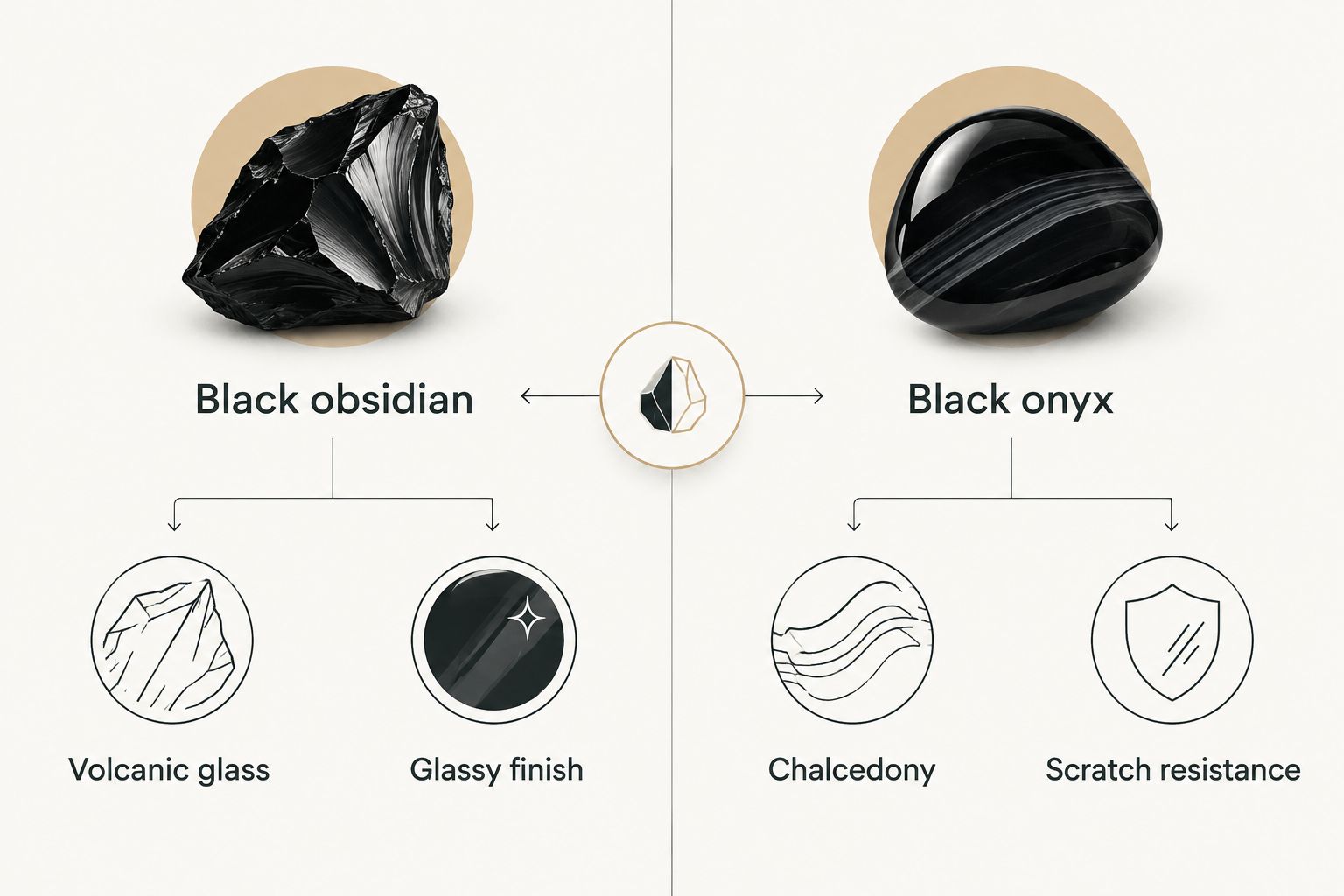
A listing can use “onyx” without explaining whether the black color is natural or the result of treatment. That does not automatically make the bead unsuitable. It does mean you should ask for an accurate material and treatment description before relying on the name.
Black obsidian: best for a glassy, reflective look
Obsidian forms when molten material cools rapidly enough to become glass rather than developing a conventional mineral crystal structure. Polishing brings out its smooth, reflective appearance. Some obsidian also shows visible sheen, but that effect is not a feature of every black obsidian bead.
Best for: You like the look and geological origin of volcanic glass, and you are comfortable giving the jewelry a little more protection during wear. A pendant can be a practical choice if bracelets regularly strike your desk, doorframes, or other hard surfaces.
- Pro: Its glassy surface gives black jewelry a distinct visual character.
- Pro: Its volcanic origin is a specific, understandable material story.
- Con: It scratches more readily than chalcedony on the Mohs scale.
- Con: Edges and beads still need protection from hard impacts.
People often choose obsidian as a symbolic reminder of grounding, boundaries, or protection. Those are personal and spiritual associations, not measured effects of wearing the material. You can value the ritual without treating the stone as a substitute for practical safety or care.
Onyx: best for greater scratch resistance
In gemology, onyx is a form of banded chalcedony. In jewelry listings, however, “black onyx” does not always mean that visible natural banding is present. Uniformly black pieces are often dyed chalcedony, so a seller’s material and treatment description is more useful than color alone.
Best for: You want a dark stone with more resistance to surface scratches than obsidian. Onyx still needs thoughtful handling: the stone’s hardness does not tell you how strong a bracelet cord, clasp, setting, or bead hole is.
- Pro: Chalcedony is harder than obsidian on the Mohs scale.
- Pro: Its polished, dark appearance suits someone seeking an even-looking bead or pendant.
- Con: The retail name can leave treatment and exact material unclear.
- Con: Harder does not mean safe from chips, drops, or damage to the jewelry’s other parts.
Black onyx is commonly given associations of steadiness and self-control in contemporary crystal practice. Treat those meanings as intentions you bring to the piece, not properties that a material test can establish. If a listing makes a stronger claim, separate the symbolic language from its verifiable description of the stone.
Why black obsidian and onyx jewelry differ
These are the factors that change the buying decision, even when two pieces appear equally black in a 2026 product photo:
- Material identity. Obsidian is glass; onyx is chalcedony. Ask for the material name rather than accepting “black stone.”
- Treatment disclosure. A black onyx listing should clarify whether the chalcedony has been dyed. Treatment is a material detail, not a reason to dismiss a piece automatically.
- Surface wear. Onyx’s higher Mohs hardness favors it when scratching is your main concern. Protect either material from contact with harder objects.
- Impact exposure. A bracelet can hit hard surfaces during daily tasks. Consider where and how you will wear it, not just how it looks in a photograph.
- Finish and shape. A polish changes how light moves across a stone. Rounded beads and exposed edges also present different places for wear or impact.
- Personal meaning. Choose symbolism that helps you remember an intention. Neither material can verify a promised spiritual result.
EclipticJew’s Midnight Obsidian Bracelet is best for someone who specifically wants obsidian jewelry, not onyx’s greater scratch resistance. Its description identifies black obsidian and silver obsidian; it is not an onyx comparison piece. That distinction is more useful than treating every dark bracelet as interchangeable.
How can you check which black stone you have?
Start with the seller’s material description. Photos, shine, and color offer clues, but they do not reliably identify a polished black bead on their own. A convincing label should say what the bead is and disclose relevant treatment; an unsupported protection claim does neither.
- Read the material name. Look for “obsidian,” “onyx,” or “chalcedony,” rather than a description limited to color or spiritual meaning.
- Ask about treatment. If the listing says black onyx, ask whether the stone is dyed chalcedony and whether the seller can describe any banding.
- Check the whole piece. Examine photos of edges, bead holes, settings, and stringing. The stone is only one part of jewelry you intend to wear.
- Avoid a home scratch test. It can permanently mark the bead and still leave you uncertain about its identity.
- Seek a qualified gemologist for a consequential purchase. A visual guess is not a substitute for identification when the exact material is central to your decision.
For an ordinary jewelry choice, a clear seller description is the practical starting point. If the exact material cannot be established, choose based on the appearance you like while keeping that uncertainty in mind. Do not pay for a claimed identity that the listing does not explain.
How should you wear and care for each stone?
A simple routine protects both materials. In 2026, the safest everyday habit is to reduce impacts and keep cleaning gentle, rather than following a cleansing ritual that exposes jewelry to water, heat, or chemicals without checking its other materials.
- Put jewelry on after getting ready. Keep cosmetics and household cleaning products away from the stone, cord, and metal components.
- Remove it for impact-heavy tasks. Take off a bracelet before work or exercise where it will repeatedly strike hard surfaces.
- Wipe it gently. Use a soft cloth for routine surface cleaning. Check the care instructions for the full piece before using water or any cleaner.
- Store pieces separately. This limits rubbing against other jewelry and makes it easier to spot a damaged bead, loose setting, or worn cord.
- Choose a dry symbolic ritual if you want one. Holding the piece and naming an intention does not require soaking it or leaving it in direct sunlight.
“Cleansing” has two different meanings here. Physical cleaning removes dirt; a spiritual cleansing ritual is a personal practice. Neither practice changes obsidian into onyx or confirms the material in a bead. Treat those questions separately.
Is black obsidian better than onyx for a bracelet?
Onyx is the better choice when scratch resistance is your priority; black obsidian is the better choice when its glassy appearance is the point. Bracelet durability also depends on parts beyond the stone. In 2026, check the bead description and the construction before choosing either.
If your wrist often brushes hard surfaces, think about how you will wear the piece. A careful wearer can choose obsidian; someone who wants to worry less about surface marks has a practical reason to prefer onyx. Neither choice needs a promised protective effect to be meaningful.
Can you tell black obsidian from black onyx by looking?
No: appearance alone cannot reliably distinguish polished black obsidian from black onyx or dyed chalcedony. Their finishes can overlap, and a photograph hides details. Ask what the seller means by “onyx” and how the material is identified instead of relying on a shine test.
Do black obsidian and onyx mean the same thing spiritually?
No fixed meaning applies to either stone. Contemporary crystal practices often associate obsidian with grounding and protection and onyx with steadiness, but meanings vary across people and practices. Neither association is proof that wearing a stone produces an outcome.
A black stone does not automatically make a piece Taoist, Buddhist, or part of feng shui practice. Those traditions have their own histories and contexts. If a symbol or ritual matters to you, learn about it on its own terms rather than assuming the stone carries a universal tradition.
FAQ
What is the main difference between black obsidian and onyx?
Black obsidian is volcanic glass; onyx is banded chalcedony. Jewelry labeled black onyx is also often dyed chalcedony, so check the seller’s material and treatment description.
Which scratches more easily, black obsidian or onyx?
Black obsidian scratches more easily than onyx under comparable conditions. Obsidian is about 5–5.5 on the Mohs scale, while chalcedony is about 6.5–7.
Is black onyx always naturally black?
No. Black onyx sold in jewelry is often dyed chalcedony; ask the seller whether the color has been treated rather than judging from a photograph.
Is obsidian a crystal?
Obsidian is natural volcanic glass, not a mineral crystal with a conventional crystalline structure. It is still commonly grouped with crystals in jewelry and spiritual retail categories.
Is onyx stronger than obsidian in jewelry?
Onyx has greater scratch resistance than obsidian, but hardness alone does not establish how a finished piece will withstand a drop. Settings, bead edges, and stringing also matter.
Can I identify black obsidian with a scratch test at home?
Do not use a home scratch test on jewelry you want to keep unmarked. Ask for a clear material description, or consult a qualified gemologist when exact identification matters.
Do black obsidian and onyx provide protection?
Neither stone has a proven protective effect from being worn. You can use either as a personal reminder of boundaries, calm, or another intention without treating symbolism as a guarantee.
One last thing
The most useful question to ask about black onyx jewelry in 2026 is not whether it looks dark enough. Ask what material the name describes and whether the color is treated. Once you have that answer, you can choose between onyx and obsidian for the reasons that actually matter to you: wear, appearance, and intention.
If you want to keep exploring, EclipticJew’s crystal jewelry guides can help you compare forms as well as stones. Choose a piece that feels right to wear, then care for the material it actually contains.


