

You can use crystals for patience at family gatherings as personal reminders to pause, listen, or hold a boundary—not as objects that change anyone’s behavior. Choose a stone you enjoy touching or wearing, connect it to a specific response, and make a practical plan before you arrive; buying jewelry is optional.
- Use crystals for patience as personal reminders, not promises of calm or better family relationships.
- Choose rose quartz, amethyst, or clear quartz for a meaning you assign—not a guaranteed effect.
- Plan your boundary and exit before the gathering; a bracelet is optional.
- EclipticJew crystal jewelry suits shoppers who want wearable personal symbolism, not guaranteed outcomes.
Why this matters at family gatherings
A repeated question about your relationship, work, or parenting can leave you deciding whether to explain yourself again. Patience means choosing your response; it does not mean accepting disrespect. A crystal can represent that distinction, but your words and actions establish it.
Before your next gathering in 2026, decide what you want to participate in and what you will decline. The guide to setting boundaries with a protection intention offers a related way to separate symbolic meaning from practical action.
How can you use crystals for patience at family gatherings?
Choose a familiar object, assign it a clear meaning, and connect that meaning to something you can actually do. For example, seeing your bracelet can remind you to let someone finish speaking before you answer. The bracelet does not create patience; it represents the response you intend to practice.
There is no need to find a universally correct “patience stone.” Start with the kind of reminder you want, then decide whether a stone adds anything useful.
| Option | Best for | Personal meaning you can assign | Advantage | Limitation |
|---|---|---|---|---|
| Rose quartz | A reminder to speak kindly | Warmth without self-abandonment | Gives your intention a specific object | Kindness alone does not establish a boundary |
| Amethyst | A reminder to pause | Space before answering | Makes a pause easy to describe to yourself | Does not prevent frustration or conflict |
| Clear quartz | A reminder to stay on topic | One clear response | Connects the object to a simple intention | Does not improve judgment or cognitive function |
| No stone | Keeping the routine purchase-free | Your words are enough | Requires no jewelry or special object | Gives you no separate tactile reminder |
These are suggested personal meanings, not claims about what the materials do. Choose the option that feels natural, including no stone at all. The useful choice is the reminder you will actually connect to a respectful action.
Rose quartz: a reminder to speak kindly
Choose rose quartz if you want your intention to center on warmth. You might connect it to listening without interrupting or answering a clumsy question without immediately assuming hostile intent.
Keep the limit equally clear. Speaking kindly does not require discussing your body, finances, relationships, or other private matters, and a rose quartz piece cannot make another person respect that limit.
Amethyst: a reminder to pause
Choose amethyst if you like the idea of a visible pause cue. Give it a plain instruction: notice the bracelet, release your grip on the conversation, and decide whether an answer is necessary.
The advantage is simplicity. The limitation is that an object cannot take the pause for you, especially when you are already involved in a difficult exchange.
Clear quartz: a reminder to stay on topic
Choose clear quartz if your intention is to keep an answer short and direct. Connect the stone to the point you want to make, rather than to a promise of mental clarity.
For a family visit in 2026, that point might be that you are not discussing a particular decision. You do not need to defend every detail, and the stone does not determine whether your decision is right.
No stone: the same practice without a purchase
Choose no stone if jewelry distracts you, gets in the way, or simply does not appeal to you. A written note before leaving home can express the same intention.
This is not a lesser version of the practice. You do not need a crystal to pause, say no, or leave a conversation.
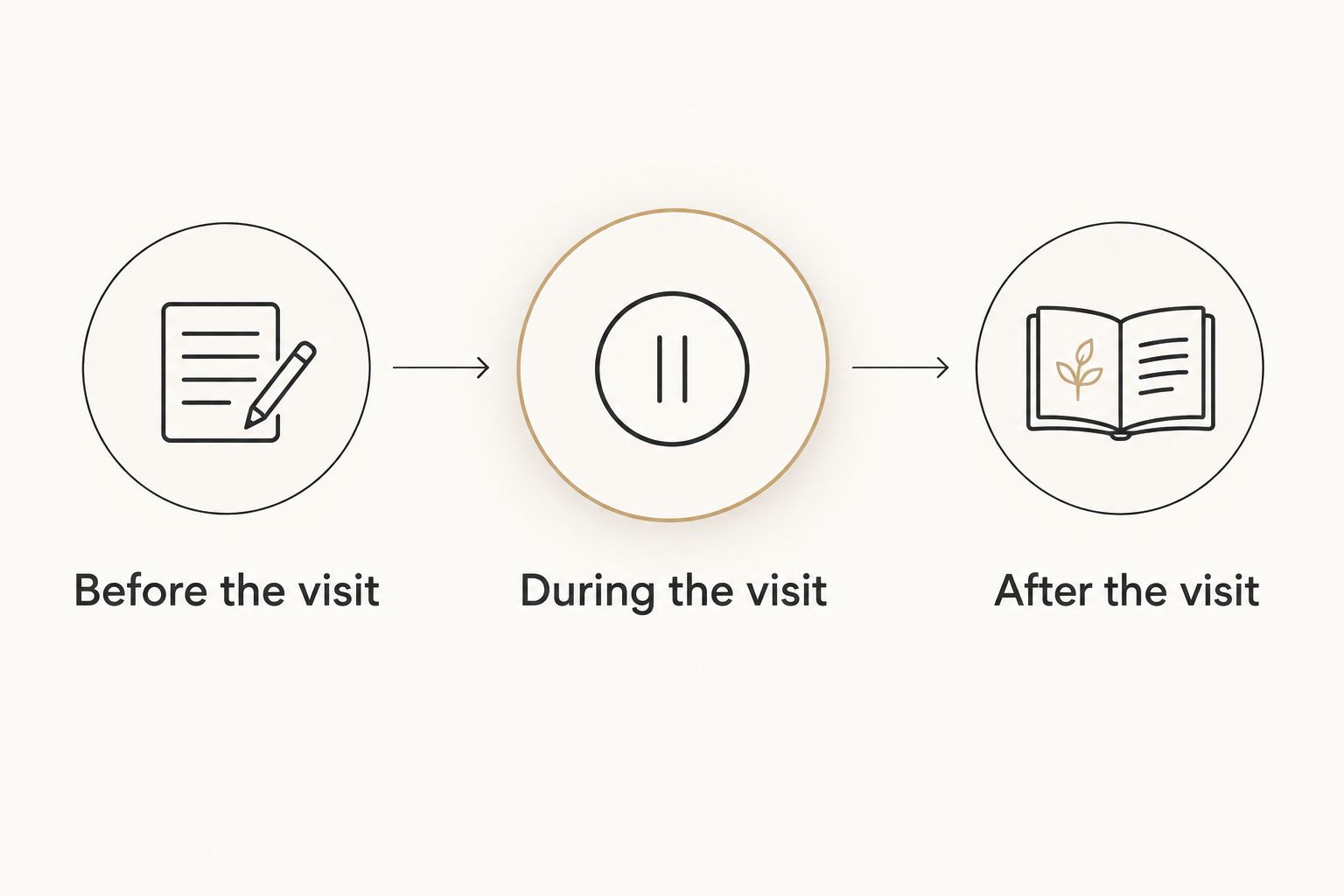
A simple routine before, during, and after the visit
Use this 3-step routine as a plan for your next gathering, not as a test of how calm you can remain. Practice the wording beforehand so the object, if you use one, points back to something familiar.
- Before the visit: Write 1 sentence describing your intention. Keep it within your control: listen without interrupting, decline personal questions, or leave when you have had enough. If you wear a bracelet, connect it to that sentence while getting dressed.
- During the visit: Notice when you want to react immediately. If touching a bead feels comfortable, use that moment to decide whether to answer, redirect, or step away. You can do exactly the same thing with empty hands.
- After the visit: Name something you handled as intended and something you want to change. Put the jewelry away according to its care instructions rather than treating the evening as a success or failure measured by the stone.
Keep the routine flexible. If you forget the bracelet, your plan still applies; if you become upset, you can return to the plan without blaming yourself or the object.
Prepare language for the moment you usually dread
Prepare 2 short replies: a gentle redirect and a firm boundary. You might redirect a personal question toward a shared activity, then state directly that you are not discussing the subject if it continues.
Use your own language rather than memorizing a speech. A brief answer leaves less to explain, and you can repeat the same boundary without adding new reasons each time.
Make leaving an available choice
Decide how you will get home and whether you depend on someone else for transport. If you attend with a partner or friend, discuss what you will do if either person wants to leave.
Patience is not an obligation to remain in a threatening or unsafe situation. Prioritize safety over politeness, ritual, or keeping a family tradition intact.
Why the right patience reminder varies
The right choice depends on how you intend to use it, not on a stone ranking. These factors help you decide whether jewelry belongs in your plan at all:
- Personal meaning: Choose an association you understand. A complicated explanation is unnecessary when your intention is simply to pause before answering.
- Physical comfort: Check the individual listing’s sizing guidance. A piece that pinches or interferes with movement is a distraction, not a useful reminder.
- The gathering’s activities: Cooking, washing dishes, carrying children, or helping with cleanup can make removing jewelry the practical choice.
- Privacy: Decide whether you want to explain your symbolism. You are allowed to enjoy a stone without discussing your spiritual interests at the table.
- Your existing possessions: Start with something you already own if it suits the purpose. A new purchase is not required to mark a new intention.
For a 2026 gathering, use these criteria before choosing a color or symbolic association. If none of the options feels useful, keep the plan and skip the jewelry.
Choosing an optional bracelet without overreading the listing
EclipticJew crystal jewelry is best suited to shoppers who want a wearable symbol of personal intention, not a promised change in family relationships. Its role here is optional: you can enjoy a piece while keeping responsibility for the conversation separate from the jewelry.
If mixed-stone jewelry appeals to you, the tiger’s eye, clear quartz and prehnite beaded bracelet is a relevant listing to examine. Check its current material description, sizing, construction, and care instructions before deciding whether it fits your plans.
The advantage of a bracelet is that you can wear your chosen reminder without carrying a separate object. The drawback is practical: beads or fittings can get in your way, and material names alone do not establish comfort, durability, or suitability for every activity.
Do not assume that a bracelet includes a blessing because the store offers blessings on select pieces. A Taoist blessing is a distinct religious practice, not another name for assigning a personal intention, and any associated service or video must be confirmed on the individual listing.
What can I do when a relative keeps pushing?
Repeat the boundary, change your participation, or leave the exchange. A crystal is not a substitute for any of those actions, and you do not have to keep explaining a decision because someone dislikes it.
You can acknowledge that the other person wants an answer without providing one. If the conversation becomes circular, step away rather than looking for a perfect explanation that will make everyone agree.
Do I have to tell my family what the crystal means?
No—you can keep your personal symbolism private. You can describe the piece as jewelry, explain that it reminds you to pause, or say nothing about it.
You also do not need to persuade relatives to share your beliefs. A family gathering can include different spiritual views without turning your bracelet into a debate.
How should I review the practice after a difficult gathering?
Review your actions, not the supposed performance of the crystal. Ask whether you stated your boundary, noticed when you wanted a break, or chose a response you can stand behind.
For the remaining gatherings on your 2026 calendar, change the practical plan where needed. An earlier departure or a clearer conversation beforehand is more relevant than replacing a stone because an evening was difficult.
FAQ
What are the best crystals for patience at family gatherings?
The best choice is a stone you connect to a specific, realistic intention. Rose quartz can represent kind speech, amethyst a pause, and clear quartz a focused response; these are personal meanings, not proven effects.
Can crystals stop me from getting angry with my family?
Crystals are not a reliable way to prevent anger or control your reactions. You can use a piece as a reminder to pause, but practical boundaries and your next action remain separate from the object.
Which wrist should I wear a patience bracelet on?
Wear a patience bracelet on whichever wrist feels comfortable and keeps it out of your way. This personal reminder does not require a particular wrist or a claim about receiving or releasing energy.
Do I need to buy a crystal before a difficult family dinner?
No, you do not need to buy a crystal before a difficult family dinner. Prepare your boundary, transport, and departure plan first; use an existing object only if you want a reminder.
Does EclipticJew jewelry guarantee calm or better relationships?
No, EclipticJew crystal jewelry does not guarantee calm or better relationships. Treat it as jewelry with optional personal symbolism, not as something that controls your emotions or another person's behavior.
Do I need a Taoist blessing to set a patience intention?
No, setting a personal patience intention does not require a Taoist blessing. Taoist blessings belong to a distinct religious context, and any optional blessing service must be confirmed for the individual product.
Can I keep my crystal bracelet on after the gathering and sleep in it?
Remove your bracelet before sleeping, particularly elastic-cord jewelry. Follow the individual piece's care guidance, and store it safely rather than making overnight wear part of your intention practice.
One last thing
A useful intention can include ending the conversation. Patience does not always look like staying longer, smiling more, or finding another way to explain yourself.
Before your next family gathering in 2026, choose the response first. If a stone feels meaningful, choose one you enjoy and check the wrist measurement before ordering; if not, take your boundary with you anyway.


