

Instead of trying to remember your intention throughout the day, pair a short morning journal entry with putting on a bracelet, then review one real action when you take it off. This intention bracelet journaling routine works with a notebook or a digital journal; the bracelet is an optional reminder, not the source of change.
- An intention bracelet journaling routine connects a visible reminder with one action and an honest evening reflection.
- EclipticJew crystal jewelry suits shoppers who want personal symbolism, not guaranteed outcomes.
- Start with a notebook and a bracelet you own; no purchase or blessing is required.
- Keep intention-setting specific: write what you will do, not what a stone will make happen.
Why this matters
An intention such as being more patient leaves an important question unanswered: what will you actually do when someone interrupts you? A useful journal entry names that moment and chooses a response before it happens.
The bracelet gives you a place to attach that reminder. Your journal records whether the response fit the situation. Neither needs an elaborate ritual, and a missed entry is not a spiritual failure.
If choosing a prompt is your first obstacle, start with this guide to an intention journal daily question. For this routine, the central question is simple: What is one action I want to practice today?
Before you start
- Choose one writing place. Use a notebook and pen or a digital journal you already know. A paper version needs no account; a digital version needs access to your chosen app. Keep personal entries somewhere you are comfortable storing them.
- Choose an optional reminder. Use a bracelet you own, or substitute a bookmark. If wearing jewelry, check the fit and inspect the cord or clasp before use. The routine works without a stone or symbol.
- Plan the removal cue now. Bracelets come off at night; do not make sleeping in elastic-cord jewelry part of the practice. Choose a dry resting place near your journal, away from sink splashes, so removal can prompt the evening entry.
Set aside 2 minutes for the morning entry and 2 minutes for the evening review. These are suggested limits, not a required dose or a promise of results.
Choose your journal format
Best for starting today: use the format you already open. Switching tools is unnecessary unless your current format makes the routine difficult.
| Format | Best for | Practical advantage | Limitation |
|---|---|---|---|
| Paper notebook | Keeping reflection away from your phone | Your bracelet and pen can share a visible resting place | You need the notebook with you to add an entry |
| Digital journal | Writing when your phone is already nearby | You can keep the prompt with your other journal entries | Opening your phone also creates an opportunity for distraction |
Choose one home for the routine rather than maintaining matching entries in both formats. Keep sensitive details out of notification previews if you use digital reminders.
Your daily cue
The first configuration is physical: decide where the routine begins and what action starts it. Putting on a bracelet is useful only if you connect it to something specific.
- Choose an existing transition. Use the moment after getting dressed, sitting at your desk, or finishing breakfast. Pick a transition that already belongs to your day.
- Place the materials together. Leave your closed journal, pen, and optional bracelet in the same dry place. If you use a digital journal, keep the bracelet near the place where you normally write.
- Write a cue sentence. For example: after breakfast, I open my journal before putting on my bracelet. This is an instruction to yourself, not an affirmation about what the bracelet does.
- Choose the bracelet's meaning. Assign a plain-language reminder such as listen first or finish one task. Choose your own association rather than treating a stone meaning as a rule you must follow.
Expected result: you can name the moment, place, and action that start your entry. You do not need to wait for a particular mood, lunar phase, or purchase.

Your morning entry
Use the same short template each morning. The labels below are journal prompts you write yourself, not software buttons or required app features.
- Add the date. Use your usual date format, including 2026 where you normally include the year. This makes later entries easier to distinguish.
- Complete Intention. Name a quality you want to practice today: patience, honesty, attention, or kindness. Choose one rather than making a list of everything you want to change.
- Complete Situation. Name a likely moment when that quality matters. A scheduled conversation or a familiar distraction gives the intention somewhere concrete to land.
- Complete Action. Write something you control. Replace being appreciated with asking a clear question, or replace feeling confident with rehearsing your opening sentence.
- Complete Reminder. State what noticing the bracelet will invite you to remember. Put it on only after you have written the action; skip this step if jewelry is uncomfortable or unsuitable for your day.
Here is a sample entry, not a reported result:
Date: September 21, 2026
Intention: Listen carefully.
Situation: My afternoon project discussion.
Action: Let the other person finish, then ask what matters most.
Reminder: When I notice my bracelet, remember to listen before preparing a reply.
Expected result: your entry contains an action another person could observe. You have not asked the bracelet to change someone else's behavior or guarantee a successful conversation.
Your daytime check-in
A reminder does not need to interrupt everything you do. Use the bracelet when you naturally notice it, especially near the situation named in your journal.
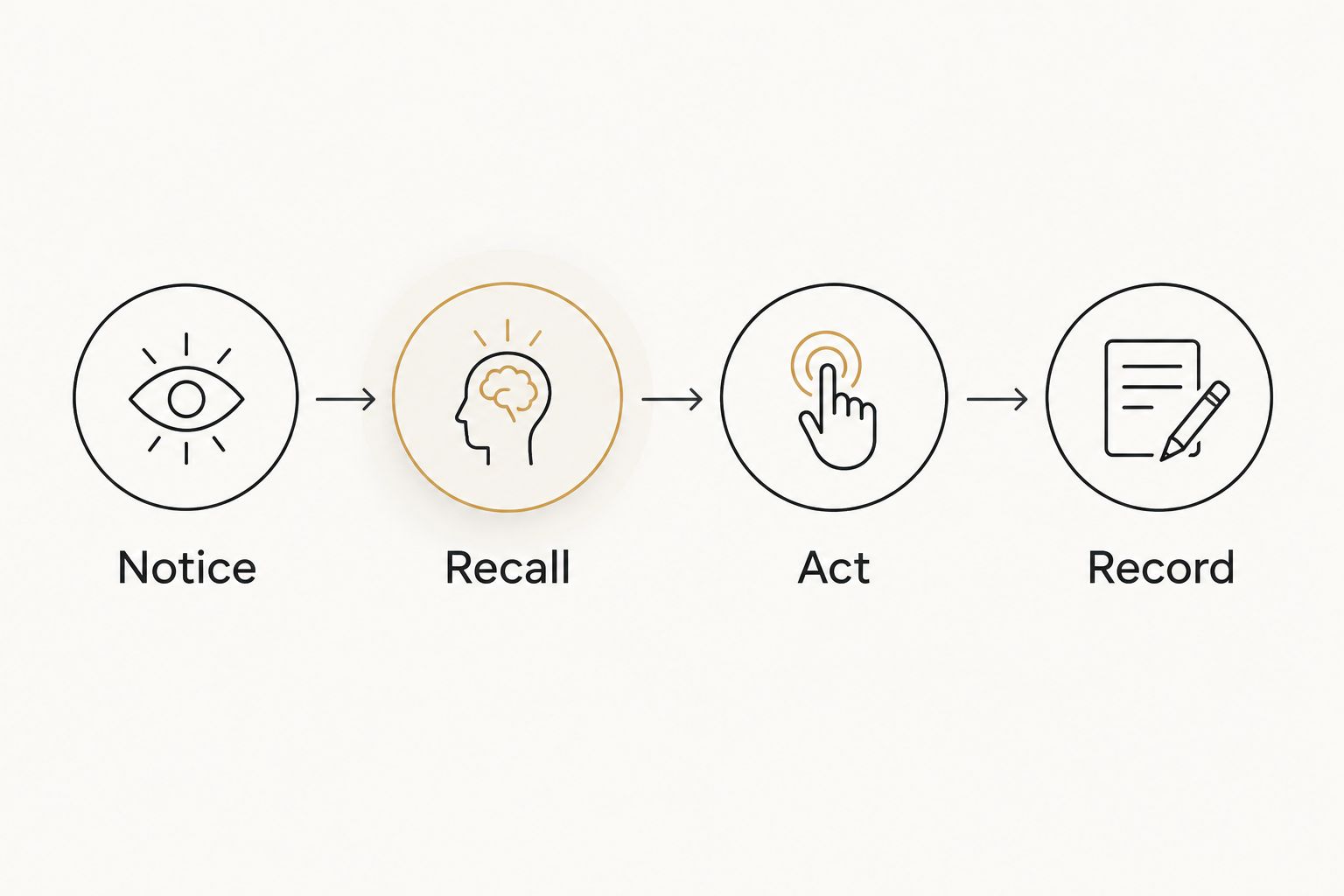
- Notice. Look at the bracelet or briefly touch a bead without pulling the cord. If jewelry is not suitable, look at your written reminder instead.
- Recall. Bring back the action from the morning entry. Keep the wording unchanged unless the situation has genuinely changed.
- Act. Take the relevant step: ask the question, close the unrelated tab, or state the boundary. Reflection supports the choice; it does not replace it.
- Record. Add a brief note later if the moment matters. You do not need to stop a conversation to document it.
Allow a 30-second check-in if a time boundary helps. That is a suggested pause, not a scientifically established requirement for intention-setting.
Expected result: you return to a chosen behavior rather than checking whether the stone feels different. If the original situation disappears, choose a comparable action or note that the opportunity did not occur.
The sequence stays small: Notice, Recall, Act, Record. Repeat it when useful, not every time the bracelet moves against your wrist.
Your evening review
Evening reflection is not a score for being a good person. Its purpose is to make tomorrow's instruction more realistic.
- Remove the bracelet. Put it in its dry resting place before bed. Do not sleep in elastic-cord jewelry to preserve the ritual.
- Complete What happened. Describe an event rather than judging your whole day. Write that you interrupted during the meeting, not that you are terrible at listening.
- Complete What helped. Identify something concrete, such as reviewing your question before the call. If nothing helped, say so without inventing a positive lesson.
- Complete Next adjustment. Make the next action smaller, clearer, or better timed. You can also decide that the intention no longer fits.
A sample follow-up dated September 21, 2026 might read: I asked my question but interrupted the answer. Tomorrow I will keep my pen still until the person finishes speaking.
Expected result: your journal contains an observation and an adjustment, not a claim that jewelry caused the outcome. Stop after the useful point; a short entry does not need expanding to look meaningful.
Evening-only routine for busy mornings
Best for rushed mornings: prepare tomorrow's intention when you remove your bracelet. This version keeps the same connection between writing and handling the object, but moves the planning to the evening.
- Review one situation from today without trying to summarize everything.
- Choose tomorrow's likely challenge and write one response you control.
- Place the bracelet beside the closed journal. In the morning, read the response before putting it on.
- If tomorrow changes, revise the action instead of forcing an irrelevant intention onto the day.
You lose the opportunity to plan from your morning perspective. In exchange, you avoid adding another task to an already crowded departure routine. Choose the version that fits your actual schedule, not the one that looks more ceremonial.
Optional crystal symbolism
You can use color, texture, or personal history to choose a reminder. A bracelet received from a friend can represent speaking kindly; a familiar stone can represent returning to a commitment. Neither association requires a universal crystal meaning.
EclipticJew offers crystal and natural-stone jewelry for shoppers who want that symbolic layer. The advantage is a wearable, personal object; the limitation is that jewelry cannot perform the action written in your journal. Check each listing for materials, construction, and fit rather than assuming every bracelet is made alike.
A secular journaling routine does not require Taoist consecration, Buddhist prayer beads, feng shui, or chakra symbolism. These are distinct contexts, not interchangeable names for intention-setting. If you choose a culturally specific piece, learn its context separately and confirm any optional blessing service on that listing.
Troubleshooting your routine
- You stop noticing the bracelet. Return attention to the existing transition, such as opening your notebook after breakfast. Do not tighten the bracelet, pull the cord, or add more jewelry to make the cue harder to ignore.
- Your entries repeat vague wishes. Replace an outcome outside your control with a visible action. Finding love becomes sending an honest message; career success becomes preparing a question for an interview.
- You miss several entries. Start with today's date and one sentence. Do not backfill a convincing streak or turn the missed days into a debt.
- The bracelet distracts you or irritates your skin. Remove it and use the written reminder. The practice does not require wearing jewelry, and discomfort is not evidence of spiritual resistance.
- The journal becomes a running self-criticism. Separate the event from your identity and write one practical adjustment. Stop the exercise if it is making you feel worse; jewelry and journaling are not substitutes for appropriate support.
Customize your workflow
Schedule a 5-minute weekly review if daily entries start accumulating without useful changes. Read for repeated situations, not signs that a stone is working. Keep an action that remains useful and rewrite one that repeatedly proves unrealistic.
For a 2026 journal, give the routine its own clearly named section rather than scattering entries among unrelated notes. A heading such as Daily intention is enough; complicated tags and elaborate tracking are optional.
Care belongs in the workflow, too. Before introducing water, salt, oils, or sunlight as part of a ritual, read the guide to cleaning a natural-stone bracelet. Symbolic practice should not override the materials' care needs.
FAQ
How do I start an intention bracelet journaling routine?
Write one action you control, connect it to putting on an optional bracelet, and review what happened when you remove it. Start with a journal and jewelry you already own.
Do I need a crystal bracelet to journal with intentions?
No, intention journaling does not require a crystal bracelet. A bookmark or the journal itself can serve as the reminder, and you can skip the object entirely.
Can I use Day One instead of a paper notebook?
Yes, you can write the same intention, situation, action, and evening reflection in Day One. This routine uses ordinary journal entries and does not depend on an integration, automation, or particular app setting.
Which wrist should I wear my intention bracelet on?
Choose the wrist that feels comfortable and does not interfere with your work. This journaling routine assigns no special effect to either wrist; culturally specific wearing customs are a separate consideration.
Does an intention bracelet need a Taoist blessing?
No, a Taoist blessing is not required for this journaling routine. If you want that religious or cultural element, confirm the service on the specific EclipticJew listing rather than assuming every piece includes it.
Can I sleep with my intention bracelet on?
Remove the bracelet before bed, especially elastic-cord jewelry. Use taking it off as the cue for your evening reflection, then store it in a dry place.
What should I write if my intention did not happen?
Write what happened and choose one adjustment within your control. An unmet intention is not evidence that your stone failed or that you performed the routine incorrectly.
One last thing
Your evening action does not have to be keeping tomorrow's intention. Sometimes the useful discovery is that you chose the wrong task, expected too much, or need to have a different conversation.
For the rest of 2026, let the journal remain editable rather than treating it as a contract. Start with what you own; if you later choose a stone, choose a meaning you understand and measure your wrist before selecting the piece.


