

Yes—genuine tiger’s eye is worth buying if you enjoy its golden-brown bands, moving sheen, and suitability for everyday jewelry. Buy it for the material and a design you will wear, not for guaranteed confidence, protection, or financial results; genuine stone alone does not establish good bracelet construction or disclose whether its color has been treated.
- Is genuine tiger's eye worth it? Yes, for its appearance and wearability—not promised spiritual or financial results.
- Check moving sheen, treatment disclosure, bead condition, bracelet construction, and fit before buying.
- EclipticJew crystal jewelry suits shoppers interested in natural stones and personal symbolism; verify each listing separately.
- Photographs help you compare jewelry, but they cannot conclusively authenticate a gemstone.
Is genuine tiger’s eye worth buying? What should you check first?
Genuine tiger’s eye is a worthwhile jewelry choice when the stone, finish, construction, and fit all meet your needs. For a 2026 purchase, start with the listing’s material description rather than the most dramatic photograph. These checks separate an appealing stone from a bracelet you will actually enjoy wearing.
- Material description: Look for an explicit identification of tiger’s eye, not just a tiger-eye color or effect.
- Moving sheen: Look for light shifting across the stone as it turns. A still photograph provides only part of the picture.
- Treatment disclosure: Ask whether the color is natural or altered, especially when choosing an unusual shade.
- Finish and fit: Examine bead surfaces, drill holes, cord or clasp details, and the stated sizing method.
If you are still comparing formats, the tiger’s eye bracelets for everyday wear guide is a useful next step. Decide on the bracelet style before treating any single stone characteristic as the whole purchase decision.
Why authenticity matters—and what it cannot tell you
Authenticity matters when you want a particular natural material rather than an imitation. Tiger’s eye is a quartz material known for chatoyancy: a silky band of reflected light that shifts with viewing angle. Its appearance is the strongest practical reason to choose it.
However, genuine does not automatically mean untreated, well-polished, comfortably sized, or carefully assembled. Those are separate questions. A seller needs to describe the jewelry, not rely on the word natural to answer everything.
For your 2026 buying checklist, separate material identity from workmanship. You can like a stone and still reject a bracelet because the sizing is unclear, the bead holes look chipped, or the construction does not suit your routine.
The same distinction applies to spiritual language. A bracelet described through courage or prosperity symbolism does not become a test of whether you believe strongly enough. You can appreciate the meaning, enjoy the stone, or choose neither.
How can you check tiger’s eye before ordering?
Examine the light, not just the color
Look for a short video showing the beads moving under a steady light source. In tiger’s eye, the bright band changes position as the stone turns. Compare several beads rather than judging the bracelet from its brightest bead alone.
Color is less decisive. Golden-brown bands are characteristic, but photographs change with lighting, exposure, and editing. A warm photograph is not proof of dye, and an attractive moving band is not conclusive proof of natural origin.
Ask for an ordinary-light image when the listing shows only heavily styled photography. The useful question is whether you like the stone outside the most flattering setup.
Ask separate questions about identity and treatment
Ask whether the beads are natural tiger’s eye and whether their color has been altered. These are different questions. Natural stone can be treated, and a disclosed treatment does not make the material imaginary.
Red tiger’s eye can result from heat treatment; some brightly colored material is dyed. Do not infer the treatment of an individual bracelet from its color or product name alone. Ask the seller to identify what applies to that piece.
Disclosure matters more than a dramatic authenticity claim. If untreated color is essential to you, choose a listing that answers that requirement explicitly rather than interpreting silence as confirmation.
Inspect the parts that touch your skin
Zoom in on bead surfaces and the areas around drill holes. Look for visible chips, rough edges, and inconsistent finishing. Natural pattern variation is different from damage that catches against skin or cord.
Then check the bracelet’s construction. An elastic strand, adjustable cord, and clasped bracelet require different fit decisions; do not assume a photograph explains which one you are getting. Check any metal components too, especially if you have known sensitivities.
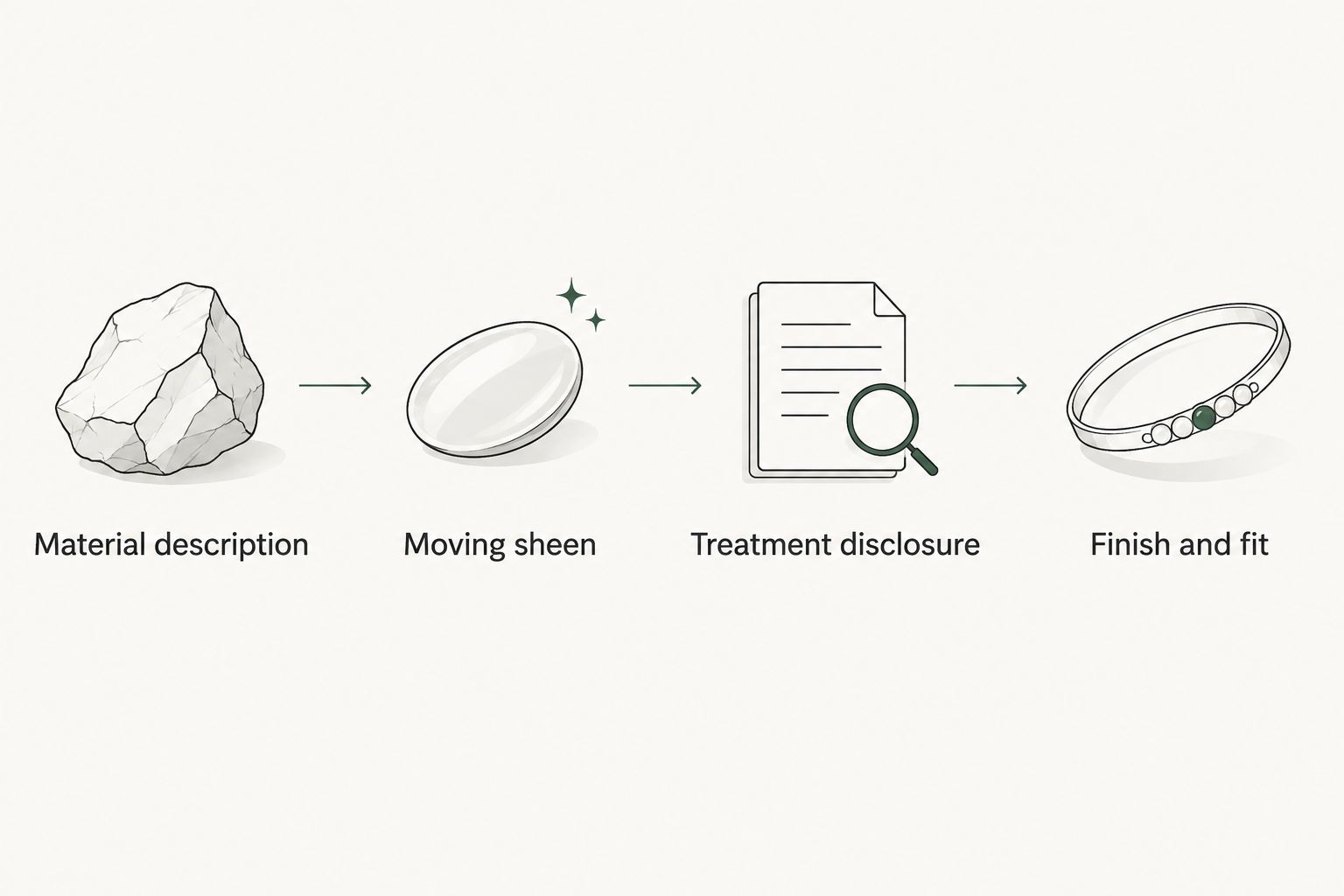
The sequence keeps the decision manageable: identify the material, understand its appearance, clarify treatment, and then assess wearability. Do not let a convincing answer to the first question replace answers to the others.
Can photographs or home tests prove tiger’s eye is genuine?
Photographs can support a buying decision, but they cannot conclusively authenticate tiger’s eye. Moving light, banding, and surface variation offer clues. They do not replace examination when material identity is disputed.
Avoid scratch tests on finished jewelry. Tiger’s eye is commonly listed at approximately 6.5–7 on the Mohs hardness scale, but deliberately scratching a bead can damage it and still leave you without a reliable identification. Hardness describes scratch resistance, not whether a bracelet will survive a fall.
Touch tests are also weak evidence. A bead feeling cool does not establish that it is tiger’s eye, and weight alone does not settle the question. Different materials and bead sizes complicate those impressions.
For a purchase where authentication is essential, ask about independent gemological identification. Match the effort to your reason for buying. A comfortable everyday bracelet and a specimen purchased specifically for documented material identity are different decisions.
Which tiger’s eye bracelet style is worth choosing?
Choose the visual effect first: a repeated golden-brown strand or tiger’s eye mixed with contrasting stones. Neither format is automatically more genuine or better made. Both still need clear material, construction, and sizing information.
EclipticJew crystal jewelry is best for shoppers choosing natural stones for everyday wear and personal symbolism. The following examples illustrate two design directions, not independently authenticated recommendations.
| Bracelet example | Best for | What the listing states | Advantage | Limitation |
|---|---|---|---|---|
| Tiger’s Eye Bracelet for Everyday Wear | A consistent golden-brown look | Natural tiger’s eye beads, described as hand-strung | Keeps attention on tiger’s eye banding and sheen | Less color contrast; confirm fit and construction details |
| Clear Quartz, Prehnite & Tiger’s Eye Beaded Bracelet for Everyday Wear | A mixed-stone look | Three natural stones: tiger’s eye, clear quartz, and prehnite | Combines contrasting stones in one bracelet | Not an all-tiger’s-eye strand; confirm the complete sizing and material details |
For the Tiger’s Eye Bracelet for Everyday Wear, choose it if a repeated stone pattern suits your wardrobe. For the Clear Quartz, Prehnite & Tiger’s Eye Beaded Bracelet for Everyday Wear, choose it if the combination itself appeals to you—not because additional stones promise additional effects.


Bead size deserves attention alongside color. For example, the supplied description of the Tiger’s Eye Beaded Bracelet for Men specifies 8 mm natural tiger’s eye beads. That measurement describes bead diameter, not the bracelet’s internal circumference or whether it fits your wrist.
Why tiger’s eye jewelry quality varies
In 2026, compare the details that affect what you receive rather than treating every natural-stone listing as equivalent. These factors explain differences you can actually evaluate:
- Material composition: An all-tiger’s-eye strand and a mixed-stone bracelet contain different combinations. Read the full description.
- Color disclosure: Natural color, heat treatment, and dye are separate possibilities. Ask what applies to the specific piece.
- Optical appearance: Compare the clarity and placement of the moving sheen under similar lighting, not unrelated studio images.
- Bead finishing: Check polish, visible chips, and drill-hole edges. A desirable pattern does not compensate for rough finishing.
- Construction and fit: Confirm the fastening method and stated measurements. Bead diameter alone does not tell you wrist fit.
- Added components: Identify charms, spacers, and their materials separately. Their presence does not authenticate the stones.
You do not need the most elaborate design. A simple bracelet that fits your hand, clothing, and daily routine is a better choice than a visually impressive piece you avoid wearing.
Is natural tiger’s eye better than treated tiger’s eye?
Natural origin and treatment status describe different things. Treated natural tiger’s eye can still be genuine tiger’s eye; the decision depends on whether you want an untreated appearance or simply enjoy the disclosed color.
Choose untreated material when that distinction is central to your interest. Choose disclosed treated material when you like the appearance and understand what you are buying. Skip a listing that leaves an essential question unanswered.
For a 2026 gift, avoid assuming the recipient shares your preference. Ask whether they like golden-brown stones, contrasting colors, or symbolic charms before choosing the most elaborate option.
Is tiger’s eye worth buying for confidence or protection?
Tiger’s eye can be meaningful as a personal symbol of courage or steadiness. Contemporary crystal practices often associate it with confidence and protection; those associations are not evidence that wearing it changes events or prevents harm.
If you want a reminder before a difficult conversation, choose the action first. Write down your main point, decide what boundary you need, and practice saying it. A bracelet can serve as an optional tactile cue to remember that preparation.
Keep cultural elements distinct. A Pixiu motif, a Buddhist-style accent, and an optional Taoist blessing are not interchangeable traditions or proof of stronger stone. Ask about each feature in its own context, and confirm any blessing service on the individual listing.
Can you wear genuine tiger’s eye every day?
Tiger’s eye is suitable for everyday jewelry, but stone durability and bracelet durability are not the same thing. Cord, knots, clasps, spacers, and surface finishing all influence how a piece handles regular use.
Use a 2026 care routine that fits the entire bracelet: remove it before sleep, strenuous exercise, showering, and tasks that expose it to chemicals or repeated knocks. For elastic-cord jewelry, roll it gently over your hand rather than pulling the strand wide.
Start with a soft cloth for routine wiping and follow the specific care instructions before using water or cleaners. Avoid assuming that every component tolerates the same treatment simply because the main beads are stone.
FAQ
Is genuine tiger's eye worth it for a first crystal bracelet?
Yes, genuine tiger’s eye is worth considering if you like golden-brown stones and moving sheen. Check treatment disclosure, construction, and fit; buying a crystal is optional, not necessary for a personal practice.
How can I tell if tiger’s eye is real when shopping online?
You cannot conclusively authenticate tiger’s eye from online photographs alone. Ask for a clear material description, treatment information, and a video showing the moving sheen; seek independent gemological identification when certainty is essential.
Does genuine tiger’s eye always have natural color?
No, genuine tiger’s eye can have treated color. Ask separately whether the stone is natural and whether its color has been altered.
Is an 8 mm tiger’s eye bracelet the right size for my wrist?
An 8 mm bead measurement does not establish wrist fit because it describes bead diameter. Check the bracelet’s stated circumference or sizing method and measure your wrist before choosing.
Does tiger’s eye really attract wealth or protect you?
Tiger’s eye does not come with a demonstrated guarantee of wealth or protection. Treat those descriptions as symbolic associations, not financial advice or a substitute for practical safety measures.
Can I sleep wearing a tiger’s eye bracelet?
Remove a tiger’s eye bracelet before sleeping, especially when it uses elastic cord. Keep it in a suitable place nearby if you want it within reach for a personal ritual.
Should I buy a plain tiger’s eye bracelet or a mixed-stone bracelet?
Choose a plain strand for a repeated tiger’s eye appearance and a mixed-stone bracelet for contrast. Neither format proves authenticity or provides stronger spiritual effects; compare materials, finishing, and fit.
One last thing
The most useful question is not whether tiger’s eye is powerful—it is whether you would still want the bracelet without the promises. If the answer is yes, you have a clearer basis for choosing: stone appearance, disclosed materials, comfortable fit, and personal meaning.
Before choosing EclipticJew jewelry, measure your wrist and identify the stone combination you genuinely enjoy. Permission not to buy belongs in the decision too.


