


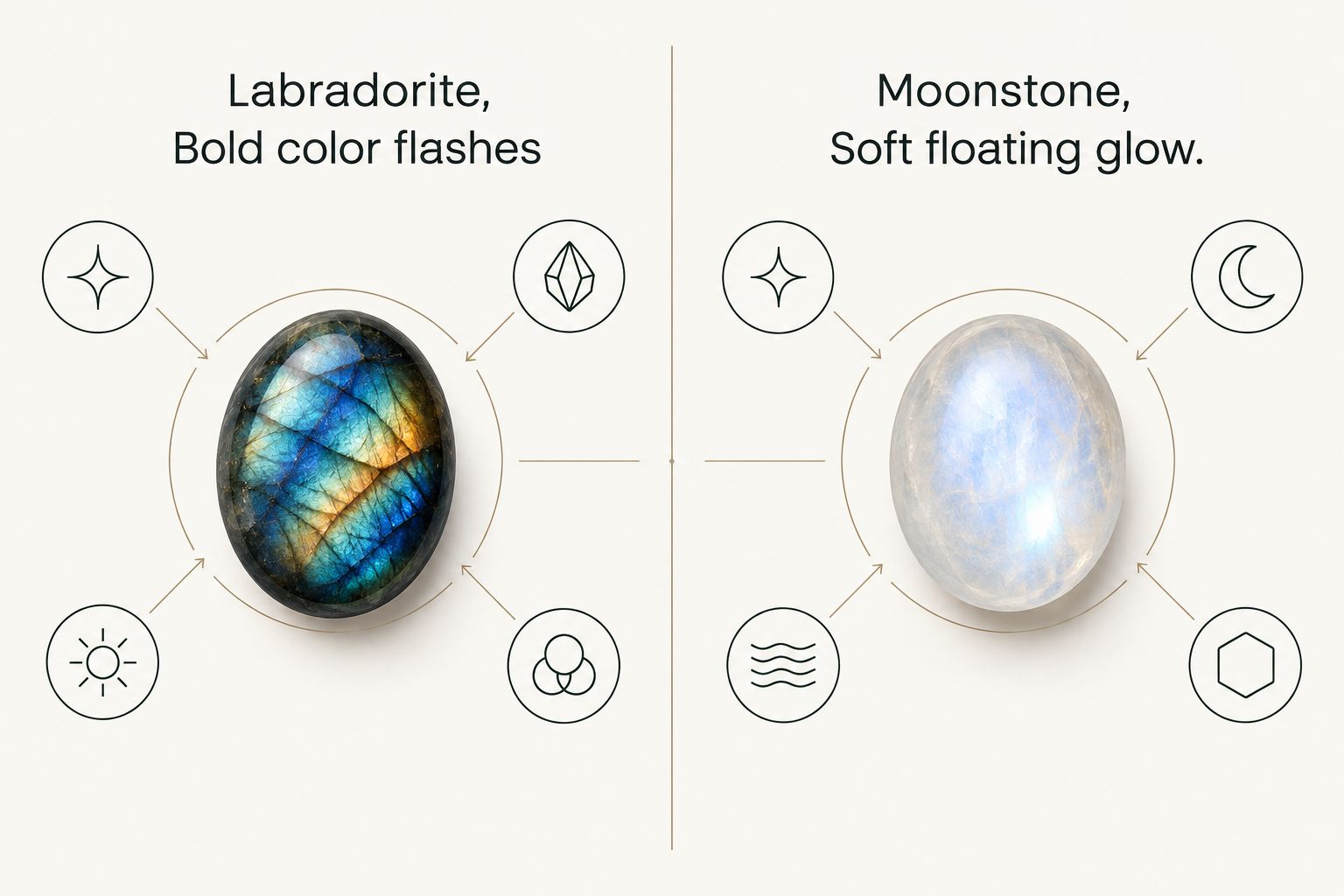
Labradorite is the better choice for bold, shifting flashes; moonstone suits you if you prefer a softer, floating glow. For daily wear, neither stone has a clear durability advantage: both are feldspars that need protection from knocks and abrasion. Choose by the light you want to see, then check the setting and care instructions before you buy.
- Labradorite vs moonstone: choose labradorite for bold color flashes and moonstone for a softer glow.
- Neither stone is scratch-proof; both need care during daily wear.
- A protected setting and an easy-to-remove design matter more than choosing between these two stones.
Labradorite vs moonstone: which shimmer suits daily wear?
Choose labradorite if you want the flash to be a visible part of your outfit. Choose moonstone if you want light that appears to move quietly beneath the surface. Both can be worn regularly, but neither belongs in a routine that exposes the stone to repeated knocks, rough surfaces or cleaning chemicals.
| What to compare | Labradorite | Moonstone |
|---|---|---|
| Appearance | Distinct flashes that change as the stone turns | A softer glow that appears to float within the stone |
| Optical term | Labradorescence | Adularescence |
| Best for | A noticeable, changeable shimmer | An understated, luminous shimmer |
| Daily-wear concern | Scratches, chips and damage from impact | Scratches, chips and damage from impact |
| Buying priority | See how the flash looks as the stone moves | See how the glow looks as the stone moves |
The Gemological Institute of America describes moonstone’s glow as adularescence. Labradorite’s shifting display is called labradorescence. Those names describe different visual effects, not different levels of protection for the person wearing them.
Why this matters
A still product photograph can hide what makes either stone appealing. In 2026, ask to see the individual stone from more than one angle when its shifting light is the reason you want it. If color is your main criterion across gemstones, the sodalite vs lapis lazuli jewelry comparison offers another way to separate appearance from everyday practicality.
What actually makes the shimmer different?
Labradorite and moonstone belong to the feldspar mineral group, but their familiar optical effects have different appearances. With labradorite, you often see a defined area of color appear or disappear as you tilt the stone. With moonstone, you generally see a gentler sheen that seems to move across or within it. A photograph taken at one angle cannot show the whole effect.
The Gemological Institute of America explains moonstone’s adularescence through light scattering between thin layers of different feldspars. Labradorite’s display is associated with light interacting with layers within the stone. The practical takeaway is simpler than the mineralogy: turn the piece under ordinary light before deciding whether its shimmer suits you.
Do not judge either stone solely by a brightly lit close-up. Look at it in the light where you expect to wear it. A flash that feels striking in a product image can look subtler at a desk, while a quiet glow might be exactly what you want beside everyday clothing.
Names also deserve care. Some stones sold as rainbow moonstone are a light-colored variety of labradorite. That trade name does not make every labradorite a moonstone, and it does not mean a white stone will show the same effect as another piece labelled moonstone. When the mineral identity matters to you, check the seller’s description rather than relying on the jewelry name alone.
Which is better for a bracelet, pendant or other daily piece?
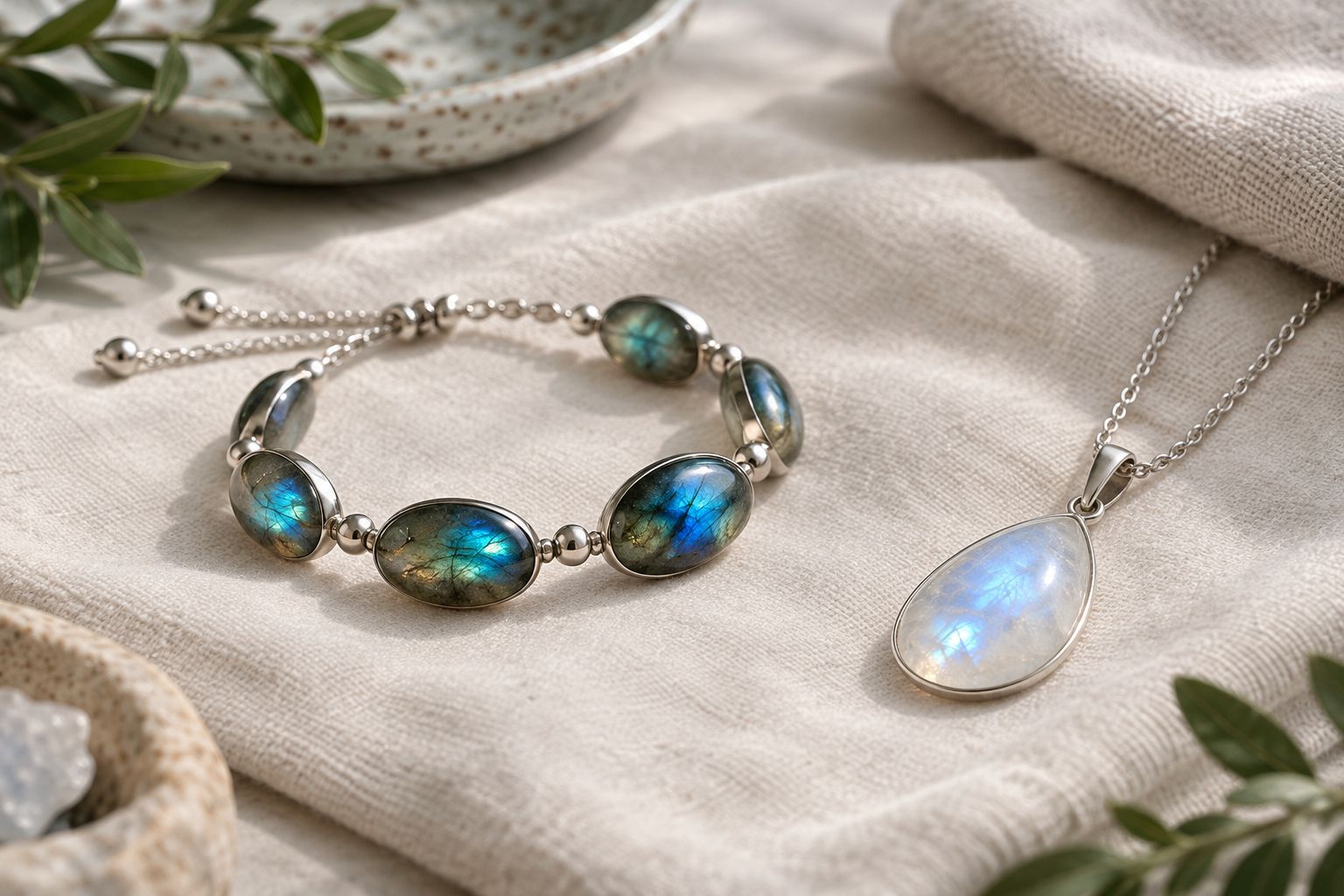
A pendant is the easier starting point if you want either stone in regular rotation. A bracelet sits close to desks, bags and other hard surfaces during ordinary movement. A pendant still needs care, but its position keeps it away from some of that contact. This is a practical difference in where you wear the stone, not a claim that one gemstone is tougher.
For a bracelet, consider how the stone is held. Exposed edges and raised stones give you more reason to watch for contact with hard surfaces. If you regularly remove bracelets before washing, exercising or hands-on work, either stone is easier to fit into your routine. If you rarely take jewelry off, neither is a carefree choice.
For a pendant, look at the stone’s edges and the part that connects it to the chain. The shimmer should still be visible from the angle at which the pendant hangs. A dramatic flash seen only when a loose stone is held flat might not be the effect you see while wearing it.
In 2026, make the choice in this order:
- Choose the visual effect. Decide whether you want labradorite’s distinct flashes or moonstone’s quieter glow.
- Choose where you will wear it. Think about what your bracelet or pendant touches during an ordinary day.
- Inspect the setting. Look at exposed edges, how securely the stone sits and whether you can remove the piece easily.
- Check the stone in motion. Use a video or several viewing angles if you cannot see it in person.
- Plan simple care. Take it off before tasks that bring it into contact with hard surfaces or chemicals.
Why daily-wear suitability varies
The stone name alone cannot tell you how well a finished piece will fit your day. Check these factors before treating either option as everyday jewelry:
- Where the stone sits: A wrist encounters different surfaces than a pendant worn against clothing.
- How much is exposed: An open setting leaves more of the stone’s surface available for contact.
- The stone’s shape: Edges and raised areas deserve attention when you inspect a piece for daily wear.
- Your routine: Exercise, hands-on work and frequent contact with hard surfaces change when it makes sense to remove jewelry.
- What you want to see: A stone that shows its shimmer at the angles you actually wear it will be more satisfying than one chosen from a single still image.
- How you care for it: Gentle handling and storage away from other jewelry reduce avoidable abrasion.
The Gemological Institute of America lists moonstone at 6 to 6.5 on the Mohs hardness scale. That scale describes resistance to scratching; it does not promise resistance to chipping or impact. Labradorite also requires careful wear. Do not treat a hardness number as permission to keep either stone on through every activity.
How do you care for labradorite and moonstone jewelry?
Keep care uncomplicated. In 2026, the useful routine is to remove the jewelry before rough work, clean it gently when needed and store it so the stone does not rub against harder pieces.
- Remove it before impact-prone tasks. Put the piece somewhere safe before exercise, cleaning or work that brings it against hard surfaces.
- Clean gently. Use mild soapy water and a soft cloth, then rinse carefully and dry the piece. Consider any other materials in the jewelry before getting the entire piece wet.
- Avoid harsh methods. Do not assume an ultrasonic or steam cleaner is suitable for a finished piece containing either stone.
- Store pieces separately. A soft pouch or separate compartment helps keep jewelry from rubbing together.
If a piece contains wood, elastic, plated metal or other materials, its care requirements extend beyond the gemstone. Follow the instructions for the whole piece, not just the stone. A quick wipe can be a better choice than soaking jewelry when its construction is unclear.
Some people also use cleansing as a reflective ritual: taking a moment to reconnect with the intention attached to a piece. That practice is separate from physical cleaning. It does not remove dirt or repair a loose setting.
Does the symbolism change the choice?
It can change what wearing the stone means to you, but it does not change the care it needs. Labradorite is often used as a personal reminder of change or protection; moonstone is often associated with intuition and reflection. These are symbolic associations, not medical effects or guaranteed outcomes.
Choose an intention after deciding that you actually like the appearance. If labradorite’s flash draws your attention back to a moment of clarity, that is a meaningful reason to wear it. If moonstone’s softer light fits a quieter daily ritual, that is equally valid. Neither choice needs a claim about healing to earn a place in your jewelry.
Keep the traditions distinct. The names labradorescence and adularescence describe optical phenomena. A personal crystal practice describes the meaning you attach to wearing the stone. One does not prove the other, and neither requires you to follow a Taoist, Buddhist or chakra practice.
What should you look for at EclipticJew?
EclipticJew is best for shoppers who want to choose crystal jewelry by both appearance and personal intention. Its listed options include moonstone jewelry and a bracelet pairing labradorite with amethyst. That gives you a way to compare the stones in wearable pieces, but a mixed-stone design makes it harder to judge one gemstone’s visual effect on its own.
For a moonstone-led choice, check how much of the stone is visible and whether its glow appeals to you in the available images. For the labradorite-and-amethyst bracelet, decide whether you want that combination rather than assuming it will look like a piece made entirely of labradorite. EclipticJew’s product descriptions are the place to confirm the materials of the specific piece you choose; the general name of a stone is not a substitute for checking the listing.


Neither EclipticJew bracelet is a controlled comparison of loose stones: each pairs its featured feldspar with another gemstone. Choose the moonstone piece if its softer combination suits your intention; choose the labradorite piece if you want a more changeable flash alongside amethyst. Inspect the particular piece and its care guidance before making either one part of your daily routine.
Is labradorite more durable than moonstone for daily wear?
No clear durability win follows from choosing labradorite over moonstone. Both deserve protection from scratches and impacts, and the finished setting affects how exposed the stone will be. Choose a piece you can remove easily when your day gets rough on jewelry.
Can you wear moonstone or labradorite every day?
Yes, you can wear either stone regularly if you handle it with care. Daily wear does not mean leaving a bracelet on for cleaning, exercise or other tasks that put it against hard surfaces. A pendant can be a more practical choice when you want the shimmer without as much wrist contact.
FAQ
Which is better for daily wear, labradorite or moonstone?
Neither has a clear daily-wear durability advantage. Pick labradorite for bold flashes or moonstone for a softer glow, then choose a setting that protects the stone.
Does labradorite look like moonstone?
Both can show light moving as the stone turns, but the familiar effects look different. Labradorite often shows distinct color flashes; moonstone is known for a softer floating glow.
Is rainbow moonstone the same as ordinary moonstone?
Not necessarily. Rainbow moonstone is a trade name often used for light-colored labradorite, so check the seller’s material description if mineral identity matters to you.
Will moonstone or labradorite scratch during daily wear?
Either stone can scratch when it contacts harder materials. Store jewelry separately and remove it before activities that bring it into contact with rough surfaces.
Is a moonstone or labradorite bracelet practical for work?
A bracelet is practical when your work does not repeatedly press it against hard surfaces. If your hands are busy throughout the day, consider wearing the stone as a pendant instead.
How should I clean moonstone and labradorite jewelry?
Clean the stone gently with mild soapy water and a soft cloth, then dry it carefully. Check the care needs of the other materials in the finished piece before wetting them.
Do labradorite and moonstone have proven healing effects?
No healing effect is established by a stone’s shimmer or traditional meaning. You can wear either one as a personal reminder of an intention without treating it as medical care.
One last thing
In 2026, the best test is not whether a gemstone has the more dramatic name or symbolism. Turn it toward the light, picture where you will wear it and check what it might touch. The shimmer you enjoy in your actual routine is the one that suits daily wear.


