


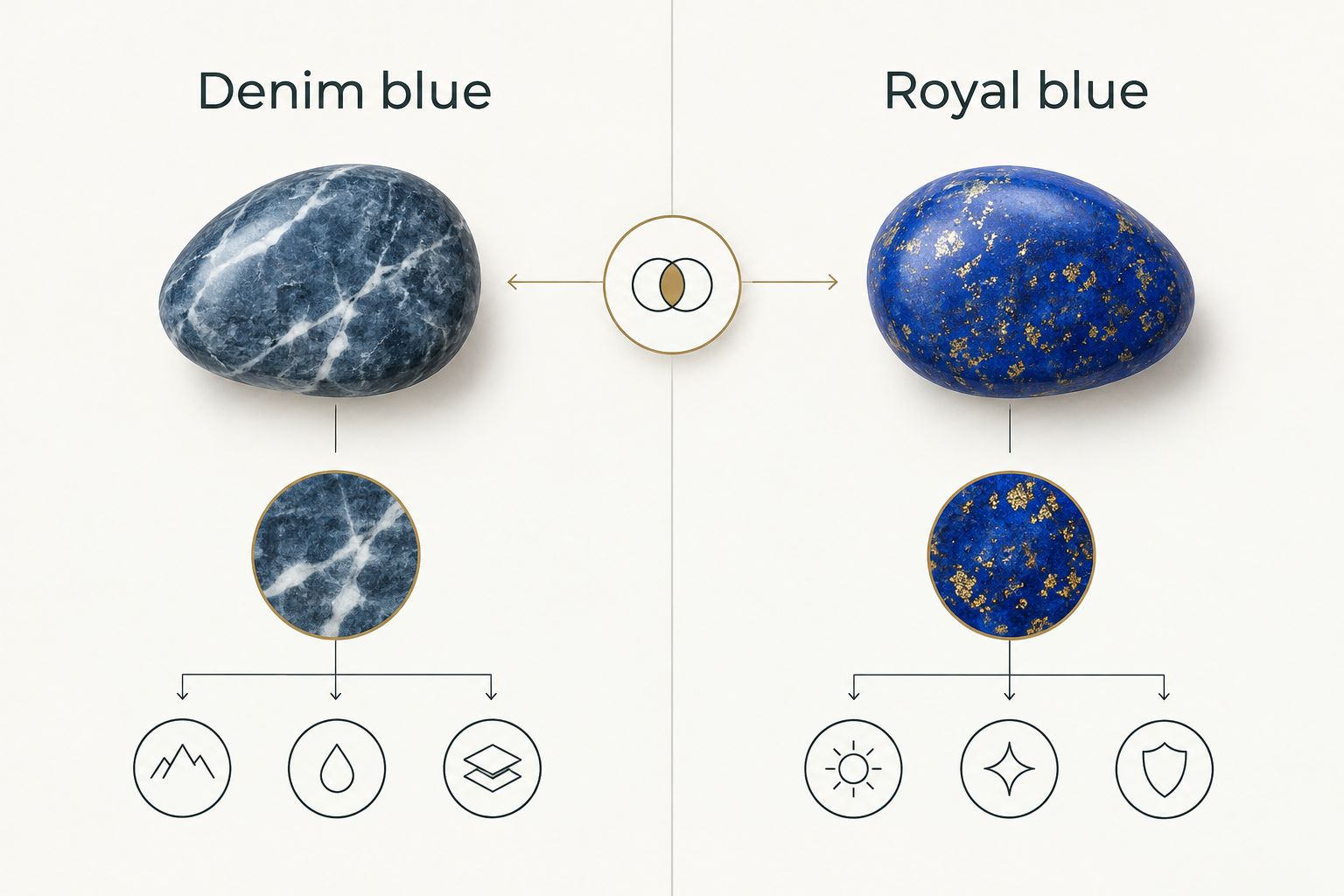
Choose sodalite for a softer blue stone with white veining, or lapis lazuli for a deeper blue with possible gold-colored pyrite flecks. For jewelry, neither is a carefree choice: both need gentle handling and should be kept away from harsh cleaners. If you want the clearest visual distinction, look for pyrite in lapis and pale, cloudlike veining in sodalite.
- Sodalite vs lapis lazuli: choose sodalite for denim blue and white veining; choose lapis lazuli for richer blue and pyrite flecks.
- Both blue stones suit intentional jewelry, but neither belongs in an ultrasonic cleaner.
- EclipticJew is best for shoppers who want crystal jewelry paired with practical stone guidance, not promised spiritual results.
Why this matters
These stones can look alike in a product photo. A close look at color, inclusions and surface finish helps you choose the appearance you want without mistaking a symbolic association for a physical property. If you are comparing settings as well as stones, start with the gemstone bracelet guide and decide whether you want a blue accent or a piece you will handle throughout the day.
In 2026, the useful buying question is not which stone has more powerful energy. It is which color and pattern you will want to wear, how the piece is made, and whether its care fits your routine. Crystal meanings can support a personal intention; they do not establish medical effects or guarantee an outcome.
Sodalite vs lapis lazuli: which blue stone suits your jewelry?
Sodalite is the pick for a quieter, often denim-like blue. Lapis lazuli is the pick for a more saturated blue and, when present, distinctive pyrite flecks. Neither name tells you that every bead will look identical. Examine the actual piece when photographs are available, particularly if a uniform color or visible gold flecks matter to you.
| What to compare | Sodalite | Lapis lazuli |
|---|---|---|
| Typical visual cue | Denim blue with white veining | Royal blue; pyrite may appear as gold-colored flecks |
| Material | A mineral | A rock made chiefly of lazurite, with other minerals that can include calcite and pyrite |
| Best for | A subdued blue accent | A richer blue focal point |
| Advantage | White patterning can give each stone visible character | Pyrite and calcite can create a distinctive mixed-mineral look |
| Trade-off | It will not give you lapis’s characteristic pyrite effect | Quality and appearance vary; some pieces show substantial pale calcite |
| Care priority | Avoid knocks and harsh cleaning | Avoid knocks and harsh cleaning |
The Gemological Institute of America’s lapis lazuli guidance describes the material as a rock associated with lazurite, calcite and pyrite. Mineral reference Mindat identifies sodalite as a mineral. That difference matters when you inspect jewelry: the white in either stone is not, by itself, proof of what you are holding, while gold-colored flecks are a more useful clue for lapis.
Which appearance will you actually wear?
Hold your choice against the clothes and metals you wear most often. Sodalite’s lighter areas break up its blue, making the pattern part of the design. Lapis can read as a stronger block of blue from a distance; its pyrite and calcite become more noticeable up close. These are appearance judgments, not grades of spiritual value.
- Choose sodalite if you want blue and white to share attention. Its veining can work as an everyday accent, though a heavily patterned bead will not look like an even field of blue.
- Choose lapis lazuli if a deep blue focal point matters more. Look at how much calcite or pyrite appears in the particular piece; neither inclusion needs to be absent for the stone to appeal to you.
Lighting changes the impression of both stones. Compare photos taken in more than one light when a seller provides them, and check whether the listing shows the exact jewelry or a representative example. A polished photograph can show color clearly without telling you how the piece will look in your own room.
Is sodalite or lapis lazuli better for everyday jewelry?
Neither stone is ideal for jewelry you wear during rough work. GIA lists lapis lazuli at 5–6 on the Mohs hardness scale; Mindat lists sodalite at 5.5–6. The Mohs scale compares resistance to scratching, not a piece’s ability to survive a drop. Those overlapping ranges do not make either stone scratch-proof.
How you wear the stone matters as much as the mineral name. A pendant sits away from many hard surfaces that a bracelet meets when you work at a desk or carry bags. A bracelet can still be your daily companion if you take it off before activities likely to knock or abrade the beads. Check the setting, cord or elastic as well as the stone; a secure piece is easier to wear with care.
For 2026 shopping, treat durability claims as a prompt to inspect the whole piece. Ask what touches the stone, whether its surface is polished, and how the maker advises cleaning it. Do not assume that a darker blue or a higher-polish photo means greater toughness.
What do sodalite and lapis lazuli symbolize?
Sodalite is often associated in modern crystal practice with clarity and calm expression. Lapis lazuli is often associated with wisdom and reflection. You can use either association as a reminder of how you want to show up; neither stone is a treatment for anxiety or a guarantee of clearer thinking.
Lapis also has a documented history as a valued blue material. GIA describes its use in jewelry and decorative objects across ancient cultures. That history does not make every contemporary claim about its energy an ancient belief. Keep the material’s recorded use separate from the meaning you choose to give your own piece.
For EclipticJew crystal jewelry, the grounded approach is to choose an intention first, then decide whether you prefer sodalite’s veining or lapis’s deeper blue. The stone can mark a moment of reflection without being asked to do something it cannot prove.
How do you choose between sodalite and lapis jewelry?
Use this sequence when two blue pieces seem equally appealing. It keeps the decision focused on details you can inspect and a ritual you can practice, rather than on a promised result.
- Name your intention. Choose a word such as calm or clarity. Treat it as your own cue, not a property a stone must deliver.
- Pick the blue you prefer. Compare white veining with a richer blue surface. If flecks matter, look for clear photos of the actual lapis piece.
- Choose the form. A pendant keeps the stone away from some of the contact a bracelet encounters. A bracelet keeps your chosen reminder visible during ordinary tasks.
- Inspect the whole piece. Look at the beads or stone, then at the fastening and any parts that contact your skin. A preferred stone is only part of a wearable choice.
- Plan gentle care. Remove the piece before rough activity, keep it away from harsh cleaners, and follow the seller’s instructions for its particular materials.
For a visual starting point, EclipticJew offers a Sodalite Stone, a Lapis Lazuli Stone and an Intuition & Wisdom Four-Stone Bracelet Set that includes lapis lazuli. The set combines lapis with blue apatite, blue chalcedony and fluorite; choose it for a mix of blue stones rather than for a direct sodalite comparison. Check each listing for the form and details you want before choosing.


Why do blue stone choices vary?
The right choice depends on the particular piece, not just its label. Use these factors to narrow a 2026 comparison:
- Color preference: Sodalite’s softer blue and lapis’s richer blue create different effects beside clothing or other jewelry.
- Visible pattern: White areas and pyrite flecks change how a piece reads up close. Inspect the stone pictured, rather than assuming every example matches it.
- Jewelry form: A pendant and a bracelet meet different levels of contact during your day.
- Care routine: Both stones call for gentle cleaning and protection from knocks; choose a form you will be willing to take off when needed.
- Personal intention: A symbolic association has value if it helps you pause and reflect. It does not replace the visual and practical checks.
No single factor settles the choice for everyone. If the jewelry is a gift, appearance and wearability give you a sounder starting point than assigning someone else a spiritual intention.
How should you clean sodalite and lapis jewelry?
Start with the care instructions for the finished piece, because the stone is not its only material. A soft, dry cloth is a conservative first step for surface dust. Avoid ultrasonic and steam cleaning; GIA advises gentle care for lapis, and neither stone needs an aggressive cleaning method for ordinary wear.
- Remove the jewelry before applying household cleaners or doing work that could strike the stone.
- Wipe the surface gently with a clean, soft cloth. Do not scrub inclusions or the areas around a setting.
- Check the other components before introducing any moisture. Cord, elastic, wood, metal and adhesives can have different care needs.
- Store pieces separately so harder jewelry does not rub against the blue stone.
Some people also cleanse a crystal as a personal ritual. If you do, a quiet pause or a stated intention does not require water, salt or prolonged sunlight. In 2026, keep physical cleaning and symbolic cleansing distinct: one addresses dirt, while the other gives you a moment to reconnect with why you chose the piece.
Can you tell sodalite from lapis lazuli by sight alone?
Gold-colored pyrite flecks point toward lapis lazuli, but appearance alone is not a definitive identification. Sodalite commonly shows white veining, and lapis can contain white calcite. When a purchase depends on a precise identification, seek a clear material description and appropriate documentation rather than relying on one photo.
Do not try a scratch test on finished jewelry. It can damage a stone without giving you a reliable answer about a mixed-mineral material or a treated surface. In a 2026 product listing, useful photographs show the whole piece and close views of the blue stone; a name without enough visual detail leaves the comparison unfinished.
Which stone works better as a meaningful gift?
Choose the stone whose appearance the recipient is more likely to wear. Sodalite suits someone who likes visible white patterning; lapis suits someone drawn to deeper blue and mixed-mineral detail. You can share an intention as your reason for choosing it, while leaving the recipient free to give the jewelry their own meaning.
If you do not know which blue they prefer, the form of the jewelry is the next question. Consider whether they tend to wear pendants or bracelets and whether they remove jewelry for hands-on work. A thoughtful match to an existing habit is more useful than an elaborate claim about what a crystal will bring them.
FAQ
What is the main difference between sodalite and lapis lazuli?
Sodalite is a mineral that commonly shows blue with white veining; lapis lazuli is a rock chiefly associated with lazurite and can show calcite and gold-colored pyrite. Compare the particular pieces because their appearances vary.
Which looks more blue, sodalite or lapis lazuli?
Lapis lazuli is the better choice when you want a richer, more saturated blue. Sodalite often has a softer, denim-like blue broken by white veining.
Does all lapis lazuli have gold flecks?
No, visible pyrite varies from piece to piece. Examine the actual stone if gold-colored flecks are part of why you want lapis jewelry.
Is sodalite better than lapis lazuli for a bracelet?
Sodalite is better if you prefer blue-and-white veining; lapis lazuli is better if you prefer a deeper blue. Both bracelet stones need protection from knocks and harsh cleaners.
Can I wear sodalite and lapis lazuli together?
Yes, you can wear the two blues together for contrast. Pair them because you like their appearance or personal symbolism, not because the combination promises a result.
Are sodalite and lapis lazuli the same stone?
No. Sodalite is a mineral, while lapis lazuli is a rock that contains multiple minerals, chiefly lazurite.
Can I put lapis lazuli or sodalite in an ultrasonic cleaner?
No. Choose gentle cleaning and follow the finished jewelry’s care instructions instead of using an ultrasonic cleaner.
One last thing
The most useful distinction is not a spiritual ranking: pyrite can help you recognize lapis, but white markings alone cannot rule sodalite in or out. If your choice still feels close, compare two actual pieces in the form you will wear. EclipticJew crystal jewelry offers a place to begin that choice; let the stone’s appearance and your intention settle it together.


