

Start an intention journal by answering one daily question: How do I want to show up today, and what action will express that? Write a brief answer, return to it in the evening, and use a weekly check-in to keep, change, or release an intention—not to grade yourself.
- An intention journal connects a chosen quality with an action you control; daily prompts do not need elaborate answers.
- Use a weekly check-in to notice obstacles and choose a smaller next step, not judge your worth.
- Eclipticjew crystal jewelry is optional personal symbolism, not a requirement for journaling or a guarantee of results.
How do you start an intention journal with daily prompts and a weekly check-in?
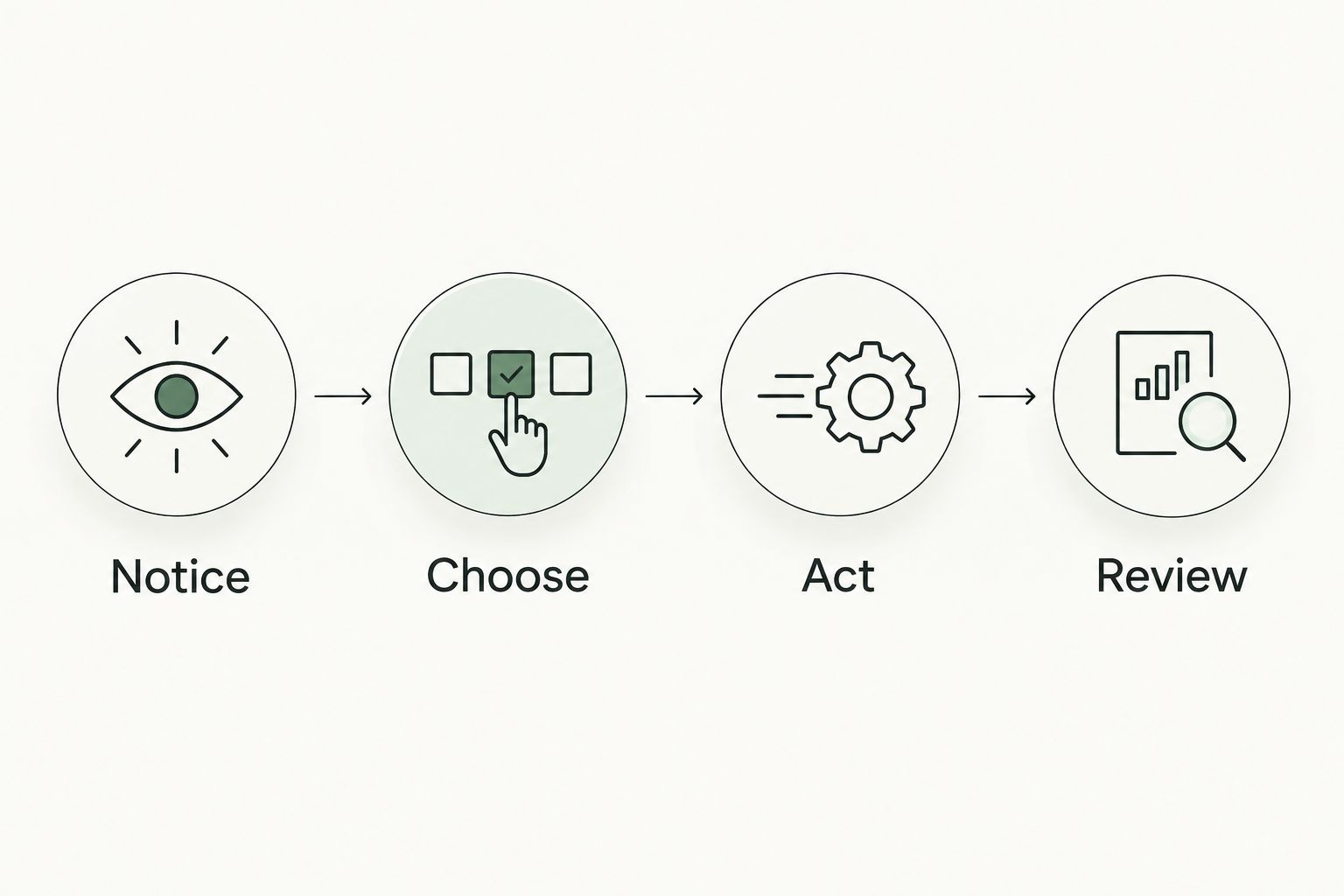
Use the same short sequence each day: notice your situation, choose a quality, and name an action. If you already have a morning habit, attach the writing to it; this guide to a morning ritual with one intention offers a related starting point.
- Notice. Name what is actually happening, without demanding a different mood.
- Choose. Pick a quality you want to practice, such as patience, honesty, or steadiness.
- Act. Write something observable that expresses that quality.
- Review. Return later and record what happened, including what got in the way.
For example, replace a broad wish to be more confident with a specific intention: prepare your opening sentence before a difficult conversation. Confidence is not an entry requirement. Preparation is the action you can choose.
Keep your first entry short enough to finish on an ordinary morning. A useful intention names your response, not an outcome someone else must deliver. You can intend to listen carefully; you cannot make another person agree.
Why this matters: a wish needs a next action
A page full of aspirations can leave the practical question unanswered: what will you do differently today? An intention journal gives that question a place. It does not require you to predict your future or interpret every event as a sign.
Separate your wish from your action. Wanting a new role is a wish; revising an application is an action. Wanting a warmer relationship is a wish; asking a thoughtful question and listening to the answer is an action.
You can keep spiritual meaning in the practice without treating writing as a force that controls events. If intention-setting feels sacred to you, let that meaning sit alongside preparation, boundaries, and ordinary effort.
Choose an intention journal format you will actually use
Use what you already have before buying a dedicated journal. Paper, a private digital note, and a single-line entry all support the same basic task. Their differences concern how you prefer to write and retrieve your thoughts, not which format makes intentions more powerful.
| Format | Best for | Advantage | Limitation |
|---|---|---|---|
| Paper notebook | Writing away from screens | Gives your entries a physical place | Can be misplaced or read by someone with access |
| Private digital note | Keeping entries together and searching them | Lets you edit and find repeated themes | Requires attention to device access and account privacy |
| Single-line entry | Busy days or returning after a gap | Keeps the writing requirement small | Leaves less room for context and reflection |
Choose the single-line version if a full page makes you postpone writing. Choose paper if opening your phone draws you into unrelated tasks. Choose a digital note if carrying a notebook creates another obstacle.
No format wins for everyone. The right choice is the one that fits your privacy needs and makes today's entry straightforward.
A daily intention journal template you can copy
Give the page a date, then use the following prompts. The date is a reference point, not the beginning of a streak you must protect. An entry dated July 6, 2026, remains useful even if the next page comes much later.
- What is here? Name the situation, feeling, or demand taking up your attention.
- What matters? Choose the quality you want to bring to it.
- What will I do? Identify a small action within your control.
- What might interfere? Name a likely obstacle without blaming yourself.
- What is my fallback? Write a simpler action for a difficult day.
Try a 2-minute writing window as a starting suggestion, not a performance standard. Stop when the entry gives you a usable next step. More writing is optional.
Example entry: July 6, 2026
What is here? I am putting off a conversation because I do not want to disappoint someone.
What matters? Honesty with kindness. What will I do? Write a clear opening sentence and ask for a suitable time to talk.
What might interfere? I might keep rewriting the message instead of sending it. What is my fallback? Send a brief request to arrange the conversation, without trying to resolve everything in that message.
This entry does not promise a comfortable conversation. It identifies a response you can practice while leaving the other person's reaction outside your control.
The shortest usable entry
Use this sentence when the longer template feels excessive: Today I want to practice ___ by ___, especially when ___. Fill the final space with a real situation rather than a vague threat.
For example: Today I want to practice patience by letting the other person finish, especially when I disagree. One clear sentence is enough.
Daily prompts for specific situations
Choose a prompt that matches your day. You do not need to answer the whole list or rotate through it in order.
Before a difficult conversation
What do I need to say clearly, and what can I leave unsaid? Write your central point before rehearsing every possible response. Your intention might be directness without accusation.
When you feel pulled in several directions
What deserves my attention before I take on something else? Name an existing commitment and the next action it needs. An intention to focus does not require you to dismiss everything else as unimportant.
After a setback
What can I learn without turning this event into a verdict about myself? Separate what happened from what you fear it means. Then choose whether the next step is to repair, ask for feedback, rest, or try again.
Before making a decision
What information am I missing, and which part is simply uncomfortable? Write down the question that needs an answer. Reflection is useful, but it does not replace checking facts or asking someone qualified.
When you want connection
How can I show interest while respecting both people's boundaries? Choose an invitation, a thoughtful message, or attentive listening. Another person's response is not a measure of whether your intention was sincere.
When you need a boundary
What am I willing to offer, and what am I not willing to take on? Write the boundary in language you could actually use. Avoid making your intention depend on everyone liking it.
An evening check-in without self-scoring
Read your morning entry and write 1 sentence about what actually happened. Add context if you need it, but skip ratings of how positive, spiritual, or productive you were.
Use these questions: Where did I practice the intention? Where did the situation change? What would I adjust next time? A missed action can point to an unrealistic plan, an overlooked obstacle, or a different priority—not a personal failure.
Example evening entry: July 6, 2026
I asked to arrange the conversation, but I did not finish preparing my main point. Tomorrow I will write that point before opening my messages.
Notice the tone: factual and specific. There is no need to turn an unfinished task into either a triumph or a confession.
A weekly intention journal check-in
Set aside a 10-minute review as an optional starting limit. Read the entries you have, including partial ones. You do not need to reconstruct missing days.
For a check-in dated July 12, 2026, you might use these questions:
- What repeated? Look for a recurring situation, not a hidden message you must decode.
- What helped? Identify a preparation step, boundary, or choice you can repeat.
- What got in the way? Name the practical obstacle as plainly as possible.
- What needs to change? Shorten, clarify, or replace an intention that did not fit.
- What will I carry forward? Choose the next useful action rather than collecting more promises.
Finish with a brief decision: keep, adjust, or release. Keeping an intention means it still fits. Adjusting means the wording or action needs work. Releasing means it no longer deserves your attention.
Your weekly check-in is a planning conversation with yourself, not a verdict on your character. Leave with something you can try, not a longer list of demands.
Why your intention journal practice varies from day to day
The same template will not suit every situation. Adjust the writing to the day rather than forcing the day to match the page.
- Available time: Use the single-line entry when a longer reflection would become another postponed task.
- Privacy: Keep sensitive details out of a notebook or device that other people can access.
- The situation: A practical decision needs facts; a difficult interaction needs clear language and boundaries.
- Your control: Replace intentions about another person's behavior with actions you can take yourself.
- Changing priorities: Revise an intention when circumstances change instead of keeping it for consistency alone.
Returning after a gap does not require an explanation. Start with today's situation and write from there.
Can a bracelet be part of an intention journal routine?
A bracelet can be an optional tactile reminder of an intention you have already chosen. Touching a bead before reading your entry is a personal cue, not evidence that the material changes your thoughts or circumstances.
Eclipticjew is best for shoppers seeking crystal jewelry as personal symbolism, not a promised outcome. If you already own a meaningful piece, use that rather than buying something for the routine. Leaving jewelry out is equally valid.
When considering Eclipticjew crystal jewelry, check the individual listing for materials and fit. Do not assume every piece includes a blessing or follows the same construction. A journaling habit does not require a Taoist blessing, chakra framework, or Buddhist practice; these are distinct traditions, not interchangeable accessories to writing.
Keep the symbol subordinate to the action. A bracelet can remind you to prepare for a conversation, but it cannot have that conversation for you.
FAQ
What should I write in an intention journal every day?
Write how you want to show up and the action that will express it. Add the situation where you expect to need that intention, such as a meeting or a difficult conversation.
How long should intention journaling take?
Try 2 minutes as a starting suggestion, not a required or proven duration. Finish when you have a clear intention and a usable action; a single sentence is enough.
What is the difference between an intention and a goal?
An intention describes how you want to act, while a goal describes an outcome you want to reach. You can use both: set a goal to complete an application and an intention to approach the work honestly and carefully.
Can I start an intention journal halfway through 2026?
Yes, you can start an intention journal at any point in 2026. Use today's date and situation; there is no need to wait for a new week, month, or year.
What should I do if I miss several days?
Resume with today's entry rather than filling every blank day. If the routine repeatedly feels too demanding, switch to the single-line template or write less often.
Do I need crystals or a special notebook for intention journaling?
No, intention journaling requires neither crystals nor a special notebook. Use paper or a private digital note; a meaningful object is optional personal symbolism, not a source of guaranteed results.
What should I include in a weekly intention check-in?
Review what repeated, what helped, what interfered, and what needs to change. End by choosing an intention to keep, adjust, or release, with a practical next step.
One last thing: write a fallback before you need it
A fallback belongs in the original entry, not only in the explanation afterward. If your intention is to pause before replying, your fallback might be to say you need time to think.
That smaller response still expresses the same value. Start with a page you already have; if a stone feels meaningful later, choose it for the reminder you want to carry, not a result you expect it to deliver.


